Follow Up: How to Change Verbal Commitments Into Actual Commitments

As a coach, the question I probably answer the most is how do I follow up with people who have said they will give, but haven’t started giving yet?

Having to follow up with verbal commitments is normal, and the need for it is frequent. It can also be one of the more awkward things we do in raising up our financial partnership teams – but it doesn’t have to be. Below are some tips for changing verbal commitments into written ones, and how to do it correctly. 

follow-up-graph_903_2f3569adce6e29c7cf6aceefc5c1893653411e32

I hope this infographic helps you in your follow up! Don’t forget to smile through the phone if your calling – it makes a difference. – JF

How To Get From 28% Funded to 100% In ONE WEEK: Testimony

Eariler this month a couple I coach in financial partnership went from 28% funded to 100% funded within ONE WEEK. Yes, that’s right, ONE WEEK.

The story is full of those Jesus moments that hits like a ton of bricks. It’s the kind of story that reminds me that yes, God is real. And yes, Jesus loves all the little children of the world. And yes, God cares more about His people and the Great Commission WWWAAAYYY more than I do – even in my most zealous moments.

In short, the story had my mind blown, so you need to hear the testimony too. Right? Right.

raw

So how did this couple go from 28% to 100% in one week? JESUS. Definitely JESUS. Let that be known first and foremost. However, God also used their attitudes and strategy that I think we can glean from. Let me tell you the story first, and then get into some takeaways.

TESTIMONY TIME

Rick and Pam are a couple heading overseas as christian workers for the first time. As they began their first time raising a budget, Rick and Pam took my financial partnership training and learned how to ask individuals to join their team by way of face-to-face appointments. They have been going strong building their team for 5 months, primarily holding meetings inside their home sharing their ministry vision and passion with friends and family.

A couple of weeks ago, I was on the phone with Rick for a coaching update. Rick shared that he and Pam were fasting and praying together, and felt from their time praying that God wanted to double what they had raised by the end of the month (they were at 28% raised at the time). #faith!

I was excited with them and admired their zeal, but as the ever practical coach I encouraged Rick that if that didn’t happen God was still moving on their behalf and wanted them on the field. As they really felt it was going to happen, they shared their faith on their secret Facebook group and began getting their team praying with them.

A day after we spoke on the phone, Rick and Pam had a meeting set up with a couple (we will call them Joel and Judy Smith) from their home church. Their relationship with the Smith’s was a good one, but it was more of a former connection than a current one.

(This is where the testimony comes in…keep reading)

That night during the appointment Rick and Pam shared their heart for their ministry with passion and asked if the Smiths would join their financial partnership team. Potential Partner Joel responded by asking what their budget requirements were. He then folded up a piece of paper with an amount on it. Joel handed it to Rick and then Joel said, “Judy and I could go to the car and discuss what we would like to do as support, but I know what The Lord wants us to do already.”

Meanwhile Potential Partner wife Judy had already heard the Lord tell her before coming over for dinner that her and her husband were to “finish what was left” of Rick and Pam’s budget. Joel and Judy had not discussed amongst themselves what they would do to financially support Rick and Pam – but when the paper that Joel had written on was unfolded it was EXACTLY what Judy had heard God told her.

The paper unfolded and read $5,000 A MONTH, the commitment thus finishing the rest of what Rick and Pam needed to get to 100%  – just as they believed God would do! (And remember, this happened only a day after they shared in faith that God was going to double their budget by the end of the month).

WHHHAAATTT??

It gets better – actually Rick and Pam had started their faith journey many years ago by giving $5,000 into missions. It was a huge stretch for them to give that much at the time, and came out of them both praying and hearing God separately challenge them to give. They knew when they saw Joel and Judy’s gift that God was strengthening their faith and giving back what they had already sown into the kingdom many years ago.

TAKEAWAYS

Now let’s talk about some takeaways from Rick and Pam’s story.

  1. It’s easy to get into a routine of making phone calls, having appointments, and calling pastors for services without consulting God on the particulars. Rick and Pam kept their ears open to what God had to say about building their team and leaned into Him for timing on asking potential partners like the Smiths. They also prayed and fasted concerning their financial partnership on a regular basis. Are you fasting? Are you praying continuously? Are you listening to God’s voice? Is building your team a spiritual pursuit for you, or merely a means to an end?
  2. Rick and Pam worked hard and met face to face with potential partners. They didn’t just pray and sit back on the couch – letting God bring in their partnership team. They didn’t take any short cuts either, they met personally with potential partners and typically had 3 or 4 appointments a week. It can be tempting to take a short cut instead of investing the time and energy with meeting people face to face – but face to face will always be the best way to invite people onto your team. It will always be the most relational, thus yielding an actual TEAM of committed financial partners.
  3. Give extravagantly yourself! Rick and Pam started their lifestyle of missions by giving, and thus it was given back to them. Are you giving into missions? Are you fulfilling your stewardship goals? Are you an extravagant giver? 
  4. Rick and Pam invited Joel and Judy onto their team although they hadn’t been in touch with them as much over the recent years as they were prior. Don’t be scared to ask people who aren’t on your “A list” of potential supporters. It can be tempting to edit our list of potential supporters to only people we are comfortable asking. Don’t make that mistake! You may miss out on who God is wanting to bring onto your team! Are you editing your list? 
  5. Now here’s something I didn’t tell you, Rick and Pam are actually still raising up their team! God more than doubled their budget, however they feel through prayer they are to continue to inviting their friends and family onto their partnership team. Why you ask? Because they know more people may want to sow into the Great Commission, and they don’t want to keep them from that opportunity. They also feel God wants them to keep going past 100%. Sometimes God will provide that “major donor” – but it is possible He may want you to keep going and build up a larger team. What a different (and refreshing!) perspective am I right?!  What is your perspective – is it that raising up your team is just a means to an end, or a vital part of your ministry? Does He want you to invite more people to join with the ministry of sharing the Gospel, maybe taking you past 100%? 

Let this be a reminder – continually involve God in your journey of raising your budget. Pray, fast, seek God for His timing, who He is directing you to ask, and minister faithfully throughout the process. He will provide! He is faithful! 

“Now all glory to God, who is able, through his mighty power at work within us, to accomplish infinitely more than we might ask or think.” Ephesians 3:20

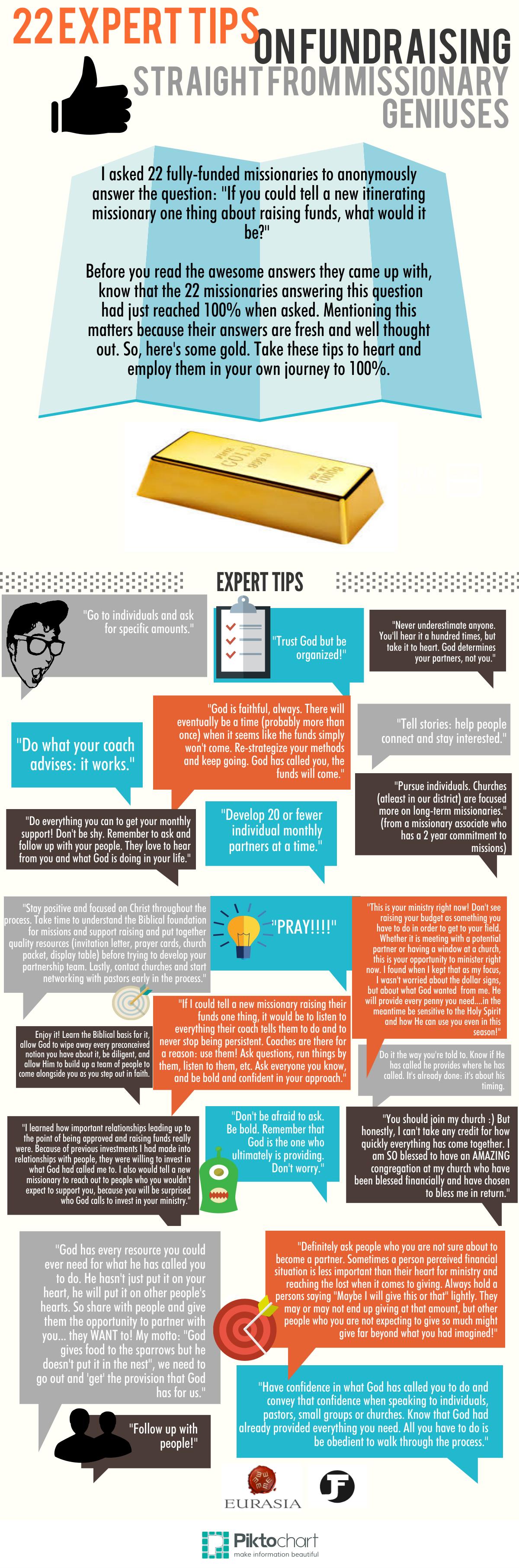
Missionary Geniuses Drop Knowledge: 22 Expert Tips

This post is from a repeat, but I think there are little nuggets of wisdom everyone raising their finances should read – so if you haven’t – here are expert tips from those who have gone before you and gotten to 100%.

22 Expert Tips (4)

Start 2017 Off Right!

Did you know that 45% of the American population make New Years Resolutions? In general this is the month that the nation is thinking about health, wellness, and personal goals. Are you? Though I didn’t make New Years Resolutions per say, I know I am thinking about my personal goals for this year. As I have been developing my own for 2017, I found these Top 10 New Year’s Resolutions from 2017 interesting:

Top 10 New Years Resolutions for 2017:

#1  Lose Weight

#2 Get Organized

#3 Spend Less, Save More

#4 Enjoy Life to the Fullest

#5 Stay Fit and Healthy

#6 Learn Something Exciting

#7 Quit Smoking

#8 Help Others In Their Dreams

#9 Fall In Love

#10 Spend More Time With Family

Can you relate to any of these? For those of you thinking about your 2017 goals along with me, I’d like to add the goals below for your consideration. Consider making 2017 your best year of living a healthy lifestyle of ministry partnership development. Without further ado, here are some goals to consider in making 2017 a fabulous ministry partnership development year:

GOAL #1: DO BETTER AT KEEPING UP WITH YOUR EXISTING FINANCIAL AND PRAYER PARTNERS. Where do you find yourself on this spectrum:

  1. “COMMUNICATION ROCK STAR”: You have always been good at regularly contacting your financial and prayer partners. You keep up with at least a few of them each month by email, text message, phone call, or skype. You continually write your newsletters and are very personal with those whom support you.
  2. “KINDA STRUGGLE BUT E FOR EFFORT”: You have had seasons at being good at communicating with your financial and prayer partners, perhaps here and there emailing the ones you felt comfortable with. However if are were honest you haven’t done much besides a few group Facebook posts and newsletters.
  3. “#EPICFAIL”: You have never been good at contacting your financial and prayer partners. You avoid contacting them, feel awkward when you do, and struggle to write newsletters.

So where do you find yourself on the spectrum?

Maybe you find yourself somewhere in between “Communication Rock Star” or “Kinda Struggle but E for Effort”? Or maybe “#EpicFail” doesn’t even begin to describe your lack of efforts? Wherever you find yourself in that spectrum make 2017 the year you start with regular (and quality) communication with your financial and prayer partners. Make regular social media posts, newsletters, emails, skype conversations, and phone conversations a priority in your existing ministry schedule.  Go beyond the newsletter. Get beyond the mass communication and become relationally driven. Don’t just get a team of people giving you checks every month and wondering what your up to – strive to keep your financial partners informed and make them actual friends. Contact them personally and ask how they are doing, and how you can pray. Give personal updates. I PROMISE this is a BIG DEAL. Remember, without your financial and prayer team you WOULD NOT be ministering to your particular population. Make them feel valued and it will make all of the difference to them, and ultimately to you.

GOAL #2: ENSURE YOUR FINANCIAL PARTNERS CAN EASILY GIVE ONLINE. A recent study done by Dunham&Company shows that 67% of donors ages 40-59 said they have given online. That percentage is up by 20% since 2010. If your organization provides a way to give online, make sure you readily offer that option to your potential financial partners and that you make it easy for your financial partners to give online. Create giving instructions that can be emailed or texted out for your financial partners or get into the habit of walking them through the steps of online giving yourself.

GOAL #3: BEEF UP YOUR SOCIAL MEDIA PRESENCE. The same study mentioned above by Dunham&Company shows that 26% of donors said they have given to a charity’s website as a result of being asked on social media. This is up by 20% from only A YEAR AGO. Wow. I love this quote on the findings:

“It’s important to not misinterpret the findings,” Dunham says. “Donors are not responding more to requests for support from organizations through social media. They are responding to friends or others they know who, through social media, ask them for support of a specific charity, like the ALS Ice Bucket Challenge. Social media for nonprofits is still primarily a means to build community and engagement rather than a fundraising tool.”

What we can say about social media at this point is this: it is a very effective tool to build community and engagement. I’m not saying to ask for blanket support on Facebook. Nope. Nope I’m not at all. But I am saying consider making your social media presence more intentional in 2017. Use exciting videos, informative posts with pictures, and infographics to grab people’s attention. Stay up to date on what is going on with your financial and prayer partnership team. If you do use Facebook for “the ask”, make sure you create a structured Facebook campaign.

GOAL #4: MAKE YOUR PRESENTATION GREAT. If you are regularly speaking inside church congregations or small groups, make sure what you are saying is as effective as it can be. Don’t have a mediocre presentation – make it great! Video yourself giving your next sermon or 5 minute window in front of a congregation. Spend some time going through that video and thinking of ways you could improve. Send it to a few trusted friends for a critique. Having their honest feedback could be what takes your presentation from “meh” to “YESSS!!” If you haven’t polished your presentation in awhile go through it with fresh eyes thinking of ways to improve. Maybe you could add a short video, or a visual of the population you serve? Maybe you could add a new effective story?

GOAL #5: STAY (OR GET) ORGANIZED. This goal is pretty self explanatory. If you are struggling in an area of staying organized, get back on the horse. Being organized with records of who you have asked, who has given, when they have given, how much, etc. is important to have in the genesis of a lifestyle of partnership development. If you are organized you will have more time for ministry and more time for staying connected with your financial and prayer partnership team – it’s that simple. Great programs for this are: TNTMPD, MPDX, or iMissionsPro.

GOAL #6: USE VIDEOS. According to statistics found on the www.Cadre31.com website videos on landing pages increase conversions by 87%. Not only that, 65% of audiences are visual learners and visual data is processed 60,000 times faster by the brain than by text. Let the reader understand: videos are a big help in effectively communicating your visionIf you have not created a high quality video that communicates your ministry vision I highly suggest you make it a priority to do so. Spend some time looking at the videos found on Cadre31’s site for some great examples.

If you are not in the habit of making videos (not necessarily high quality – just home videos used to communicate) on social media, get into it. Another statistic states that by 2017 90% of all web traffic will be video.

GOAL #7: PRAY FOR YOUR FINANCIAL AND PRAYER PARTNERSHIP TEAM. When was the last time you made prayer for your financial partnership team a regular part of your prayer life? Have you ever prayed for your team? If you haven’t taken the time to talk to God about your team, then start in 2017. There are multiple benefits of praying for your team that go beyond the obvious. For starters remembering your team in prayer will promote your desire to stay connected to them, naturally have you asking what is going on in their lives, and will remind you that they are a vital part of your ministry.

zachgalifianakisthumbsuThere you have it! May your 2017 be a year filled with happy and relational support raising! Consider making some of these goals your own in 2017.

Podcast on Financial Partnership Development

Recently I was honored to be on the family podcast of one of our areas in Eurasia talking about Financial Partnership Development. On the podcast we talk about partnership development topics such as how to build and maintain good relationships while busy in ministry, adding new financial partners, and much more.

Take a listen by following the links below:


Podcast 1: https://www.dropbox.com/s/ac8ug933tlca5yi/November-2016.mp3?dl=0

Podcast 2: https://www.dropbox.com/s/23uhw5e4fwnwxpo/December-2016.mp3?dl=0

10 Blog Posts I Love for Successful Support Raising

I have a gift for you.

I love picking up bits and pieces from other ministries on support raising. Over the years I’ve done my fair share of digging from various viewpoints – nonprofits, ministries, and other missions sending organizations.

Thus, here’s a list of 10 inspiring blogs and websites that cover a wide variety of subject matter on ministry partnership development as you close out your year! Your Welcome! Merry almost Christmas friends!

url

  1. Cadre 31 Classes: Cadre31 is a company who specializes in telling your story via video. They have a tab on their website dedicated to education on creating your own videos, watch and learn!
  2. TedTalk by Jia Jiang on facing rejection. The possibility of rejection and/or facing it is hard – this video on the subject is incredibly inspiring and entertaining.
  3. Video from Global Frontier Missions on Unreached People Groups. This video is so helpful if you are raising your finances to reach a tough population. Check it out!
  4. Seeing Your Donors As Partners by 101Fundraising maybe one of my favorite blog posts EVER on the subject of financial giving. Get inspired and get perspective.
  5. This guest post by Pastor Chris (on my blog) reminds us that a season of itineration looks a lot like a season on the ministry field. I highly recommend this to anyone struggling with obstacles and fears in raising their support.
  6. Thanking Donors on Social Media from The Balance is a great for those looking to make their social media interactions count. It has some fantastic ideas to get the gears going on your own social media strategy.
  7. This TedTalk from Amanda Palmer on The Art of Asking may be the most helpful TedTalk I’ve ever watched. This is not Christian content by the way, but gives incredible insight.
  8. Do you want to become a better public speaker? Are you afraid of public speaking? Here’s a post from RealSimple on conquering your fear.
  9. Being negative hurts YOU. Are you negative and don’t even know it? Check out this blog post on positive thinking during your season of raising support by Michael Hyatt.
  10. Reaching out to millennials can confound as you support raise. Gosh, I’m a millennial and sometimes I have a hard time figuring out what to do. Here’s a great post on the subject.

I hope some of these posts help you like they have me. Do you have a favorite blog post? Share it in the comments! – JF


Don’t Stop Til You Get Enough: 5 Lessons from 2 Successful Support Raisers

Here’s a beginning question everyone asks when raising support: How do I effectively ask individuals to support me monthly? The answer to that question has a lot of moving parts, to start here’s a simple answer, it is this:

AS RELATIONALLY AS YOU POSSIBLY CAN.

I want to reinforce this sentence by telling you about the journeys of two different missionaries whom I coach. Both recently raised their finances in record time. Let me tell you a little about them:

The Jones Family. The Jones Family is a family of four who raised their extensive overseas budget within 6 months. SIX MONTHS! Let me tell you, that is a feat for a family of four! 

Sally. Sally is a single woman, and a 21 year old college grad. Sally raised her budget within 5 months. She had never raised finances for a missions trip before, and particularly felt nervous that most of her friends were just out of college – and broke.

How did the Jones family and Sally do it? Well, the main successful commonality between them is this: they were always relational in their approach. So here are some things we can learn from The Jones family and Sally in their journeys  to raising their budgets relationally and successfully:

1. They set weekly goals and stuck to them. When raising your finances, knowing your vision is valuable and so is determination. Both the Jones family and Sally set weekly goals (that were obtainable) for themselves based on their vision and held onto those goals with determination. They hit their goals 90% of the time.

Take away: As you raise your finances, set weekly goals for yourself and find a way to make yourself accountable to them. Before you do, think about what you can handle each week and when you want to get to 100% before you set them. Typically I tell missionaries I coach that they need to make initial contact with at least 5-10 people each week – initial contact entails that they have either sent an invitation letter (setting up the face-to-face appointment) or they called someone asking for a face-to-face appointment.

2. They didn’t take short cuts. They met face-to-face with people. The Jones family and Sally both strived for each “ask” to be face-to-face, even if that meant traveling a little to see people and ask them in person. They didn’t merely call people, send out bulk newsletters, or Facebook blasts – they took time to ask people in the most relational way possible.

jackson-moonwalk

Take away: I’m not saying Facebook posts or newsletters are bad things. Both are effective tools when used accurately. However, those tools become detriments when missionaries try to make them the main way they do their personal asks. Whenever possible, try to meet with your potential partners face-to-face. If it’s not possible face-to-face, try meeting with them over Skype or Google Hangouts. When you ask, have a well thought out presentation and concretely ask for financial support.

3. They asked for a range or specific amount. When the Jones family and Sally did their financial asks they boldly asked for a range of monthly support or a specific amount.

Take away: Don’t leave your financial needs nebulous and in the hands of your potential partners to guess. That’s awkward for them. Tell them what you need and provide them with parameters. A couple of reasons for this: (1) It will greatly help your friends and family to know what you need, particularly if they aren’t used to giving to a christian worker. (2) People will default to the least amount possible, so you want to ask them for an amount that stirs their faith.

If you are asking for a range make your range comfortable for you to ask for, but also not too low. Also when providing a range make a graph to explain if necessary. When asking for a specific amount, make sure to stay silent while they respond to what you just asked them. You don’t need to apologize or provide nervous “filler.”

Fundraising Pyramid Image[1]

4. They believed they were asking their potential partners to invest in the Great Commission, not just their ministry assignment. Perspective in raising support is a powerful thing, if not one of the most important ingredients to success (or lack there of). Sally and the Jones Family believed that when they asked their friends and family for financial support, they were involving them in more than just their need for money. They were involving them in the Great Commission and thus were not apologetic about it.

Take away: If you aren’t at that point in your thinking / perspective you, you are not alone. But I do challenge you to ask God to change your perspective. Spend time in the word and seek understanding on support raising in the Bible. There are over 700 direct statements in the Bible about finances, find some of them and study. As you read ask yourself why God set up the Christian worker to live off of support, and why He wants you to do it as well. (Some places in the Bible to start reading: Philippians, Nehemiah, 2 Kings 4, and 1 Corinthians 16 or check out my workbook and buy a complete Bible study on fund-raising.)

5. They didn’t stop when it got challenging. Both the Jones Family and Sally were both hesitant to begin the process of raising their support. They also both had real fears and genuine obstacles, just like you probably do. Even though they were hesitant and ran into hard weeks while raising their budgets: they kept going and continued to ask.

Take away: Don’t let fear, a bad week, obstacles, or a “no” keep you from asking. Remember, when you invite people onto your team in a relational way, really you are asking them to get more involved in the Great Commission. When you run into a hard week (and you will, I promise you are not alone) just keep going and continually ask God for help along the way. He will provide what you need if you keep moving forward — but the key is you have to keep moving forward.

So as you look over these 5 take aways think about how you can invest and create your team relationally. As you do, you’ll find yourself growing in ministry and more happily (and quickly) raising your support.

What do you think as you hear The Jones Family and Sally’s stories? How can you raise your finances as relationally as possible?

tumblr_lh6qjalpgw1qauweoo1_500

Develop Your End of The Year Strategy

Did you know that last year 31% of ALL GIVING occurred in the month of December? Or that 12% of giving occurred in the last three days of the year?
That’s right. 12% all in 3 days.full

Thus begs the question: Do you have a end of the year strategy for financial partnership development? If the answer is no, or you were even tempted to coast in December and only eat Christmas cookies, Christmas shop, and watch Elf and/or the new Star Wars movie 6 times in one week… I plead with you to keep those percentages in mind and reach higher.

12-adorable-funny-christmas-2013-gifs-to-share-enjoyHere is a couple of quick ideas for your year end strategy:


  1. CREATE A CHRISTMAS NEWSLETTER TO YOUR EXISTING PARTNERSHIP BASE. Sometime before December 31st (probably not on Christmas or Christmas Eve), send out a Christmas newsletter to your existing financial and prayer partner list. These should be people you have already communicated your ministry vision and details with. Make it short and sweet and include the following components:
    1. Merry Christmas greeting and express your authentic thankfulness for your support team.
    2. 3-5 bullet points of prayer requests.
    3. A percentage update of where you are at raising your finances.
    4. A gift-wrappy-Christmasy-wonderful-snowy graphic that is a clickable link to your organization’s giving website. (Make it pretty – I made this one in 5 minutes using Canva.comFrom the Montgomery family
  2. HAVE AS MANY FACE-TO-FACE APPOINTMENTS AS POSSIBLE and DON’T STOP SCHEDULING THEM NOW BECAUSE YOU THINK EVERYONE IS TOO BUSY. Are you are tempted to put the breaks on contacting individuals for face-to-face appointments in the month of December? Let me tell you, experience has taught me that it is a GREAT time for face-to-face appointments. Don’t stop reaching out to connect with people over coffee and making the ask. Some tips:
    1. Pay for their coffee.
    2. Get a small gift for your potential financial partner and bring it to your appointment.
    3. Try and set up the appointment sooner than later. If they cant meet before the end of the year, put something in the calendar for January. Allow a couple of extra weeks to put something on the calendar.
    4. Make it about them when you meet as much as it is about you. Ask questions and get excited about who they are.
    5. Send a thank you card after you meet with everyone!
    6. If you cannot reach someone now, don’t sweat it. Try reaching out to them again in January.
  3.  SEND YOUR FINANCIAL PARTNERS CHRISTMAS CARDS / SMALL GIFTS. Now is a great time of year to express your thankfulness to your support team. Send a Christmas card with a handwritten note and include a small gift of thanks. It can go a long way in letting your financial partners know you care about them.
  4. CREATE A FACEBOOK CAMPAIGN IN DECEMBER. A well crafted, intentional, relational Facebook campaign can be helpful during this month of giving. Click here to find out more how to craft your own successful Facebook campaign.
  5. DUST OFF YOUR CONTACT LIST AND TAKE ANOTHER LOOK AT IT. Now is a good time to go back to the beginning of your season of itineration. Dust off that old initial contact list and go through it with a fine comb. As you comb through it create a new list of those you were not able to get ahold of, those who have committed to give but haven’t started yet, and those you never asked because you got too scared (whhaaatt you say?! How did she know that?!), and those that you just simply have yet to ask. Take that list and get back to contacting them about joining your team. BONUS POINTS: As you go through your list text / email / Facebook message those that are highlighted to you and just say hi.

I hope you find these helpful. Whatever you end up doing for your end of the year strategy, make it as relational as possible.

Also, MERRY CHRISTMASTIME! I pray it is an amazing time of fellowship and family for you.

santa-claus-animated-gif-4

End of the Year Giving: The Facebook Campaign

During November and December try to focus on some good ways to reach out to individuals and utilize the best two giving months of the year.

If you are down the road in raising your finances enough (close to 80% raised) doing a Facebook campaign in the month of November or early December could be perfect in utilizing this window and helping you reach 100% (I DO NOT RECOMMEND FACEBOOK CAMPAIGNS BEFORE 80%).

You may have already read the previous post on this subject from last year: “How to Create a Successful Facebook Campaign and Other Glorious Facebook Information.”   

https://www.google.com/amp/s/jennfortner.com/2015/03/10/how-make-your-own-facebook-campaign-and-other-glorious-facebook-information/amp/?client=safari
If not, let me give you a summary. A Facebook Campaign essentially is getting together a team of 10-15 people who post daily on their Facebook walls, on your behalf, for around 10 days. You create the campaign with video content, give-a-ways, graphics, and a monthly goal you would like to reach over the duration of the Facebook Campaign. The end result is reaching out to a wide audience that may not have ever heard about you or your ministry any other way – and may be really eager to support someone in the ministry field.

If this is something that interests you, watch the videos below for more information and then read the very important tips:


Here are key things to keep in mind as you develop your Facebook campaign and develop any new relationships that come from it:

1. It is VERY IMPORTANT while doing your FB campaign to stay abreast on all likes and comments that come to you campaigners pages. Check them every day, more than once a day. Return comments with Private Messages (PM) and likes with PM when it feels appropriate. It is your job to connect further with the people responding, and if they have commented or liked but haven’t given, chances are with a personal message from you they may.

2. It is also VERY IMPORTANT to create great graphics and videos. No half-way doing this thing or results will be minimal. With a little work, the results will be fantastic.

3. it is VERY IMPORTANT to create a reasonable goal. (see video)

4. It is VERY IMPORTANT to follow up with your new financial partners after the Facebook campaign. Never let someone give to you without trying to get to know them. Attrition rates for someone giving to you on a monthly basis that you don’t know are statistically low – so beat that by building a relationship with your new financial partners. Do this by emailing them, calling them, Facebook messaging them. Whatever you do, ask them questions about themselves. Of course don’t overwhelm them – make them feel safe as they probably don’t know you well. Use common sense. Think about what would make you feel connected if you were in their shoes.

5. Think about creating a Facebook secret group with your campaigners and some prayer partners in the group. In that group you can post your posts for the campaigners every day. There should be around 15-20 campaigners and perhaps somewhere around 10-15 prayer partners in this group. (Your prayer partners will probably catch a burden and start funding you monthly if they aren’t already on your team)

6. It is VERY IMPORTANT that you communicate well with your campaigners from the very beginning. Tell them your goal and how many days, and communicate that you want them posting every day. ALSO VERY IMPORTANT to find out how they can best receive the post information from you. Some people post on Facebook from their phones – so a text may be better. Some people may do better with you giving them content in an email. Some may remember just fine by only getting it through your secret group. Find out what works best for them so they don’t miss a post. Make it easy for them.

I hope these tips help you create a solid Facebook campaign with new financial partners that you minister to along the way!

images

Connect Cards are Awesome.

Have you ever spoken at your home church, small group, or fundraising event and gotten stuck at your back table talking to a particularly chatty individual? All the other people scurry to lunch before your conversation ends and you feel the wave of missed opportunities that just passed?  Whomp.

Insert a wonderful tool to help combat: connect cards!

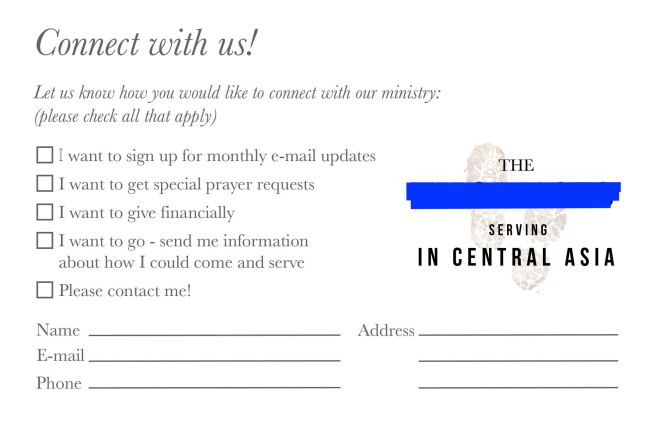
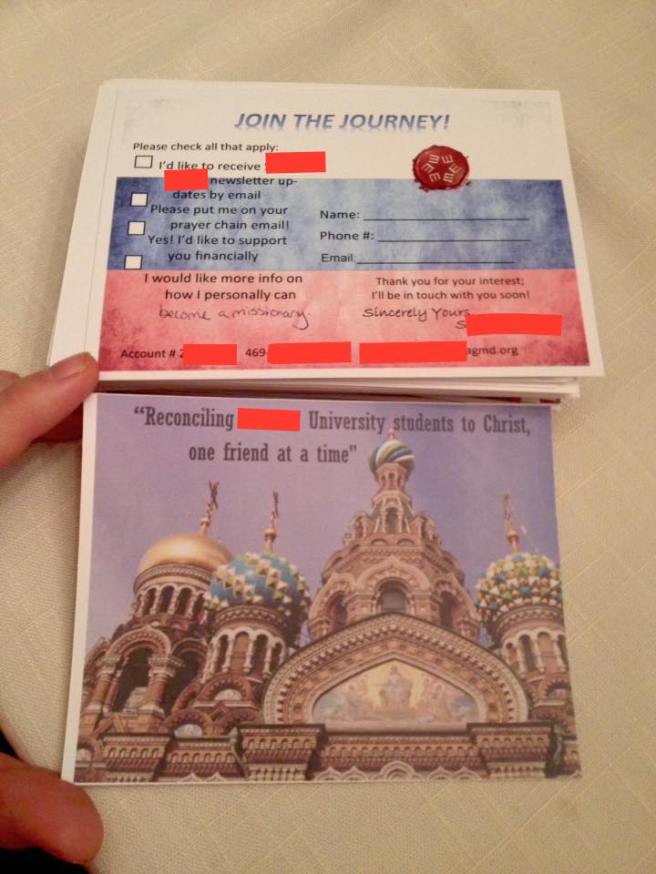
What’s a connect card you ask? It’s a stack of cards you put on your display table, chairs of an event, and/or attach to Sunday morning’s bulletin. Connect cards give you the ability to follow up with interested people after a service or event is over, and is an effective tool all about facilitating more face-to-face appointments and building relationships with the body of Christ. Below there are some examples of connect cards from various workers I coach. (thanks guys!)

Now, don’t go off quite yet and make your own. I want to explain something important first – here we go – pay attention: keep in mind that connect cards are only appropriate in certain circumstances.

“Connect cards are only meant for events, services, and small groups where you have gotten permission to connect personally with individuals about giving.”

Connect cards should only be used when they fall in accordance with a pastor / leader’s protocol in giving. So don’t assume that these cards can be placed on chairs of a congregation without communication or sneakily stuck into bulletins on a Sunday morning. Connect cards are only meant for events, services, and small groups where you have gotten permission to connect personally with individuals about giving.

Why is this so important? Well, a lot of churches do their missions / ministry giving by collecting offerings and disbursing where the church leadership collectively decides. That means if you were to come into that congregation and ask all the people inside to give to you personally, it may mess up what the pastor, board, and leadership of the congregation has decided to give to. You DO NOT want to be that person. #boo

Thus, connect cards are preferably only when you ask the pastor / leader “how does your congregation do missions / ministry giving?” If they say you may connect with individuals inside of the congregation on your own, ONLY THEN do connect cards come into play.

Connect cards are ideal when speaking to your home church (after you’ve figured out the protocol with your pastor on giving), small groups, fundraising events, and the like. If you do use connect cards, make sure to explain them from the platform in which you are speaking from – letting everyone know how to fill them out and what they are for.

I hope these help you as you seek to build out new relationships as you interact with the body of Christ! See the examples below and have fun building yours!

Connection Form PDF copypostcard-3.5inx5.5in-h-front

14316802_10157439182320503_316598276514332702_n.jpg2016092295161241-copy