10 Blog Posts I Love for Successful Support Raising

I have a gift for you.

I love picking up bits and pieces from other ministries on support raising. Over the years I’ve done my fair share of digging from various viewpoints – nonprofits, ministries, and other missions sending organizations.

Thus, here’s a list of 10 inspiring blogs and websites that cover a wide variety of subject matter on ministry partnership development as you close out your year! Your Welcome! Merry almost Christmas friends!

url

  1. Cadre 31 Classes: Cadre31 is a company who specializes in telling your story via video. They have a tab on their website dedicated to education on creating your own videos, watch and learn!
  2. TedTalk by Jia Jiang on facing rejection. The possibility of rejection and/or facing it is hard – this video on the subject is incredibly inspiring and entertaining.
  3. Video from Global Frontier Missions on Unreached People Groups. This video is so helpful if you are raising your finances to reach a tough population. Check it out!
  4. Seeing Your Donors As Partners by 101Fundraising maybe one of my favorite blog posts EVER on the subject of financial giving. Get inspired and get perspective.
  5. This guest post by Pastor Chris (on my blog) reminds us that a season of itineration looks a lot like a season on the ministry field. I highly recommend this to anyone struggling with obstacles and fears in raising their support.
  6. Thanking Donors on Social Media from The Balance is a great for those looking to make their social media interactions count. It has some fantastic ideas to get the gears going on your own social media strategy.
  7. This TedTalk from Amanda Palmer on The Art of Asking may be the most helpful TedTalk I’ve ever watched. This is not Christian content by the way, but gives incredible insight.
  8. Do you want to become a better public speaker? Are you afraid of public speaking? Here’s a post from RealSimple on conquering your fear.
  9. Being negative hurts YOU. Are you negative and don’t even know it? Check out this blog post on positive thinking during your season of raising support by Michael Hyatt.
  10. Reaching out to millennials can confound as you support raise. Gosh, I’m a millennial and sometimes I have a hard time figuring out what to do. Here’s a great post on the subject.

I hope some of these posts help you like they have me. Do you have a favorite blog post? Share it in the comments! – JF


Develop Your End of The Year Strategy

Did you know that last year 31% of ALL GIVING occurred in the month of December? Or that 12% of giving occurred in the last three days of the year?
That’s right. 12% all in 3 days.full

Thus begs the question: Do you have a end of the year strategy for financial partnership development? If the answer is no, or you were even tempted to coast in December and only eat Christmas cookies, Christmas shop, and watch Elf and/or the new Star Wars movie 6 times in one week… I plead with you to keep those percentages in mind and reach higher.

12-adorable-funny-christmas-2013-gifs-to-share-enjoyHere is a couple of quick ideas for your year end strategy:

  1. CREATE A CHRISTMAS NEWSLETTER TO YOUR EXISTING PARTNERSHIP BASE. Sometime before December 31st (probably not on Christmas or Christmas Eve), send out a Christmas newsletter to your existing financial and prayer partner list. These should be people you have already communicated your ministry vision and details with. Make it short and sweet and include the following components:
    1. Merry Christmas greeting and express your authentic thankfulness for your support team.
    2. 3-5 bullet points of prayer requests.
    3. A percentage update of where you are at raising your finances.
    4. A gift-wrappy-Christmasy-wonderful-snowy graphic that is a clickable link to your organization’s giving website. (Make it pretty – I made this one in 5 minutes using Canva.comFrom the Montgomery family
  2. HAVE AS MANY FACE-TO-FACE APPOINTMENTS AS POSSIBLE and DON’T STOP SCHEDULING THEM NOW BECAUSE YOU THINK EVERYONE IS TOO BUSY. Are you are tempted to put the breaks on contacting individuals for face-to-face appointments in the month of December? Let me tell you, experience has taught me that it is a GREAT time for face-to-face appointments. Don’t stop reaching out to connect with people over coffee and making the ask. Some tips:
    1. Pay for their coffee.
    2. Get a small gift for your potential financial partner and bring it to your appointment.
    3. Try and set up the appointment sooner than later. If they cant meet before the end of the year, put something in the calendar for January. Allow a couple of extra weeks to put something on the calendar.
    4. Make it about them when you meet as much as it is about you. Ask questions and get excited about who they are.
    5. Send a thank you card after you meet with everyone!
    6. If you cannot reach someone now, don’t sweat it. Try reaching out to them again in January.
  3.  SEND YOUR FINANCIAL PARTNERS CHRISTMAS CARDS / SMALL GIFTS. Now is a great time of year to express your thankfulness to your support team. Send a Christmas card with a handwritten note and include a small gift of thanks. It can go a long way in letting your financial partners know you care about them.
  4. CREATE A FACEBOOK CAMPAIGN IN DECEMBER. A well crafted, intentional, relational Facebook campaign can be helpful during this month of giving. Click here to find out more how to craft your own successful Facebook campaign.
  5. DUST OFF YOUR CONTACT LIST AND TAKE ANOTHER LOOK AT IT. Now is a good time to go back to the beginning of your season of itineration. Dust off that old initial contact list and go through it with a fine comb. As you comb through it create a new list of those you were not able to get ahold of, those who have committed to give but haven’t started yet, and those you never asked because you got too scared (whhaaatt you say?! How did she know that?!), and those that you just simply have yet to ask. Take that list and get back to contacting them about joining your team. BONUS POINTS: As you go through your list text / email / Facebook message those that are highlighted to you and just say hi.

I hope you find these helpful. Whatever you end up doing for your end of the year strategy, make it as relational as possible.

Also, MERRY CHRISTMASTIME! I pray it is an amazing time of fellowship and family for you.

santa-claus-animated-gif-4

Connect Cards are Awesome.

Have you ever spoken at your home church, small group, or fundraising event and gotten stuck at your back table talking to a particularly chatty individual? All the other people scurry to lunch before your conversation ends and you feel the wave of missed opportunities that just passed?  Whomp.

Insert a wonderful tool to help combat: connect cards!

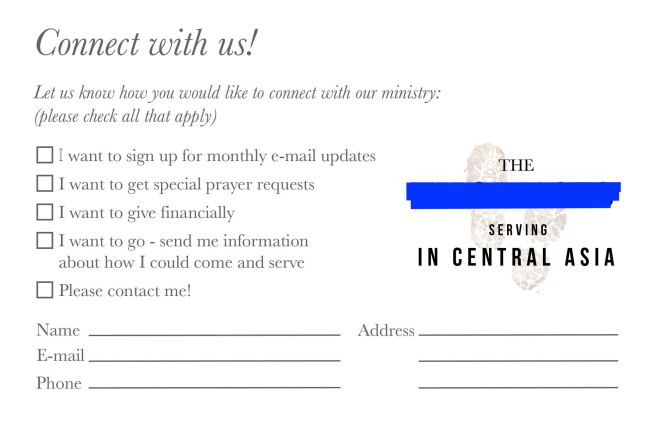
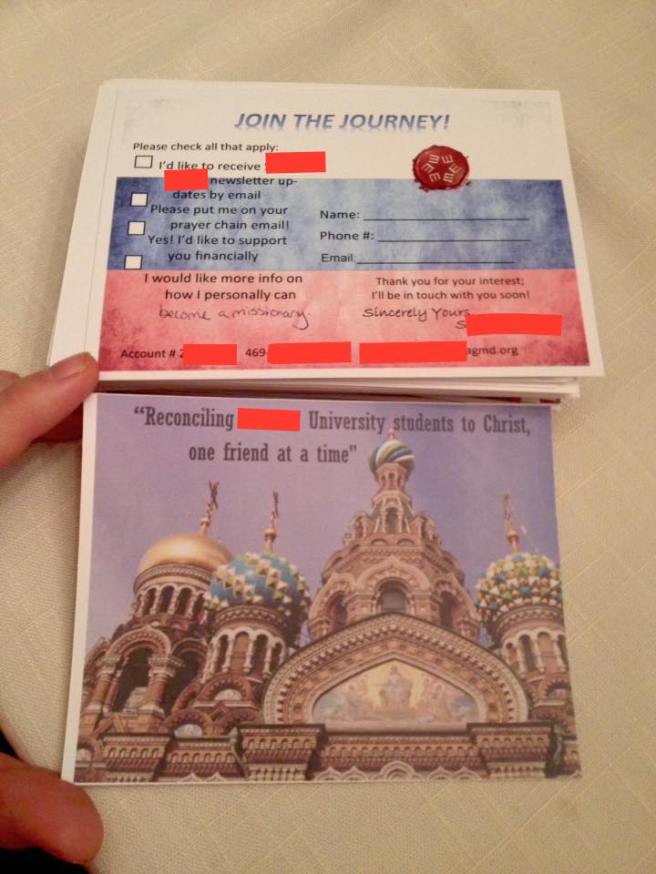
What’s a connect card you ask? It’s a stack of cards you put on your display table, chairs of an event, and/or attach to Sunday morning’s bulletin. Connect cards give you the ability to follow up with interested people after a service or event is over, and is an effective tool all about facilitating more face-to-face appointments and building relationships with the body of Christ. Below there are some examples of connect cards from various workers I coach. (thanks guys!)

Now, don’t go off quite yet and make your own. I want to explain something important first – here we go – pay attention: keep in mind that connect cards are only appropriate in certain circumstances.

“Connect cards are only meant for events, services, and small groups where you have gotten permission to connect personally with individuals about giving.”

Connect cards should only be used when they fall in accordance with a pastor / leader’s protocol in giving. So don’t assume that these cards can be placed on chairs of a congregation without communication or sneakily stuck into bulletins on a Sunday morning. Connect cards are only meant for events, services, and small groups where you have gotten permission to connect personally with individuals about giving.

Why is this so important? Well, a lot of churches do their missions / ministry giving by collecting offerings and disbursing where the church leadership collectively decides. That means if you were to come into that congregation and ask all the people inside to give to you personally, it may mess up what the pastor, board, and leadership of the congregation has decided to give to. You DO NOT want to be that person. #boo

Thus, connect cards are preferably only when you ask the pastor / leader “how does your congregation do missions / ministry giving?” If they say you may connect with individuals inside of the congregation on your own, ONLY THEN do connect cards come into play.

Connect cards are ideal when speaking to your home church (after you’ve figured out the protocol with your pastor on giving), small groups, fundraising events, and the like. If you do use connect cards, make sure to explain them from the platform in which you are speaking from – letting everyone know how to fill them out and what they are for.

I hope these help you as you seek to build out new relationships as you interact with the body of Christ! See the examples below and have fun building yours!

Connection Form PDF copypostcard-3.5inx5.5in-h-front

14316802_10157439182320503_316598276514332702_n.jpg2016092295161241-copy


Do Something Different, Use Sway

Have you ever heard of Sway? Sway is an App / web application that is about a year old and is a part of the Microsoft Office family of awesomeness.

It’s also free to use + simple, and I am in love with it. 

I wanted to dedicate a post to Sway because I think it can be a very effective (and outside-of-the-box) tool for anyone support raising. Below is a link of how I used it to present some basics on financial partnership development for an online class I taught:

Untitled

https://sway.com/xf67TFXn6wlrdDEX

Perhaps this makes you think, gee Jenn, that’s nice, but what are some practical ways I could use it in my support raising? Well, practical is practically my middle name – so I’ve thought about it and here is my list of ways to use Sway:

  1. Personal Stories. Connecting online with individual and church potential partners is a huge part of building your team. Use Sway to create something visually stimulating that immediately grabs people’s attention. I can see Sway helping you share your personal story and vision for ministry in some of the following ways (***always keep in mind – with all of these suggestions – to follow any security measures your sending organization  deems needed in developing content and sending out content):
    1. Put your Sway as a link in the signature of your emails.
    2. Email or Facebook pastors and potential support team members your Sway so they can read up a little of your passion and vision for ministry.
    3. Share your Sway on your Facebook group.
    4. Use Sway as a platform for a video. Instead of just watching your video – you could have it nicely displayed on your Sway with some text and background to enhance it even more.
    5. Put up your Sway on a tablet or computer for your display table for services, meetings, small groups, fundraising events, etc.
  2. Newsletters. Mailchimp is probably still the winner for electronic newsletters, but I wouldn’t hesitate to play around with Sway to see if one could create something of an archive of newsletters or something different from the norm.
  3. Reports. Infographics and interactive graphs are available on Sway and very simple to use. Here are some ways I can think of to use Sway for reports:
    1. Create a budget report with infographics and interactive graphs/charts to share with your support team or those on your potential support team who are asking for financial specifics.
    2. Create a landing page for your core prayer team. Include a video or other interactive material to get them excited about praying for your ministry (this could be prior to going to your field or while on your field).
  4. Presentations. If you have pictures or videos to share during your face-to-face appointments with potential financial partners, create a Sway to put them into one place. All you need is wifi or your phone to show the content.

Some advantages to using Sway:

  1. Downloading is not necessary. Sway is web and app based so no one will need  a certain software program to view your content.
  2. Sway comes with the ability to password protect the content and has various sharing preferences. For those of you going to sensitive areas, Sway comes with a little security. (however, as we all know nothing on the internet is wholly “secure”)
  3. Sway is great if you have a report, presentation, or personal story that needs to be updated on a regular basis. As it is web based, the person looking at your Sway won’t need to have the latest version sent to them, changes are automatically displayed for them.
  4. If creating a website seems daunting to you, you can create a simple one by using Sway. Fun!

If you have used Sway, please share with me how you used it for your work life or personal life! I would love to hear more examples of this tool.


How Postcards Are The New Postcards: Testimony from a Ministry Worker

Recently I received a letter from a ministry worker that I thought would be helpful to share with you. Essentially the letter is on the importance of keeping up with your financial partnership base, particularly through the form of postcards.

Thus this post is dedicated to all of you out there who have been in ministry partnership development for awhile. This post is also for those traveling overseas for ministry. Keep in mind however, postcards can work no matter if you find yourself domestically or internationally called / serving. Without further ado:

Dear Jenn,

I have a story to tell you.

The postcards…

1412930470509_Image_galleryImage_Swiss_collector_Adolf_Fel

Over a year ago you challenged people to write postcards to their support teams. I went out and bought some to start, but in busyness I never got started. Finally, I got around to them at the beginning of this year. I was doing great writing the postcards, and then I counted how many I still had left. I still had way over 100, more like 150, to go. I wasn’t even half way through and felt like I had written a million postcards. I felt discouraged and stopped for about a month.

Then, I got with it and finished. I wrote somewhere around 250 postcards total, to every single person or church that has regularly supported us–whether they started 2 months ago or have been giving since we first went out. Honestly, I was bored to death with what I said.

“Assembly So-In-So, When we see your faithful gift come in each month, we are so grateful. Your partnership enables us to build His church in Holland. Thank You.”

I wrote that or some variation of those same lines, postcard after postcard. Of course, I got especially good on the variations toward the last 50. I was so bored, yet, with every one I wrote, I WAS grateful. I looked at how many gave to us so faithfully over so many years. I saw the incredible faithfulness of our home church and the churches and individuals that sent us out. We have some that give just $5 a month, many at $50 or $100 and some with several hundred a month. I wrote to them all.

I was so bored, yet, with every one I wrote, I WAS grateful.

url

Today I just looked at our monthly giving from July. We had a huge month with NOT ONE SINGLE SPECIAL GIFT. It was comprised solely of all the people who regularly give. Many of those on our support team will miss a month or so, but no one missed this month. There are many months we will have a special extra few thousand from someone and that brings our overall budget up.

This month none of that–just faithfulness. And a great month.

Not only that, what blew me away was the new and renewed commitments. Usually there are 2 or 3. Today there are 27 NEW COMMITMENTS.  A few of those 27 increased the commitment. Some have given to us regularly and never made the commitment, but they took the time and made the commitment. Others have given for years, but never renewed it. This month, they renewed it.

Moral of the story: Postcards work.

Thanks for the encouragement to do something that is boring, but so worth it.

– Sincerely, “Kathie”

The Only Resource List You’ll Ever Need

Okay it’s not the only Resource List you’ll ever need, but it’s pretty great. Below are some websites and tools ministry workers are finding to be of great help to them. Do you have an online tool, app, or book you are finding to be a major help to you in support raising? Tell us about it in the comments!

resource-list-2016 (1)

  1. Cadre31
  2. A Spirituality of Fundraising by Henri Nouwen
  3. Piktochart
  4. Sway
  5. Dunham & Company
  6. Magisto App
  7. iMissionsPro, TNTMPD, MPDX, DonorElf, SupportGoal
  8. Funding Your Ministry by Scott Morton
  9. The Phone Call Mind Map
  10. Commission Creative
  11. Chalkline
  12. Support Raising Solutions, The God Ask
  13. Canva
  14. Happy Cow Missions
  15. 101 Fundraising
  16. Reachmodo
  17. Portent’s Content Generator
  18. Cadre’s Education Classes

The Phone Call Mind Map

Most of the time, you will be asking individuals on the phone for face-to-face appointments to invite them onto your partnership team.

Phone calls can be daunting for anyone. For some of you (particularly for younger generations) phone calls can just be down-right scary.

One worker I coach found the phone call to be very daunting. To combat this she made a Phone Call Mind Map to help her move through her phone call script. I found the map extremely helpful when thinking through some of the scenarios we may face while making phone calls asking for appointments. Thus, I created one like her’s including some of the typical responses workers get when making phone calls.

Just so you know, I’m fully aware that it looks like a mess.

However you may find it helpful to print off and have near you while you begin making phone calls, especially those of you that are new-er to the process. Phone calls require the caller to go with the flow in some respects, but it does help to be prepared.

Below the mess are two things:

  1. Some important things to remember when making your phone calls.
  2. A basic phone call script / outline.

I hope you find this helpful!

the-phone-call-mind-map (14)


PHONE SCRIPT

WHAT DO I KNOW ABOUT THIS PERSON  (i.e. hobbies, job, sports, family, name of spouse and kids…)  If a referral, who referred this person?

_________________________________________________________________

GREETING, INTRODUCTION, RAPPORT

_________________________________________________________________

TRANSITION TO THE APPOINTMENT

_________________________________________________________________

ASK FOR APPOINTMENT (MAKE SURE TO TALK ABOUT DESIRE FOR FINANCIAL PARTNERSHIP)

_________________________________________________________________

CONFIRM TIME, DATE, PLACE OF APPOINTMENT

_________________________________________________________________

CLOSING AND THANKS  (Details, dates, times, write directions on the back).

_________________________________________________________________


Make YOUR Newsletter WAY MORE Read-able

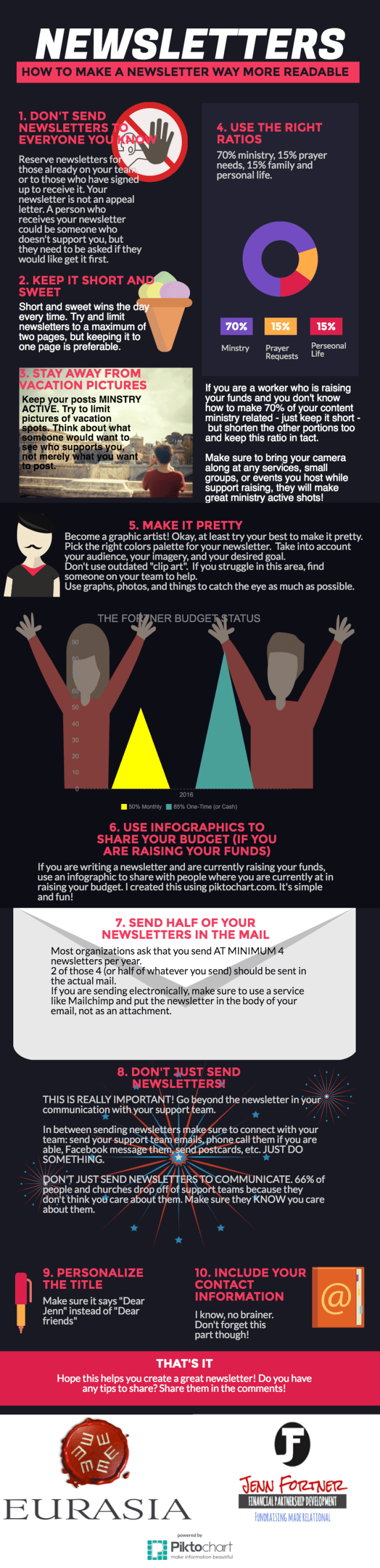
Are you writing a newsletter on a regular basis? Or maybe I should put it this way, SHOULD you be writing a newsletter on a regular basis? Well, if you want to make your newsletter awesome, this post is for you! Here are 10 Tips on Making Your Newsletter WAY MORE READ-ABLE.

newsletter (3)

Setting Up Your Social Media: Facebook Ministry Pages and Groups

Setting up various ministry social media is one of the beginning steps a christian worker takes in raising their support. Rightfully so! These days anyone raising personal support should be active on social media to build community and awareness of their ministry.

Creating a Facebook ministry Page or Group is one of the cornerstones in setting up ones social media presence. However, often times a worker chooses one before knowing the differences (or consequences) between Pages and Groups. Pages and Groups both have pros and cons. Groups have different settings making one Group vastly different from another. Here’s a guide to help you set up the Page or Group that works best for you!

facebook-page-group (1)

GUEST POST – Let’s Be Real: Why Ministry and Fund Raising Follow Up is So Important

Before we get into this amazing post, I (Jenn Fortner), just want to say how thankful I am for another Pastor Chris guest post. In this post Pastor Chris continues to challenge us with his wisdom in a huge area of ministry partnership development: follow-up. If you didn’t get to read his first guest post you can find it here.You can also read Chris’s full bio below. Enjoy! – JF

Are You Doing Proper Follow-Up?  This is a critical question regarding your success as a christian worker.  As a christian worker or missionary you are going to find many people interested in speaking to you about Jesus, but they may not always be ready to make a commitment.  They may not be prepared to forsake Islam or their family’s religion of many generations because you told them a nice story.  Successful ministry work requires faithful and patient follow-up with that person who has shown some interest.  The man who pumps my gas gave his life to Jesus, but only after I spoke with him many times.  He had to know more than my “story” about Jesus… he had to know ME. Was I a worthy person to carry such a story to him?  Could I be trusted?  Did I really believe the message I was sharing with him?

The first place you learn and practice how to do follow-up is while raising your financial support.  You may think raising money and sharing the gospel are vastly different but they are not.  If you are unable to look a pastor square in the eyes and say, “I need your support to fulfill God’s call on my life” – then you will find it difficult to look another man, with another religion, square in the eyes and say to him, “I need you to abandon everything you have been taught and follow Jesus!

Before you get to meet that man and share the gospel with him – you must meet many pastors and individuals who will help send you to the field of your calling.  You will face a lot of rejection along the way.  Your success will depend on how YOU HEAR rejection.  Yes, you read that correctly… it is up to YOU how YOU hear rejection.  When a pastor says to you, “I’ve just taken on several other families and our budget cannot support another one right now” – What do you hear?  Do you hear “NO”?  Or do you hear “NOT NOW”?

I have been serving on the field for many years.  I have raised a lot of funds.  I have done a lot of asking. I do not remember in all of those times of asking that I have ever heard a “NO”. If you hear “NO” when you ask (or if you are hearing “I DO NOT WANT TO SUPPORT YOU”), then I believe you are hearing incorrectly.  Most people you share your vision with likely believe in you, and admire what you are doing.  However, everyone is not going to be willing, AT THE MOMENT YOU ASK, to support you.  This is where follow up becomes a key to your success.

Successful sales people will tell you the one difference between them (the successful ones) and the others (the unsuccessful ones) is performing proper follow up.  Salesmen are pushed by their organizations to close the deal on the first meeting.  When they are not able to do that (close the deal) they allow the potential client to drift off to a competitor, while they go looking for a new potential client.  This is a HUGE mistake.  Recent studies have shown that most sales come much later than originally thought and after multiple contacts.

In an article entitled – Shocking Sales Statistics as it Relates to Follow Up – the author shares these statistics:

48% of sales people never follow up with a prospect
25% of sales people make a second contact and stop
12% of sales people make more than three contacts

– – – – – – – – – – – – – – – – – – – – – – – – – – – – –

2% of sales are made on the first contact
3% of sales are made on the second contact
5% of sales are made on the third contact
10% of sales are made on the fourth contact
80% of sales are made on the fifth to twelfth contact

follow up

Look at that last line.  80% of all sales come between 5 and 12 contacts. Amazing!!! I do not know how those statistics compare to fund raising, but I believe they would be very similar.

How can you apply this information to your fundraising campaign? Here are some ideas:

1.Change the way you HEAR rejection

Unless a “NO” is a very emphatic “NO” – you must learn to hear it as “not now.

2.Develop a Contact & Follow-up Strategy

Every contact with a potential supporter does not need to be an “ask”.  In fact if it is, you may become obnoxious and pastors will run when they see you.  This is true when presenting the gospel on the field also… every time you meet that guy or gal you are sharing with – you cannot ask them to accept Jesus; however, there will be the right time when you can.  Every time you meet a pastor you cannot ask for money, but there will be the right setting when you can.

3.Set a Goal to Work your Strategy

If you are raising your support for the first time set a goal to contact every pastor in your district multiple times (of course always follow the protocol within your organization / your role on this one).  Contacts can be any kind of contact: a newsletter, a Facebook post, a postcard, a formal letter, an invite to coffee or lunch, greeting him/her at a district function, etc. Create a spreadsheet and track how many times you have contacted each pastor.  Look for the ones you have had little contact with and try to increase your connection with them.

Doing these things will help keep you moving towards your goal of reaching the field and sharing the gospel with the people God is calling you to.

Ye have not… because ye follow up not!

Begin today putting together a Follow-Up & Contact Plan that works for you!

-Pastor Chris

Want more on these subjects? Here are some suggestions:

Dealing with the Monster of Rejection

6 Tips for Connecting with Pastors

Effectively Communicate with Your Financial Partners