

This will be a quick post on sharing your budget with friends and family members. Here’s what I have to say: don’t!
Okay just kidding. Kind of.
There will be times it’s appropriate to share your specific budget figures with friends and family, but most of the time it’s best to speak in percentages. Less is always more, unless someone asks for specific numbers.
Why you ask? Let’s explore one major reason.
It is possible if you share your specific budget details, the person with whom you are sharing the information will make uninformed judgments on your lifestyle in ministry. Let’s use an example to illustrate. Say you are fresh out of college and share with a potential partner who is also fresh out of college that your budget to go overseas is $3,500 in monthly support for two years and a cash budget of $30,000. That’s reasonable right? Well lets say that peer is struggling to find a job and could only dream of making that much money each month. When you share this information quickly with them in a face to face appointment, they don’t have the ability to see what goes into that $3,500 per month and $30,000 in cash (overseas insurance, cost of living is higher due to the country you are going to, language learning school, etc.). To them your budget merely seems extravagant in the wake of their own circumstances. In contrast, an overprotective family member may do some mental math on your behalf and evaluate that you aren’t making enough for those two years.
All of that to say, if you share your budget details off the cuff in your presentations, newsletters, etc., people are simply prone to make judgements they are not qualified to make.
So what is the solution? Talk in percentages! Change the sentence from “I need $3,500 in monthly support and $30,000 in cash” to this: “In order to go over seas I need to raise 100% of my budget. Would you be willing to partner with me at $100 a month?“
BONUS: Did you notice in the sentence above I also did NOT mention my need for cash gifts? That is strategic as well, as typically it is much harder to raise monthly support than it is one-time / special gifts. Potential partners (and people in general) tend to default to the least amount of commitment possible, and if you are giving the people an option during your face-to-face appointments to give one time they will take you up on it! This will leave you with less in monthly commitments. Your partners will be patting themselves on the back because they gave, and you leaving disappointed that you didn’t get a new monthly partner.
So as a rule when making the ask: stick to percentages and ask for monthly support alone.
Now, I realize you may be asking if there are exceptions to this rule? Of course there are. Responses to “asks” are as varied as there are people, and here are some examples of when to deviate:
- If you are talking to a pastor about church support, go ahead and share the specifics of your budget straight away. Pastors are different than individuals, as they tend to know more about the landscape of needs involved in ministry. Typically it’s helpful for them to have specific information on your budget, so share away!
- If an individual asks what your budget is, go ahead and share. I would advise you to have something written up for this scenario that shows some of the line items in your budget to make it understandable for those who ask.
- If someone cannot commit to giving monthly support, then ask if they would like to give a special / one-time gift. True it is far better to ask someone for monthly support, but if they can’t commit – definitely explain they can give to your cash budget / give a special gift.
- If you are sharing a specific goal on a Facebook campaign or special post on social media, it is okay to share a line item in your budget. For instance, a couple I coach for #GivingTuesday recently challenged their friends on Facebook to help them raise $1,000 toward their budget on Giving Tuesday. They shared in their videos and posts that the $1,000 would go toward their language learning costs specifically. They didn’t share the entirety of their budget, but they did project a specific need out of their budget with their audience.
I hope this helps in your communications of your specific budget. You don’t have to share all of the details to ask and to keep people informed! Have any thoughts on the subject? Share them in the comments!







 B. After clicking on Lists, click “Create List”.
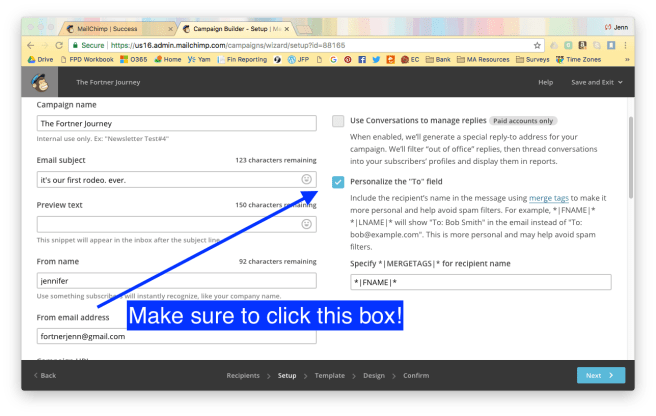
 C. Fill in the List’s name, what email address you’ll be sending this from, your name, and other information needed.
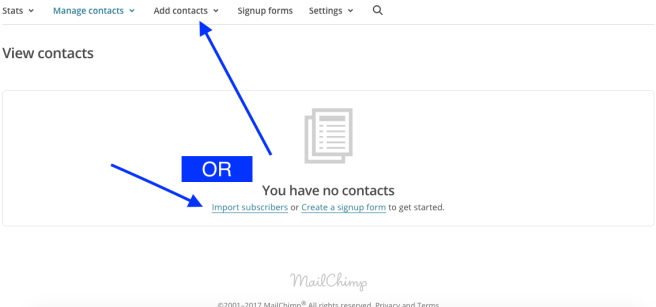 ** If you do choose to import your contact list typically you’d either do so by .csv files (this is good if you keep your contacts organized on your computer using a program such as “Contacts” for Macs or “Address Book” for PCs) or by copy and pasting from a file (for instance from Excel). Either way you may have some cleaning up of your files to do, so be patient!
  E. When you are done importing or manually adding the subscribers to your List, you are ready to move onto Creating Your Campaign!
 C. Choose “Regular” for your email type. Choose a campaign name, then click “Next” at the bottom right of your screen.
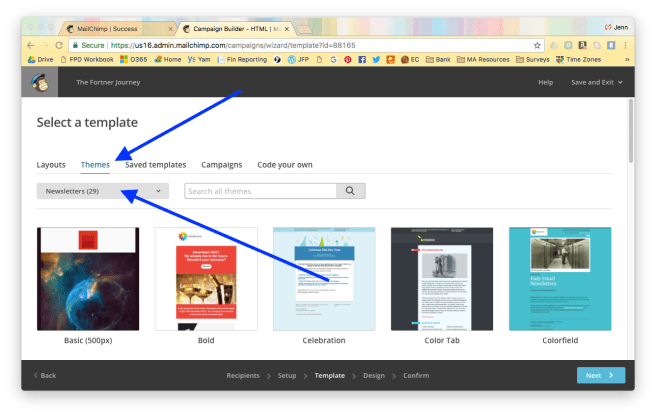
 F. Now it’s time to select a Template. There are a lot of pre-made templates out there that are great! If you’d like to go the easy route click “Themes” and explore until you find one that works for you. If you want to choose a Layout and build the template yourself go for it! Simply click “Layout” and choose the one that works best for you. You’ll spend some time custom making your Template by choosing design and content elements. (Mailchimp also has a couple of helpful links in the Layout feature that will help you get started).
  G. Now that you’ve chosen and designed your Template, it’s time to actually put together your newsletter. When you create your newsletter, you can choose to add some of the elements on the left side as you wish (such as additional text, images, graphs, etc.). To do so simply drag and drop where you want the element to the right side of your screen onto your existing Template.
 H. When you are done creating your newsletter and carefully writing your text, I recommend previewing your Campaign and sending a test email to yourself first – so you can make 100% sure your e-newsletter is awesome!
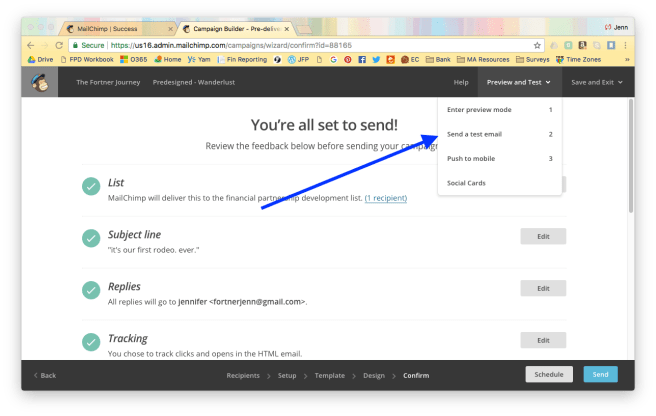 Step 5: Send Your Campaign and Your DONE!






 TEXTING
 HOW MANY TIMES SHOULD I CALL BEFORE I QUIT?

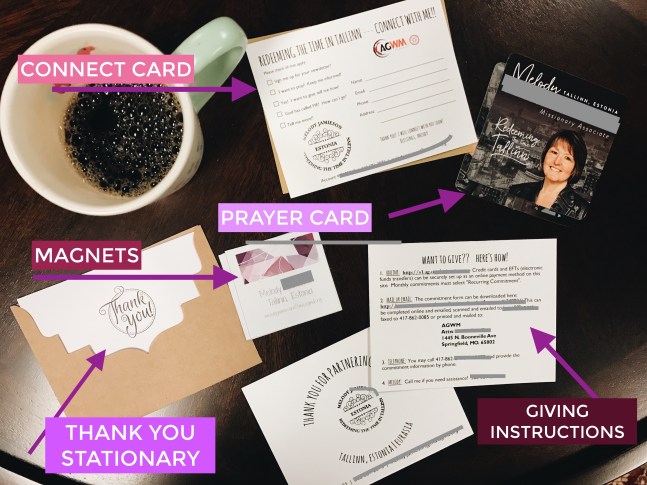 Have you made an appointment kit? Does making one seem daunting? With a little know how, making one doesn’t have to be complicated or overly pricey. Melody’s appointment kit was done using
 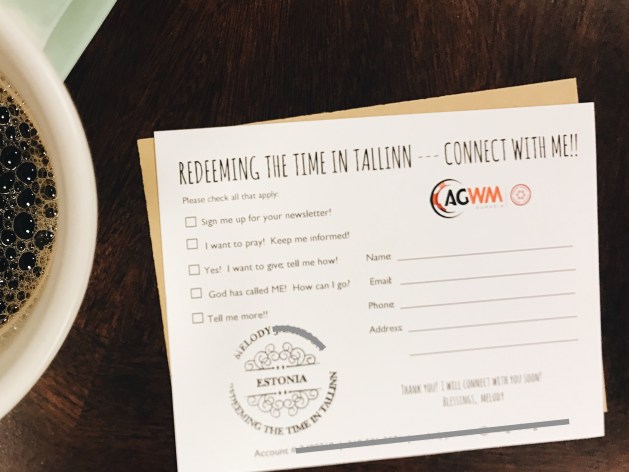 Creating a connect card can be helpful when sharing your ministry with a small or large group, or at a fundraising event. Put these cards on a back table, hand them out during the event, or place on chairs prior to the event where you are sharing. Inform the group to fill one out based on their level of interest. Connect cards help minimize the bottleneck effect that can occur when just having a newsletter sign up sheet, as multiple people can fill out a card at one time. Also, connect cards help put the ball in your court instead of your potential partner’s. That can be a big help! Instead of just giving a prayer card to a interested individual and hoping something comes of it, now you have their contact information and the means to follow up with them after the event is over! Essentially connect cards allow you to relationally seek out face-to-face appointments. More information on connect cards can be found
 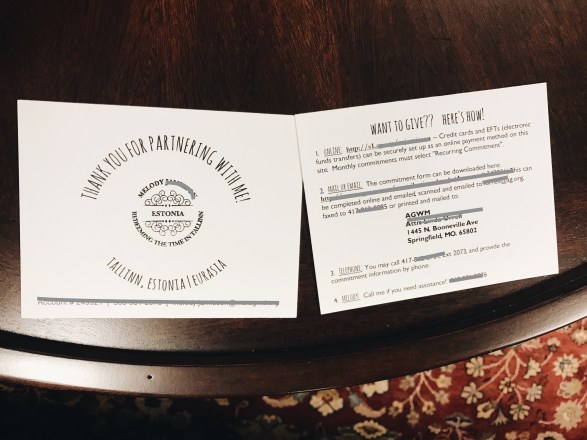 Creating simple giving instructions can help a potential partner know how to give easily. Simply state several ways they can set up their giving based on their preference. Give these as needed to someone whom you’ve just had a face-to-face meeting with or someone interested in giving for the first time that you happen to connect with in passing, etc. Keep in mind though, if you don’t see that commitment go through don’t hesitate to walk them through the necessary steps to make it happen. The responsibility to get their commitment in is typically YOURS.
 Prayer cards are fantastic for giving out to anyone and everyone! Keep prayer cards on you at all times and hand them out regularly. They should have giving information, information about where you are going, your contact information, a professional picture of you, your sending organization info and branding, and if you have created one – your tagline. I suggest spending a bit more money here and get your prayer cards done professionally (just like Melody did). There are some great places out there that make great looking prayer cards such as
 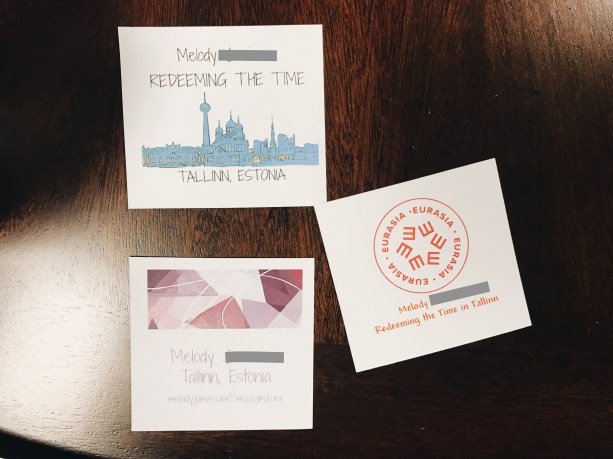 Magnets are a nice way to get your team praying for you regularly. Ask anyone who takes one to put it on their refrigerator and remember to pray for you when they see it. The magnets Melody made are nothing overly fancy, but they are a great way to reinforce the concept of “team” and put something additional in the hands of those who lift her up in prayer and financial support.





 Financial Partnership Development