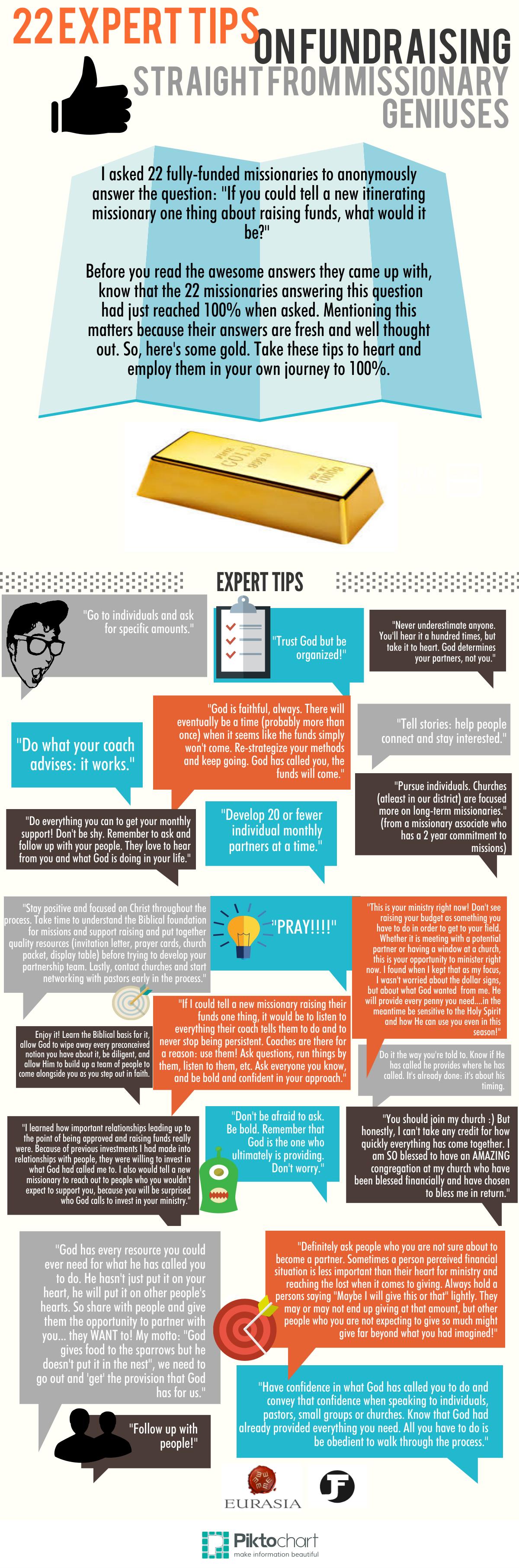
I pray you find these tips insightful and helpful. Do you have a favorite? Mention it in the comment section. Don’t agree with something? Mention it in the comment section.
Read here for more practical tips on fundraising.
I pray you find these tips insightful and helpful. Do you have a favorite? Mention it in the comment section. Don’t agree with something? Mention it in the comment section.
Read here for more practical tips on fundraising.
Did you know 10% of annual giving occurs on the last 3 days of the year, and on December 31st most online giving occurs between noon and 7 p.m (stats from http://www.durhamandcompany.com). Needless to say, it’s a good week to be asking people to join your financial partnership team. So, how can you use this information to your advantage? My first two ideas:
Get back to face-to-face appointments and develop a social media campaign.
Face to Face Appointments: If you have procrastinated over the Christmas break in asking individuals to become involved in your team – now is the time to follow up or schedule some face-to-face appointments! Start fresh today and into the New Year in relationally building your team.
Social Media Campaign: Secondly, answer this question for me:
Are you fully utilizing social media?
You should be! Remember, on Dec 31st most online giving occurs between noon and 7pm and 10% of annual giving is happening NOW. Thus, a good appropriate post on a new Facebook page would be a great start!
Straight from the Assemblies of God World Missions Mobilization Department, here is a How-To on building a successful Facebook Campaign. Take a moment to watch and then apply a Facebook campaign in your own financial partnership development.
As you think about what steps you need to take into the New Year with financial partnership development – don’t make the mistake of replacing the face-to-face appointment with a social media campaign. However, learn how to utilize both to relationally build your team of financial and prayer partners.

You may be asking the question, dear reader, how do I effectively ask individuals to support me monthly? The answer to that question has a lot of moving parts, and as I begin this blog I want to continually answer that question through the posts that I write. To start with a simple answer, it is this:
AS RELATIONALLY AS YOU POSSIBLY CAN.
I want to reinforce this sentence by telling you about the journeys of two different missionaries whom I coach. Both recently raised their finances in record time. Let me tell you a little about them:
The Jones Family. The Jones Family is a family of four who raised their extensive overseas budget within 6 months. SIX MONTHS! Let me tell you, that is a feat for a family of four!
Sally. Sally is a single woman, and a 21 year old college grad. Sally raised her budget within 5 months. She had never raised finances for a missions trip before, and particularly felt nervous that most of her friends were just out of college – and broke.
How did the Jones family and Sally do it? Well, the main successful commonality between them is this: they were always relational in their approach. So here are some things we can learn from The Jones family and Sally in their journeys to raising their budgets relationally and successfully:
1. They set weekly goals and stuck to them. When raising your finances, knowing your vision is valuable and so is determination. Both the Jones family and Sally set weekly goals (that were obtainable) for themselves based on their vision and held onto those goals with determination. They hit their goals 90% of the time.
Take away: As you raise your finances, set weekly goals for yourself and find a way to make yourself accountable to them. Before you do, think about what you can handle each week and when you want to get to 100% before you set them. Typically I tell missionaries I coach that they need to make initial contact with at least 5-10 people each week – initial contact entails that they have either sent an invitation letter (setting up the face-to-face appointment) or they called someone asking for a face-to-face appointment.
2. They didn’t take short cuts. They met face-to-face with people. The Jones family and Sally both strived for each “ask” to be face-to-face, even if that meant traveling a little to see people and ask them in person. They didn’t merely call people, send out bulk newsletters, or Facebook blasts – they took time to ask people in the most relational way possible.
Take away: I’m not saying Facebook posts or newsletters are bad things. Both are effective tools when used accurately. However, those tools become detriments when missionaries try to make them the main way they do their personal asks. Whenever possible, try to meet with your potential partners face-to-face. If it’s not possible face-to-face, try meeting with them over Skype or Google Hangouts. When you ask, have a well thought out presentation and concretely ask for financial support.
3. They asked for a range or specific amount. When the Jones family and Sally did their financial asks they boldly asked for a range of monthly support or a specific amount.
Take away: Don’t leave your financial needs nebulous and in the hands of your potential partners to guess. That’s awkward for them. Tell them what you need and provide them with parameters. A couple of reasons for this: (1) It will greatly help your friends and family to know what you need, particularly if they aren’t used to giving to missions. (2) People will default to the least amount possible, so you want to ask them for an amount that stirs their faith.
If you are asking for a range make your range comfortable for you to ask for, but also not too low. Also when providing a range make a graph
to explain if necessary. When asking for a specific amount, make sure to stay silent while they respond to what you just asked them. You don’t need to apologize or provide nervous “filler.”
![Fundraising Pyramid Image[1]](https://jennfortner.com/wp-content/uploads/2014/12/fundraising-pyramid-image1.jpg)
4. They believed they were asking their potential partners to invest in the Great Commission, not just their ministry assignment. Perspective in raising support is a powerful thing, if not one of the most important ingredients to success (or lack there of). Sally and the Jones Family believed that when they asked their friends and family for financial support, they were involving them in more than just their need for money. They were involving them in the Great Commission and thus were not apologetic about it.
Take away: If you aren’t at that point in your thinking / perspective you, you are not alone. But I do challenge you to ask God to change your perspective. Spend time in the word and seek understanding on support raising in the Bible. There are over 700 direct statements in the Bible about finances, find some of them and study. As you read ask yourself why God set up the Christian worker to live off of support, and why He wants you to do it as well. (Some places in the Bible to start reading: Philippians, Nehemiah, 2 Kings 4, and 1 Corinthians 16 or check out my workbook and buy a complete Bible study on fund-raising.)
5. They didn’t stop when it got challenging. Both the Jones Family and Sally were both hesitant to begin the process of raising their support. They also both had real fears and genuine obstacles, just like you probably do. Even though they were hesitant and ran into hard weeks while raising their budgets: they kept going and continued to ask.
Take away: Don’t let fear, a bad week, obstacles, or a “no” keep you from asking. Remember, when you invite people onto your team in a relational way, really you are asking them to get more involved in the Great Commission. When you run into a hard week (and you will, I promise you are not alone) just keep going and continually ask God for help along the way. He will provide what you need if you keep moving forward — but the key is you have to keep moving forward.
So as you look over these 5 take aways think about how you can invest and create your team relationally. As you do, you’ll find yourself growing in ministry and more happily (and quickly) raising your support.
What do you think as you hear The Jones Family and Sally’s stories? How can you raise your finances as relationally as possible?

Speaking to people face-to-face in one-on-one settings remains the best way to ask potential partners for support. However, fund-raising events, non-fund-raising events, and speaking in small groups can also be effective ways to build your team when done correctly. Below are the three types of events, and I strongly recommended that you add one or several of these to your FPD strategy.
FUNDRAISING EVENTS
These events are typically something like an ice-cream social, cultural dinner, cookie and dessert night, etc., when the missionary asks for financial and prayer support. Missionaries hold events like these for multiple reasons, and here are some main reasons you might want to hold a fundraising event:
If you hold one of these events, it’s crucial to keep the following in mind:
Here are some suggested things to include in your fundraising event:
There are many different things you could do with fund-raising events. When planning them, always write down your main goals of the event first, and work backward into the details. Continually think while planning what you hope to happen and how you hope to achieve that outcome. Holding fundraising events can be a very effective way to raise a small or large portion of your budget. Think of holding your own!
NON-FUND-RAISING EVENTS
These are events similar to fund-raising events; however, at a non-fundraising event you do not ask for any finances. These type of events are good for the situations like the following:
I love non-fund-raising events. Personally, I believe they have an advantage over fund-raising events, because they ultimately lead you into face-to-face appointments. Ideas and tips for these remain the mostly the same as for fund-raising events, but again, you do not do the ask, and hold out until it can be more of a personal delivery.
These type of events are also a fabulous idea after you return home from the assignment you are currently gearing up for. Holding a non-fund-raising event will let your partnership team know they matter to you and give you the opportunity to thank them, connect with them about your future plans (or future assignment!), and show you are invested in them. Please consider doing a non-fund-raising event after your next ministry/missions endeavor.

SMALL GROUPS
Typically, small groups are around 3 to 12 people, making them more intimate settings than fund-raising events or non-fund-raising events. Small groups typically fall into these situations:
In small groups, have some of the following available:
Last week I was privileged to write a guest post for Eurasia Northwest on 8 Ways to Grow Your Relationships with Partners. Take a moment and check it out!

Lets all take a quick moment and read Nehemiah 1-2.
Most if not all trainings on how to biblically raise support reference Nehemiah chapters 1-2. Nehemiah is a great example that relates to the missionary calling and talking with individuals 1 on 1 for financial support. Two main points are seen in Nehemiah 1-2: (1.) to show the importance of opening up one’s mouth and actually asking and (2.) casting clear vision to those who would potentially partner with us.
I challenge you to read Nehemiah this week and the weeks to come during your season of financial partnership development. Take your time and ask God to show you how to biblically raise your finances. Ask God to change your paradigm from simply raising funds to inviting people to take a bigger part in the Great Commission.
Here are a few amazing partnership development tips we can pick up from reading the book of Nehemiah:
1. Continually (and always) cast your vision. Move yourself away from just getting money to getting the people in your life behind the vision of your life. Most of the time we are so focused on getting to 100% support that we never really embark on the journey of building a support team. Press into the ongoing effort of building and developing a team. Never miss an opportunity to cast the vision of what God is leading you to do and what you have asked your team to invest themselves into.
2. Continually help your ministry partners see that they are a part of a significant team. Check out Nehemiah 3 and notice all the different types of people that Nehemiah brought together to accomplish the work of God on his heart. Those who continually let their partners know they are a part of the BIG vision not only raise their funds faster, they will raise their funds with committed long-term partners! Communicate continually through your language and actions that they are a part of a big team God is using to accomplish what is on His heart – fulfilling the Great Commission.
3. Don’t give into your wrong assumptions. Do not let the enemy convince you that the people in your life don’t want to give or partake in the Great Commission. And don’t let the enemy tell you that a person doesn’t want to be on your team. Let God decide that with them! Listening to these type of assumptions will keep you from doing the very things that foster a healthy and growing relationship with our ministry partners. Likewise, don’t let the enemy convince you that when you challenge your team of partners to do even more for you, that they will not want to partake in the opportunity. Take a moment and read Nehemiah chapter 4. Nehemiah needed to add a few things to his project and challenge the people working with him to do more. You’ll find that as you involve your supporters beyond just praying and giving, they will take more ownership of your ministry and being on your partnership team. (think referrals, hosting desserts, and partners becoming advocates)
4. Be your team’s biggest cheerleader! Brag on them! Involve them often. Encourage and love them often. Nehemiah was a tireless advocate for those who were standing with him building the wall and everyone saw it and wanted to be more involved. And what is one of the biggest opportunity to serve your partnership team: be committed to pray for them. In Nehemiah 4:4, he understood that he must stand in the gap for his team. Do likewise. Share your life and prayers with them and see what happens.
As you read Nehemiah apply these intentional principles to your partnership development. You will find excited ministry partners because of it, and as you grow your partnership team you will find them ready to go with you in the long haul.
 Financial Partnership Development