Busy? 10 Easy Ways to Keep Up With Donors While On The Field

This past month I traveled for the majority of the month, visiting various christian workers I had previously coached. Those workers are now on the field in active their respective ministry roles. In almost every conversation I had with them, they touched on the need for help connecting with their financial partners while leading very busy lives on the field.

Thus I wanted to take a little time to share on my post on this topic again and update it with a few new ideas. (If you have read the old post, this one will have a few new ideas – so please read again.)

If you are a worker already in your field of ministry – this post is for you! And now for the post:

Here’s a statistic that Bill Dillon, a guru in the support raising world and author of People Raising, has that I think you’ll find potent:

For every 100 people that stop supporting you:

66% of people stop giving because they think you don’t care about them

15% are unhappy with your organization

15% transfer their giving somewhere else

4% move away or die

Woah.

Investments that Count

When I train missionaries on how to raise their budgets I tend to stay away from the word “fundraising” for many reasons, and when I really think about it — this statistic is at the heart of all of my reasons.

No one wants to invest in something that yields no return.

If the people/church giving a christian worker funds every single month feel as though the worker could care less about their giving, they will go somewhere else with their giving dollars.

And in my opinion, they should.

Ouch! Why you ask? Because the reason donors are investing in the Great Commission is because they are called to be a vital part of the Great Commission, too. And if they are called to be a part of the Great Commission, why should they be made to feel as though their vital part is on the sidelines?

I believe that one reason we forget to invest ourselves into the relationships we have with our financial partners is because we forget (or perhaps don’t have the paradigm) that they are as vital to the work that we are doing as we (as ministers) are. (Side Note: I call “donors” by the term “partners” or “financial partners” because donors also give blood – look up the definition – you’ll be surprised)

That being said, many christian workers on financial support struggle in the area of continually connecting with their financial partners even they have a high value for their relationships with them.

It makes sense. We are all busy. Ministers are typically very busy.

As much as I understand, I also believe it isn’t a valid excuse. There are so many easy ways to connect across continents in our world. As such, I would like to offer up 10 suggestions on how ministers on financial support can continually – and easily – connect with churches and individuals who financially invest in the kingdom work they are doing.

Minister to Partner: Ways to Connect

1. The Quarterly Newsletter

Here’s a no-brainer: Send your newsletters. You should do a minimum of four a year. Keep them short, and talk more about ministry than personal things. Include pictures of active ministry and not vacation spots.

Here are two “do not’s” with newsletters:

The Vacationer Newsletter

I recently got a newsletter that made me jealous. And not in a good way. There were pictures of vacation spots all over it, making me wonder (from my desk in the middle of a rainy Missouri day) why I couldn’t go myself? I want to go to these wonderful, beautiful, far off destinations to do “ministry” instead of supporting someone else as they take these paid looking vacations; however, I know my job, and my calling is here.

Sure I knew that they were active ministers, or else I wouldn’t have started supporting them in the first place. However, there was something as I was reading that felt just a twinge off and left me wondering. Let’s not put the people that are giving us the opportunity to minister in that place of wondering. Let’s keep our newsletters active in ministry.

The Negative Newsletter

I have read a lot of newsletters over the years. And can I say one thing I see over and over again? A negative outlook. I believe I’m with the majority when I say positive newsletters win verses negative newsletters all day, every day. Sure prayer requests are important, and of course there is the need to be honest. However, the general feel of your newsletter should be one of a positive outlook and experiences. No whining. No complaining about how hard it is to raise your finances. Keep your newsletters vision based and focused.

2. The Digital Hello

When you get on the field, pick 5 – 10 financial partners each month and email them a short personal hello/touch base. For example:

“Hi Sally, just wanted to touch base with you and see how you have been doing. You and Chuck are, of course, on our prayer list and we are wondering if you have any updates or requests. Things here are going wonderful! We just finished with our building project and couldn’t be more excited to receive students this coming fall. I am really looking forward to getting back into teaching. Anyhow, hope you all are well and let us know how we can be in prayer for you.” – Jenn

See…how painful is that? It took me all of one minute to write that… You may be saying, but what happens when they write back? Then, take another minute of your day to promptly reply to those who responded to your email. If all 10 respond it will take you around 10 minutes to respond to all of the emails. Then, take the time to mention them in your prayers and follow up with that as you have time. Keep a simple notebook. Write them down. It will make all of the difference and mean so much to the people spending so much time praying for you.

Once you have gone through your 5 – 10 partners each month, circle back around your list. Put these on some sort of white board in your room or house to remind you, or put it into some sort of calendar each month. Whatever you do, calendarize it in some way.

3. The Traveling Present

Send small gifts or postcards to your financial partners. Tell them thank you for their continuing support.

imgres-1

I recently received a postcard from a friend vacationing in Costa Rica. That postcard remained on my fridge for 2 months for two reasons: (1) My friend thought of me from a far off destination and it made my day getting that postcard! (2) It was beautiful! Personally, I’m a sucker for a pretty print of any far off destination.

Small gifts do not have to cost much to mean a lot.

4. Stay Active on Social Media

If you don’t already have one, create a Facebook page. Create a secret group if you are going to a sensitive country. Stay active on it while you are on the field. Pictures, prayer updates, videos and praise reports are all fantastic. *If you are somewhere sensitive keep that in mind while posting and follow the rules of your organization.

If you have the time and know-how, get onto Instagram and Twitter as well! This is not for everyone, and typically I say to start with one social media outlet and do it well. However if you have the time and know how try one or both of these. I love posting on Twitter and have a personal Instagram page as a creative outlet. Both have been effective in communicating with friends and helping me to network on a larger scale.

5. The “I’m Thinking of You” Share

Facebook message your financial partners or like their posts. Stay active on your personal page (including Twitter or other social media outlets).

Sometimes as I listen to audio sermons, worship sets, podcasts, or Scriptures, I’ll ask the Lord if He would like me to share any of those with my friends, family, or financial partners. If I feel prompted, I’ll send that sermon or verse to a friend on Facebook with a little message. These have to make sense and the sermons probably shouldn’t be overly convicting on major sins or anything. (Don’t imply that your friend has a problem). Use common sense. ie. Don’t send a message on tithing to a partner who hasn’t recently been giving.

6. The Church Letter

Write a short letter to the churches that financially partner with you. Put a note in to the pastor to please read where he feels it appropriate to the congregation (small groups, prayer groups, Sunday school).

7. The Homecoming Event

When you come back home, hold a non-fundraising event in key areas where your financial partners are. During the event provide desserts and coffee. Share stories from the field, answer any questions, tell them about your future plans, and thank them, thank them, and thank them.

These events can be as elaborate or simple as you want to make them. I would of course error on the side of taking care of your important guests by providing refreshments and some sort of dessert or snack – these also provide an incentive for your guests to come.

Recently, a ministry couple I coach held one of these type of events but made it a fundraising event (this type of event means they asked for monthly commitments from friends and family at the event. A non-fundraising event means you only ask for contact information and do not ask for commitments from your guests).

They took care to have a sign in book at the front door that collected people’s contact information as well, and they had a pastor come up and share with the guests about the value of missions and their ministry. They raised a total of $1,200 in monthly support in one night.

8. The Homecoming Coffee

In addition to the church event, when you come home set up one-on-one coffee times with pastors and friends and family that have supported you. Thank them and catch up on their lives while you were gone. Be relational and intentional.

9. The Real Time Facetime / Skype Meeting

Are you spending some time on Facetime or Skype with your far away family and friends? Why not pick 6-12 financial partners per year to Skype or Facetime while on the field? This is particularly good practice with financial partners that are giving sizable amounts or with churches and small groups that are partnering financially. Give them a real-time live update on where and how you are. Take them into an actual ministry event via skype or Facetime on your phone if you can. They will be floored at your thoughtfulness and most likely continue to financially partner you throughout assignments to come.

10. Text them!

article-2239828-1641C116000005DC-797_634x549

There are multiple programs available that will allow you to set up video and picture messaging while on the field. If you have a urgent prayer request, why not send a group text message out to your financial and prayer partners with a picture detailing your prayer need? If you have a praise report, send a text and allow them to celebrate with you (of course, keep in mind time zone differences so that you are not texting them at 2:00am)!

I personally use ReachModo for these purposes. It allows me to communicate while on the field and to set up a Text to Give option and a Text to Connect option that helps tremendously while itinerating. (Text to Give is when someone wants to start giving financially, and Text to Connect is when someone wants to sign up for prayer alerts and newsletters.) I then use the service to group text everyone on my ReachModo list. As I said above, there are numerous programs available for this type of service like Constant Contact and ReachModo. Keep in mind that you need to use a service that is secure, and check in with your organization that you are following your organizations security protocols. Check it out and you’ll be glad you did.

If you are a minister on financial support, I hope that these help you. Let’s remind our financial partners that they are important to us and to the Great Commission! Let’s keep our attrition rates up with our financial partners by spending just a little time letting them know that we care. Let’s value them! Let’s realize that they are vital part of what we do. Amen? Amen.

Want to know more about how to connect with financial partners? More practical help while raising your funds for ministry? Check out the Financial Partnership Workbook: Biblical and Practical Tools to Raise Your Support. 

How to Effectively Communicate with Your Financial Partners: ANSWERS FROM ACTUAL FINANCIAL PARTNERS

In continuation of my previous posts Hard Questions with Thoughtful Answers:  Q&A With Support Raising Geniuses, here are some “Hard Questions with Thoughtful Answers” from another perspective. The perspective of those that give. 

I hope you find these as helpful as I have! Wow. What great responses! Thank you to the pastor and individual who answered these questions. And ps. – thank you for giving to the work of the Great Commission. I hope it is said often enough to you how vital you are to the work of God. Truly, you make it possible.

Untitled Infographic (3)

Learn how to do a Successful Facebook Campaign (NEW VIDEO!)

You may have already read the previous post on this subject: How to Create a Successful Facebook Campaign and Other Glorious Facebook Information.”  

With that post I want to give you the “Part 2” – with a new video explaining some of the ins and outs of creating a successful campaign. It was crafted by myself and the brilliant mind of our brand lead for Assemblies of God World Missions, Ericka Pasquale.  (thanks Ericka!)

(March 2015 video)

(NEW! May 2015 video)

If you are launching your own Facebook campaign, keep in mind that Facebook campaigns will primarily lead you to new financial partners who are referrals. The key to referral relationships is to develop them. Don’t take these new relationships for granted or assume they don’t want more involvement with you because you acquired their partnership via Facebook. I have this new quote that I love, and I think it fits nicely here:

“Your real goal isn’t about raising money. Your real goal is to raise up people and create solid, long-term relationships.” – Myles Wilson, author of Funding the Family Business

Here are some ways to develop relationships that come from your Facebook campaigns:

1. If they live near you, go grab coffee, lunch, or dinner together. Spend time getting to know them and cast vision about your ministry.

2. Reach out to them via Facebook messenger with electronic resources on your ministry, and add them to your ministry Facebook page.

3. Ask if you could connect via phone, Skype, or FaceTime with those new financial partners that live far away.

4. Send them a thank you card in the mail and/or a small gift when appropriate. Send them a e-thank you card if snail mail seems un-appropriate.

5. Start following their Facebook page. Find out what their interests are and how you can engage.

I hope these tips help you create solid, long-term partnerships with those you meet in your own Facebook campaign!

Part 2: Hard Questions with Thoughtful Answers – Q&A with Support Raising Geniuses

Q&A with Ms (8)


Special thanks to the ministers who participated and gave their heartfelt and practical answers. You all are my heros. Have your own tips? Post them in the comments!

How to Create a Successful Facebook Campaign (and other glorious FB information)

This video was made for sensitive country missionaries interested in making Facebook campaigns, (sensitive country means a country where it is dangerous to tell the outside world where you are going, particularly on the internet) however, it could be used for a missionary going to any country – sensitive or not.

The example used in the video is Dylan, a passionate missionary who raised her goal of $500 monthly support in 10 days. Dylan used interesting and passionate videos, well thought out content posts, and give-away incentives to reach a completely new audience with her ministry and need for monthly support — all within the context of safety on Facebook.

If you are interested in launching your own Facebook campaign, follow the information on the video and include the following:

1. Correct Timing: One thing we didn’t mention in the video is when to launch your Facebook campaign. The best time to launch is when you have raised approximately 75-85% of your budget. Facebook is a great tool, however it should not replace the face-to-face appointment as the number one way to raise up your financial partnership team. Nothing can take the place of being eyeball-to-eyeball / face-to-face when raising your finances. A Facebook campaign should be used to expand your contact list and/or used as more of a “last push” tool.

2. Make sure you have time in your schedule during your Facebook campaign. This should be a no-brainer, but just in case… If you have 15 people posting on their Facebook walls for 10 days, and you are supposed to be providing all of the content, videos, give-aways, etc for those 15 people – you will be busy. You will be busy not only keeping up with your 15 friends posting for you, but you will be busy keeping up with all of the people who like or comment on your friends’ posts. Thus make sure the 10 days you pick are good in your personal schedule. Do not fall behind during this time. Remain on top of the posts and give your 15 the information they need every single day to make your Facebook campaign successful.

Below are a couple of more thoughts and tips on Facebook, provided by social-media / branding genius for AGWM Mobilization – Ericka Pasquale. (also the creator and brain behind the video above!)

10 Tips for using FB as a Missionary

1. Connect, like, share, and continuously be active.

2. When connecting with pastors, consider private messaging them. Do so for introductions or even to scheduling meetings.

3. Post pictures, not just text.

4. Tag and engage your audience in your posts.

5. Promote services or engagements in order to invite others to attend in and around the area.

6. Post prayer requests.

7. Comment on financial team’s personal pages to let them know you are thinking about them. Private message your financial partners as well to find out how they are doing.

8. Post videos (short and quick update videos).

9. Encourage other missionaries to share your posts. Follow other missionaries and ministries and share their posts. Be engaged.

10. Create a conversation on posts utilizing the tag feature.  Generate a dialogue

5 Reasons Why Facebook is Effective in Maintaining and Building Your Financial Partnership Team.

1. It’s the Largest Free Country in the World. Facebook was founded in 2004, and just over 10 years later it is now the largest country in the world. With more people on Facebook then the entire population of China it is the most used free resource for communication. Anyone with internet access and email address can sign up for a Facebook account.

2. Engaged Users. According to Zephoria Internet Marketing Solutions: 890 million people login to their Facebook accounts every single day, and currently Facebook is growing at a rapid rate. 5 new profiles are created every single second. With over 300 million photos uploaded every day this show us that users are engaged. Why not engage with you and do something productive for the kingdom of God? This statistic also shows us that there are a lot of photos competing for users’ attention. So you when using Facebook, you need to target your posts strategically.

3. It is Global. In Europe alone there are over 230 million Facebook users. Facebook is a world wide phenomenon. And as I think upon my role as a marketing and brand lead for Assemblies of God World Missions, I am truly believe there are people in those 890 million daily users who would love to be apart of what God is doing around the world… they just might not have had the opportunity yet. Facebook could be that opportunity.

4. It helps Maintain Soild Relationships.  If I give a missionary a one time donation because I saw that missionary at my church, and then we become Facebook “friends” – then I have the opportunity to easily follow all the amazing things they are doing in ministry. When that missionary chooses to launch a fundraiser on Facebook, it is likely that I will be willing to switch from a one-time-gift to a monthly committed financial supporter. Why? Because that missionary and I are connected. Because I have been following what they are doing and where they are going. And here’s the main point: As a potential financial supporter I am going to invest in what I know, and Facebook makes it very easy to get to know someone.

5. Pastors Like Interacting On Facebook. Recent studies we have done at Assemblies of God World Missions have found that our itinerating missionaries have the most success with initial contact to a pastor by merely by sending a private Facebook message. Pastors are 8 times more likely to respond to a Facebook private message then they are to return a phone call….8 times.   – Ericka

In closing, good luck and God bless you in your own Facebook Campaign. And please, let me (Jenn) know how they go for you by sending me an email or commenting here.

Special thanks to Ericka Pasquale’s brain for this post.

The Insider’s Guide to Having An Effective Display Table

Having a display table set up for speaking engagements can be an effective tool for communicating with people about your ministry.

For the sake of absolute clarity, here’s the type of scenario I’m describing:

(1) Missionary speaks for 5 minutes at a church service. (2) Missionary has a table or area set up in the foyer of the church. (3) After the service (sometimes before too) missionary uses the table / area to connect with members of the congregation.

As many of you know from observation display tables can be very effective to opening up conversations. They can also fall very, very flat if done incorrectly.

So what are some practical things you can do to make your table the best ever? Or at the very least – a more interesting place to start a conversation? Is it worth it to invest time and finances into a great display table? Below are some of my thoughts:

Thought #1: Is it worth it to invest resources into a display table?

Yes, it is worth it, but it should have the following components to make it worth it:

(1) You must have created a reason to stop by your table. At the very least, you should mention during your time that you have a table in the back. Convey that you would love to meet the congregation and connect more.

(2) Your table is not sloppy. Make your table inviting, not boring. Create a space that people want to stop by. Have some astectic appeal. No excuses — you can find someone to help you if you aren’t good at this.

(3) Make your table visible. People have to be able to find you to connect with you. Don’t put yourself in a corner. Don’t put yourself right at the entrance to the bathroom either. Your table must be in a place that isn’t awkward for people to stop and chat at.


Thought #2: Get Creative! Have something interactive on your table to spark conversation. Here are a couple of great ideas from successful missionaries:

“We put the alphabet of the country we were going to on the tabl, then asked guests to try and spell their names out in the foreign alphabet. It broke the ice. Once we did this we saw a huge difference in table interaction!”

“We made up a coloring page for kids with crayons to pass out. It was fun for our girls to give to the kids, and the kids liked it. I saw another missionary do it and thought it was a cute idea. Tables are a great way to engage in conversation with someone who otherwise may be too shy to just strike up a conversation. We try to keep our costs low by using Walmart posters and homemade stuff!” 

“When I first went out I actually had a double paned “10/40″ window with a net and fishing lures between the two pieces of glass. I used it to talk about fishing the 10/40 window. I equated the 10/40 window to a store front window, in which one can see in but can’t get to the things inside easily. I also equated it to ice fishing and how in the 10/40 window countries the fish are there, yet you have to drill holes in the ice (over time/prayer). Also one can’t use nets like other places in the world.”

“I sold coffee at my table from Eurasia Cafe and it sparked a lot of great conversation!” 

“We created a “progress map” that represented how far along we were with raising our support. Every time our support grew, we moved a toy plane closer to Georgia from the US. A little cheesy, but it was a big conversation piece and helped people visualize us at 100%.” 10953955_10204211576868236_1918223454239609490_n


Thought #3: Have a video playing. Does your ministry have a high quality video? If so, use it! If you don’t know if your ministry has a video, simply ask your mentor to find out. If they don’t, why not make your own? Adobe Voice is an app for iPads and is great place to start. There are also a lot of great companies or freelancers that make affordable videos. Find out if your ministry has a vendor list to see if they know of anyone able to help you create a video. Throw the video on a tablet and play it continuously at your table.


Thought #4: Put together all of your printed resources. You probably know this one, but just in case you don’t, make sure you have printed resources on your table. Add to them by creating a resume/packet type binder or book that combines statistics from your ministry, facts about you, your area, etc.


Thought #5: If you are going overseas, put out a map of the world so that your visitors can find the country you are going to.


Thought #6: Always smile. 


Thought #7: The most important thing you could have on your display table is a sign-in sheet. People want to get continuos information about your ministry. If you provide those that stopped by only with printed resources, you may never hear from them again.  Ask everyone you connect with to fill out your sign-in sheet. Doing this allows you to get their contact information, so that you can take the responsibility of following up with them. Here’s an example of some good sign-up sheet fields (make yours fancier):

sign up sheet

Keep in mind, you will absolutely want the permission of the host/pastor to put this sign-in sheet out.

If you do get permission, everyone you connect with signs this sheet! Tell them you would like to remember them and keep them updated on your ministry.

After the event, make a phone call to those that signed in (also make sure this is okay with the pastor/host). When you call, share the following:

(1) Ask if they are interested in joining some aspect of your partnership team – whether by prayer or finances.

(2) Thank them for connecting with you and tell them you appreciate their church/group and interest.

(3) Ask them if they have any questions.

(4) If appropriate ask if they would like to meet face-to-face. Tell them you would like to find out more about them, build relationship, and find out if joining some aspect of your team is a good fit for them.

(5) Tell them you are adding them to your newsletter list.


I hope these thoughts help you develop great display tables and communication with the people you meet as you travel. Do you have any thoughts to add?

(plane photo cred goes to the missionaries that created the “progress map” thank you! // check out http://www.faithhousedesigngroup.org/ for really great graphic design resources)

Become a Better Public Speaker

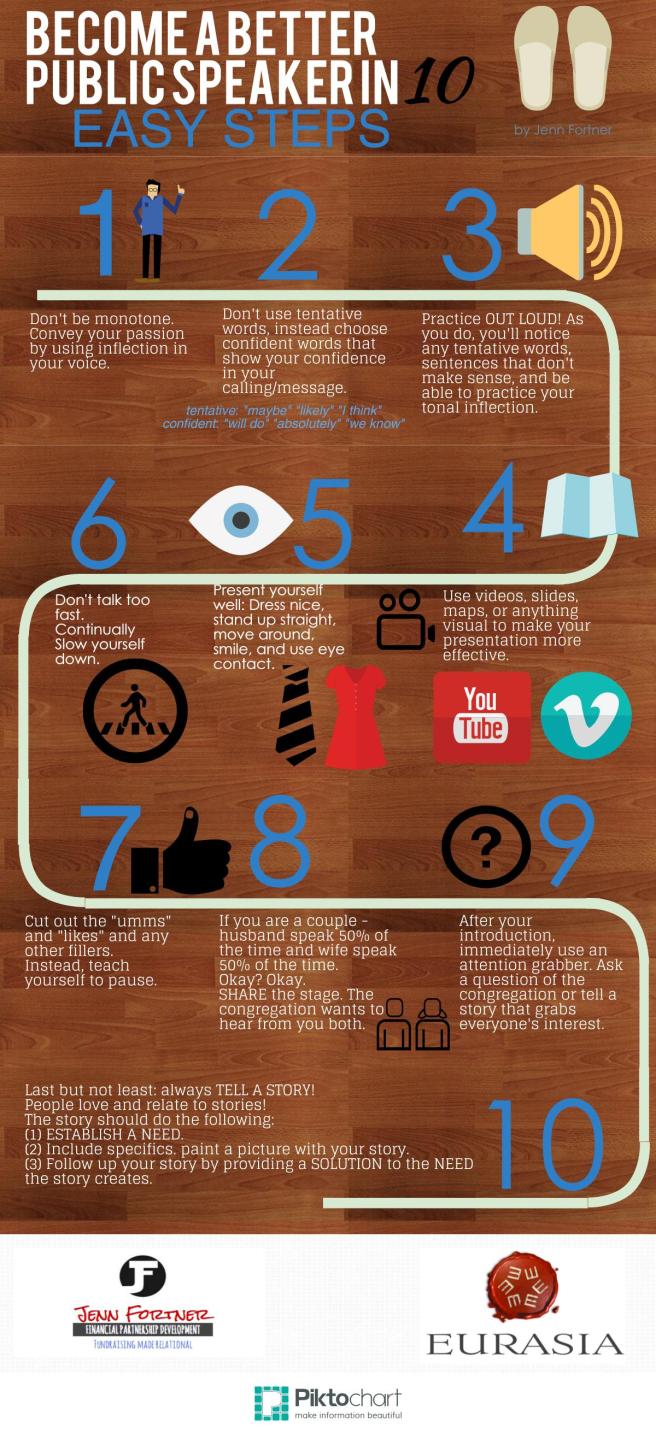
Untitled Infographic (5)

I used to be terrified to speak in public. Knotty stomach, raised pulse, sweating, and no sleeping the night before. Growing up I avoided any classes that had me speaking in front of the class. I cannot count how many times I ran in the opposite direction if there was even a hint of me having to be in front of a group.

Now, surprisingly, I’m mostly over it. Why the dramatic change? Practice. A lot of practice. I have been blessed with leadership over the years that encouraged me as well as provided no-way-out situations speaking to groups. (I hated them for it then, love them for it now) As for my personal skill level, I cannot say I have arrived exactly where I want to be; but I have come a long way and am proud of where I am today.

A lot of missionaries and those in ministry are plagued by fear of public speaking. Many missionaries are not afraid of public speaking, but have a long way to go to refine the art of giving a impactful message or 5 Minute Window at a church service. Whether you are starting off with cold sweats just thinking about public speaking, a boarder-line professional, or somewhere in between – I hope this simple info-graphic helps. Here are a couple of additional notes for some of the steps above:

STEP 4 VISUALS: If you are having a hard time describing where you are you are going overseas, a job you are doing, etc. use something visual to illustrate it! Also, if you are a missionary or traveling minister speaking at a church, set up a table in the back but don’t let it be boring. Create ways for people to comfortably interact with you after the service.

Some examples: (1) Create a alphabet in the language of the country you are going to so those stopping by your table can spell their names (and children’s names) in your country’s alphabet. (2) Have a video about your ministry continuously playing on a laptop or tablet. (3) Have something small available that represents your ministry.

STEP 9 THE ATTENTION GRABBER: After providing a brief introduction of yourself (and your family if you have one), you need an attention grabber. Use one of the following to grab people’s attention from the very beginning:

  • Share a short personal story. “I’d like to begin by telling you a story about Anna, a 5 year old girl I befriended in Spain.” 
  • Ask a group question or do a quick group survey. “Raise your hand if you have any idea where Qatar is on a map?” (then show the map later on the slide). “What do you think of when you hear the word “poor”? You shouldn’t be receiving actual answers, only developing a story / idea and involving the congregation.
  • A thought-provoking statement. Impressive to everyone (not just you). “Did you know that in Africa 1 out of every 10 people are _______” This of course needs to relate to what you are doing and why you are speaking with the group.

STEP 10 ESTABLISH A NEED: After you have their undivided attention, you must establish need. You can do this in multiple ways. Here are two suggestions that you can effectively establish need:

1. Share statistics and data. Appeal to the congregations logic and reasoning. Don’t overdo the stats — it’s easy to do.

2. Share stories, pictures, or videos. Appeal to the listener’s emotions with these. (If you shared a story for your attention grabber; a good idea is to come back to some aspect of the story, develop it more, and thread it throughout your presentation.)

One last word on public speaking: you will get better at it! Practice makes perfect, and the more you speak in front of groups the better you will become.

Are there any tips you have? Add them in the comments!

Want more information on public speaking, including an effective outline?  Read the Financial Partnership Development Workbook.

22 Expert Tips on Fundraising Straight From Missionary Geniuses

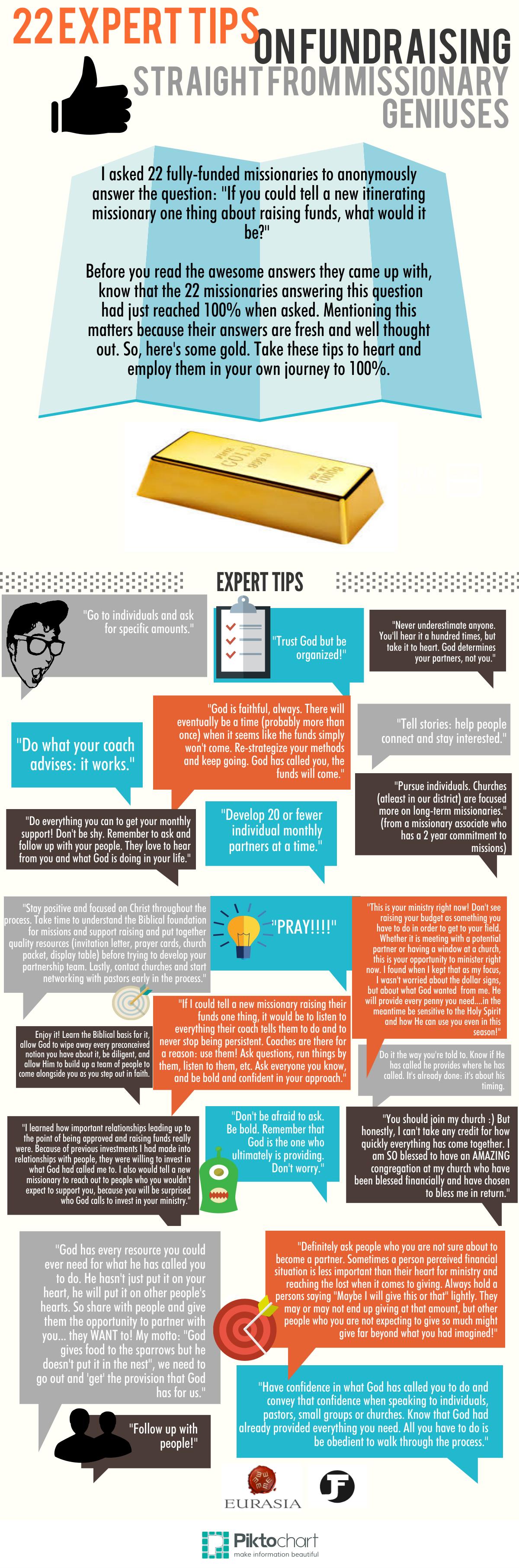
22 Expert Tips (4)

I pray you find these tips insightful and helpful. Do you have a favorite? Mention it in the comment section. Don’t agree with something? Mention it in the comment section.

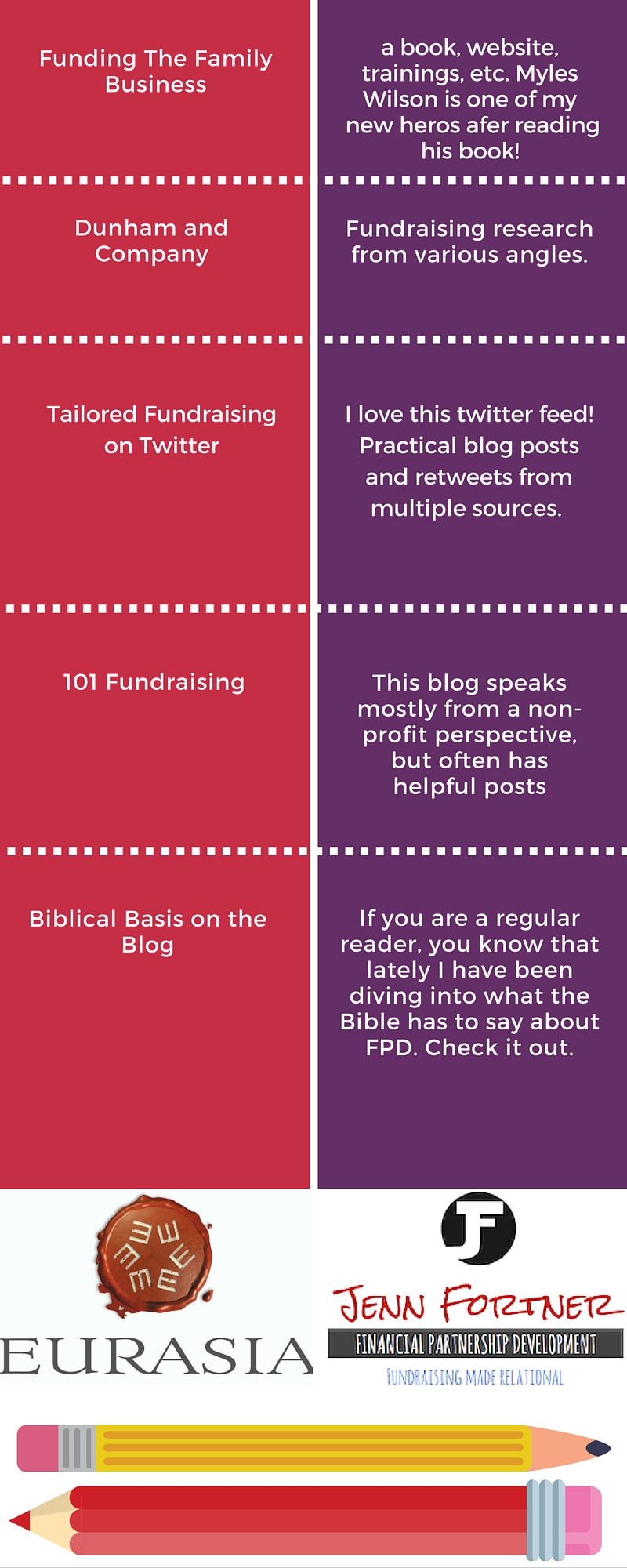
Read here for more practical tips on fundraising.

End of the Year Giving Optimization

Did you know 10% of annual giving occurs on the last 3 days of the year, and on December 31st most online giving occurs between noon and 7 p.m (stats from http://www.durhamandcompany.com). Needless to say, it’s a good week to be asking people to join your financial partnership team. So, how can you use this information to your advantage? My first two ideas:

Get back to face-to-face appointments and develop a social media campaign. 

Face to Face Appointments: If you have procrastinated over the Christmas break in asking individuals to become involved in your team – now is the time to follow up or schedule some face-to-face appointments! Start fresh today and into the New Year in relationally building your team.

Social Media Campaign: Secondly, answer this question for me:

Are you fully utilizing social media?

You should be! Remember, on Dec 31st most online giving occurs between noon and 7pm and 10% of annual giving is happening NOW. Thus, a good appropriate post on a new Facebook page would be a great start!

Straight from the Assemblies of God World Missions Mobilization Department, here is a How-To on building a successful Facebook Campaign. Take a moment to watch and then apply a Facebook campaign in your own financial partnership development.

As you think about what steps you need to take into the New Year with financial partnership development – don’t make the mistake of replacing the face-to-face appointment with a social media campaign. However, learn how to utilize both to relationally build your team of financial and prayer partners.