
Effective Strategies for Raising Support While Overseas


How to Raise Support While Still on the Field

Raising support while actively serving overseas can feel daunting. How can we raise support relationally while being separated by time zones and ocean water? The good news is—with the right strategies, it can absolutely work. Whether you’re far away on assignment or involved in full-time ministry locally, these tips can help you strengthen your support base and grow your network with confidence.

Top Tips for Raising Support While Overseas

Here are some key strategies to help you stay well-supported, even while you’re serving on the field:


1. Ask Existing Supporters For An Increase

One of the simplest and most effective ways to raise additional support is by asking current supporters for a small increase—typically 5–10%—as long as they haven’t made an adjustment recently. A personalized message (likely emailed) that acknowledges their ongoing commitment with a hearty amount of thanks and explains the current need can open the door to increased giving. It’s a strategic first step that often yields results without the need to expand your network right away.

Keep in mind, these asks are best if you haven’t requested an increase recently or asked them for support within the last 6–12 months. This approach is mainly intended for churches and individuals who have supported you for over a year.

Here’s a quick email template you can take and make your own:


Subject: Hello from Sweden + Support Update

Hi Pastor Ed,

I’m writing from Sweden! I hope all is going well there. I wanted to pop in quickly and share a few updates with you.

First off, thank you to you and 1st Assembly for continually supporting Zach and me as we’ve moved through various assignments in Sweden over the past six years. You all make what we do in CITY/MINISTRY possible, and we couldn’t do it without our team. We love and value you and are so thankful for your ongoing partnership.

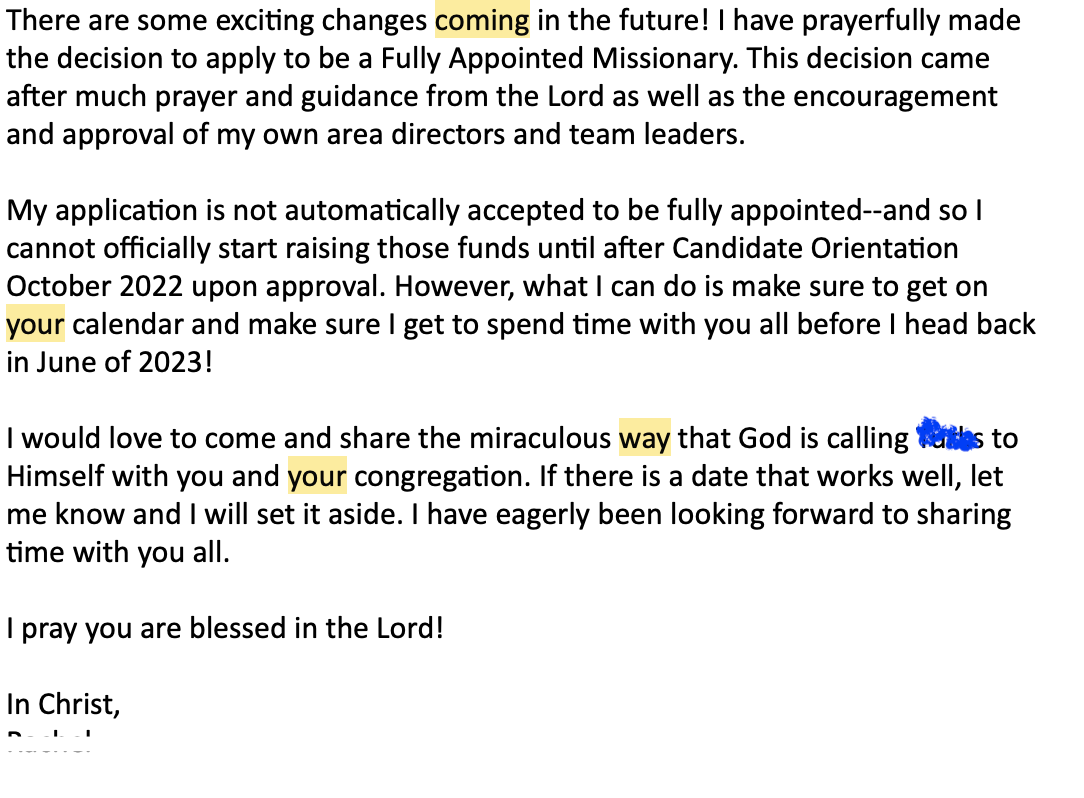
Second, I wanted to let you know that we have plans to extend our term another year (🥳), and we’re reaching out to our existing partnership team to ask for prayer and support in this effort. We’re needing about $1,000 in additional monthly support and $12,000 in special gifts to make the extension happen.

If you know of any other churches or pastors who might be open to connecting with us, please let us know. And if 1st Assembly feels led to increase or give a special gift, we’d love to hear from you.

Just to give perspective—if every church on our team increased their monthly support by 10%, we’d already be halfway to our goal!

As always, thank you so much. We’ll continue to keep you posted via newsletters and social media. We’re attaching our most recent update below.

We’d also love to hear what’s happening at 1st Assembly. Stay in touch!

Many blessings,
Jenn (and Zach) Fortner
jfortner@eurasia
Sloane and Merrick

Giving #: ________
Sign up for Prayer Alerts: link__
[Attached Newsletter]


2. Use a Multichannel Approach

This is just a general tip that may come in handy as you think through ways to push out information on your financial need. Using multiple communication channels—newsletters, social media, phone calls, texts, videos, and Zoom—is key to effective support raising – period. Different people prefer different types of communication, so using a mix helps you reach a broader audience in ways that resonate with them. A multichannel approach increases the chances that your message will be seen, remembered, and acted on. So, if you are putting a goal of $1,000 increase in monthly support as you present your need in newsletters also use the same messaging in any social media (that you can based on security), phone calls or text messages (to existing partners telling them of your need), Zoom, emails, etc. I suggest starting with a great graphic and concise copy that you can sprinkle into all of your. communication pieces. Then, text or call or email your existing partners and let them know of your need (this may coincide with asking for increases – or point 1.)


3. Stay Connected and Communicative

As you grow into your role as someone who lives off of financial support, communication with your existing partnership team should become part of your regular lifestyle—not just something you do when you’re actively raising support.

While group updates are important, nothing replaces personal connection. Reach out to key supporters via direct emails, texts, phone calls, or Zoom. Just because you’re overseas doesn’t mean you can’t maintain meaningful relationships. These touchpoints deepen relationships and create opportunities for further engagement and support.

There are tons of great tools out there for staying in touch, especially when itineration time is limited. Use them to check in, express appreciation, and ask for small increases when appropriate.

Need ideas? Check out:
10 Easy Ways to Personally Connect With Financial Partners Without Taking Too Much Time


4. Expired Credit Cards

If a financial partner’s giving stops suddenly, don’t assume they’ve pulled their support. Often, the issue is something as simple as an expired credit card. A quick, friendly message to check in can resolve the issue quickly.

If you don’t follow up, you may unknowingly leave money on the table. Many partners are grateful for the reminder and are happy to update their info once they know there’s a problem.

Here’s a sample template from another worker you may use as you communicate with anyone who has lapsed on their giving:

We pray you are doing well!

I spent some time today catching up on our financial stuff and it looks like the last time you gave was on 8/20/24. Are you wanting to continue giving each month, or are you needing to adjust your monthly commitment? 🙂

(If you didn’t realize your giving stopped, the most common issues are either your card on file expired or you had a “deadline” for your giving from when you originally signed up to give.) If either of these were the reason your giving stopped, let us know and we can help walk you through how to restart your giving.

Regardless of if you’re able to keep giving, we are so thankful for your financial sacrifice thus far. Please let us know what you plan to do so we can keep our financial records up to date!☺️

We love you and are praying for you!

C&C


5. While on Assignment, Make It a Ministry Team Effort

Support raising doesn’t have to be a solo act. Creating intentional time with your ministry team—or even just a roommate or fellow worker—to work on support together can be a game-changer.

Set up a “support raising work party.” Think: cookies, coffee, laptops, thank-you notes, postcards, and good vibes. Working alongside others helps make the task less overwhelming and more enjoyable. (Bonus points if you take time to pray for your supporters as a group.)

Whether it’s writing updates, reaching out to lapsed supporters, or brainstorming fresh ideas, doing it in community builds momentum, accountability, and encouragement.

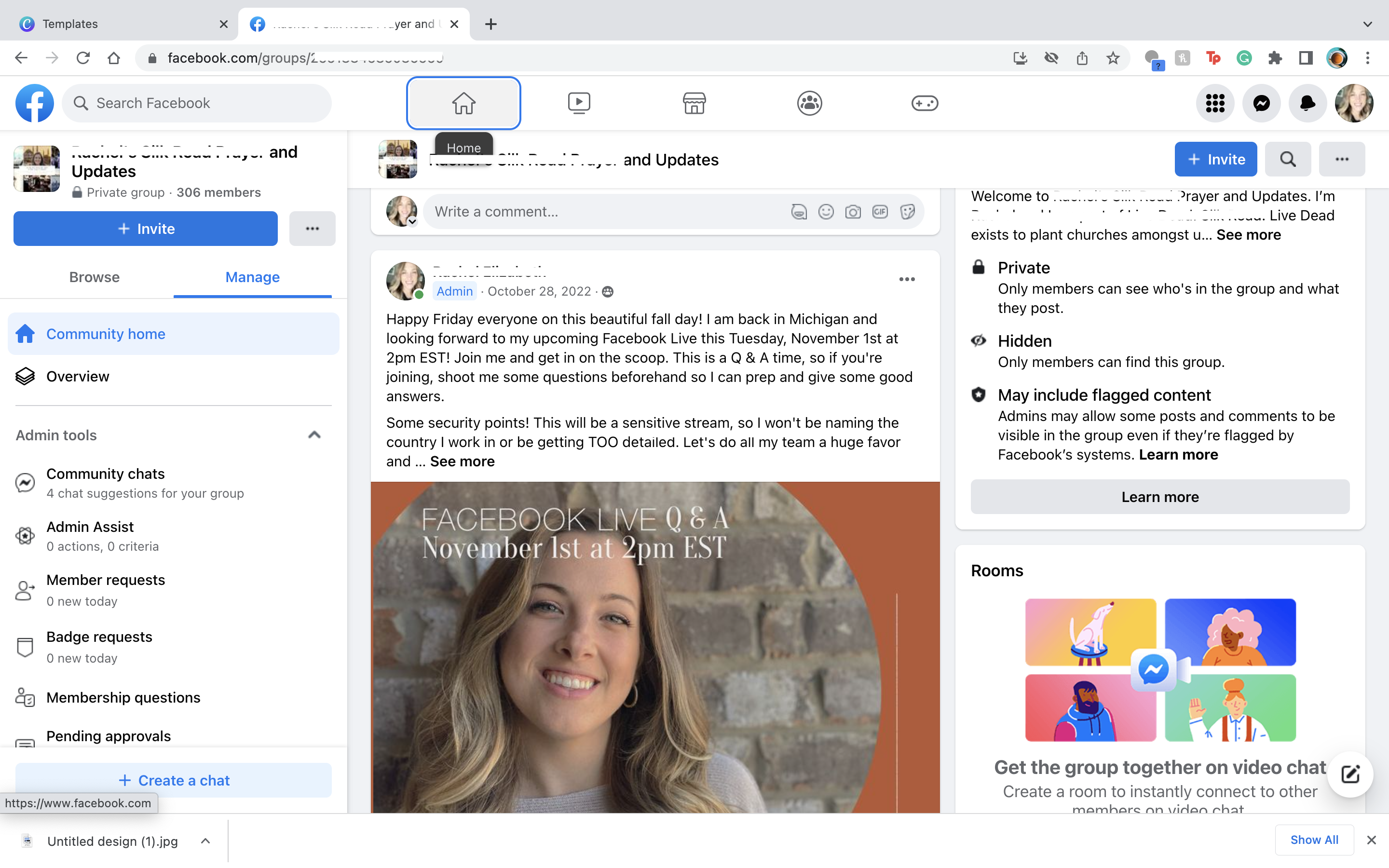
6. Try a Facebook / Social Media Campaign

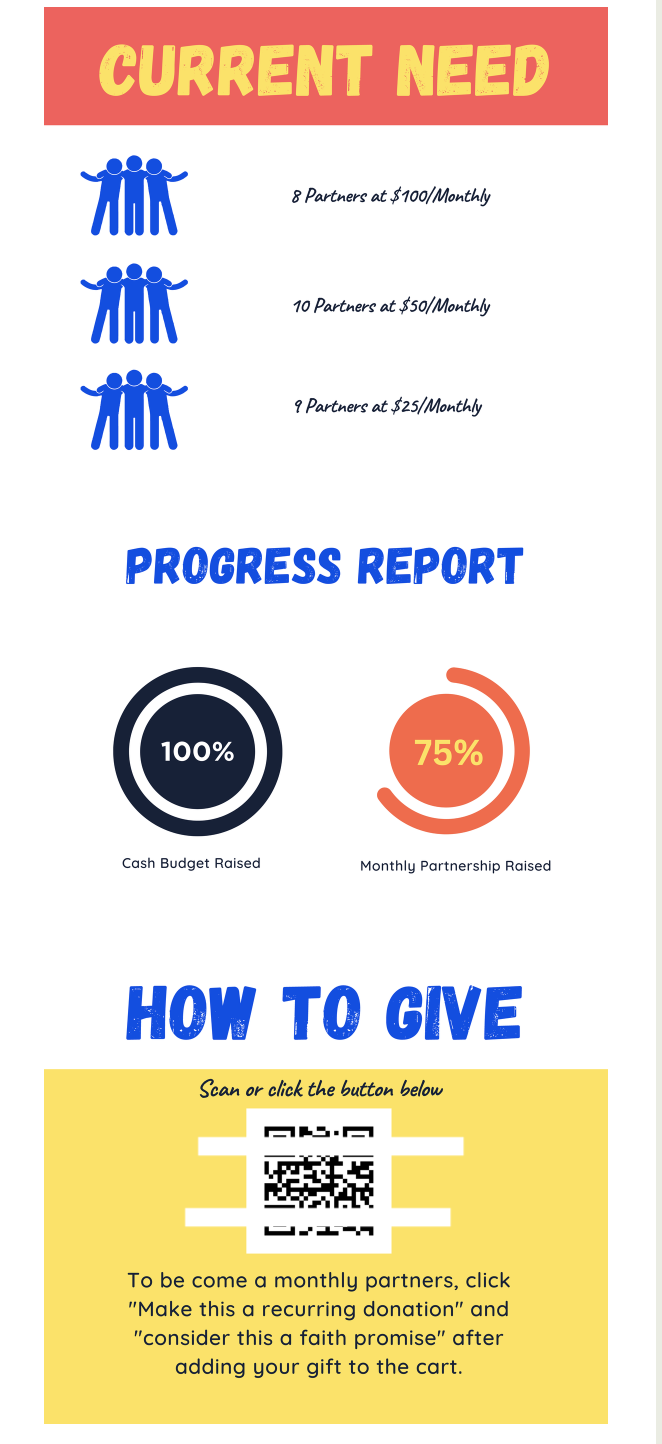
You may try in your multichannel approach to existing partners to do a social media campaign. This would include coming up with a specific goal (10 partners at $50 a month), creating a great graphic, creating posts, and getting together a team of campaigners who can post on their walls on your behalf – spreading your need farther than you could get on your own. This is a bit of an older post that explains the basics in more detail.


What’s Next? Action Steps to Try

Feeling inspired? Keep in mind, creating a concrete goal and thinking through your overall strategy before jumping in may be helpful – but here are some simple things you can do to begin!

  • Draft an email template to use when a financial partner’s giving stops—having it ready will save you time.
  • Post a heartfelt “just because” thank-you to your support team on social media or via your newsletter or text.
  • Take 10 minutes this week to pray intentionally for a segment of your supporters, then send them a message letting them know. (then, see if you can repeat that every month)
  • Schedule with your ministry team on assignment (or a roommate or anyone you know who is also on financial support!) a regular team session focused on prayer and partnership development.
  • Personally connect with your supporters in a different way than you have before—maybe even by postcard!
  • Host a Zoom webinar from the field to share updates and answer questions to your existing partnership team. Record it and share it widely (as you are able to based on security)
  • Draft an email to send to pastors and then another to send to individuals supporting you asking for an increase. Don’t forget to include in the email the ask of referrals as well!
  • Start thinking through who may help you do a social media campaign, keeping in mind your need for security!


What To Do If A Financial Partner Stops Giving

This post was originally done in 2020, and wanted to freshen it up! – JF

What happens if you are months into your assignment and you notice that the support of one of your financial partners has come to a screeching halt? Would contacting them be awkward? How would you word such a conversation? Here are some tips on how to deal when giving drops off:

  • If someone’s support drops off, try to deal with it relatively quickly. Don’t wait 4 or 5 months (or yikes…even longer) to reach out. I think waiting until the second month is okay, but I probably wouldn’t go beyond that if you can help it.
  • If someone stops their giving don’t assume that they don’t want to give any more. It could likely be a credit card expiration situation.
  • If someone’s support drops off contact that financial partner! Personally I would use email or phone call to connect, and I would stay away from less personal spaces like Facebook Messenger or text. Here’s a sample email or phone conversation:
    • Hey Paul! Hope you are doing well! Things here are going great as we continue building the school. We’ve made some huge progress within the past two months and it’s built up morale in the midst of some national unrest at times. It’s also lead to a lot of really great ministry moments recently that I’ll be sharing more in depth in my newsletter coming up next week. Excited to share more! How are you all doing ? Everything ok with you and your family? Would love to hear more. // I want to reach out because I noticed in May that your monthly support did not come in. I’m wondering if that is a credit card issue / expiration or if there are other circumstances? Let me know if you could either way. I would love to be praying if you have any specific prayer requests and thank you for the continued support in ministry, it has and does mean more than words can say. I’ll be attaching instructions to the bottom of this email if indeed it is a credit card change. Thank you Paul!” (*include giving information, instructions on credit card changes that are extremely user friendly, and your contact information)
  • If they don’t happen to answer, don’t give up, try to reach out in another way. And/or if you are emailing and don’t get a response, wait a week or so and pop in with a quick email that says something like “Hey Paul, just checking in. Did you happen to get the email I sent you on a couple of weeks ago in the beginning of June?”
  • If they answer back and let you know it’s a credit card expiration, I would respond by providing them again with the needed information to make the change. Do as much of the work as you possibly can for them, and make it AS SIMPLE AS POSSIBLE for them to complete the task.
  • If they answer that they won’t be continuing and their financial abilities have changed say something along the lines of:
    • “Hey Paul, thanks for letting me know about the situation that lead to a pause on the giving. It truly helps me. Thank you so much as well for your giving over X amount of time, words cannot say enough how grateful I am. If it’s okay I would love to touch base with you later on down the road and see if jumping back on would make sense after the challenges you are facing pass – and will be praying for you in the midst of it. I’m sure it’s a challenging time and I’m so sorry you have to walk through that (*or whatever helpful language works here based on relationship and challenge they are facing*). I’ll continue sending newsletters and thank you for your continued prayers. If you would like to not get those any longer let me know and I can take you off the list. Again, appreciate you and your family and will stay in touch.” 
    • If you send this back to them set yourself a calendar reminder to email or text them in a month or two just to simply check in and ask how they are doing. There should be no other agenda for that touch point unless they initiate it. Tell them you have been praying for them (and indeed – pray for them!) and let them know you were thinking of them.
  • Just as a reminder, stay relational with your partnership team! According to Bill Dillon’s statistics in his book People Raising, 66% of people stop giving because they don’t think that you care about them or their giving. Don’t be that worker that goes off to their assignment and forgets the team beyond you and behind you that makes it possible! If that is the case, you will likely have people drop off.

Easy Ways To Stay Connected With Your Financial Partners (THAT MEAN SO MUCH!)

Hey guys, I’ve posted this several times over the years with some tweaks ,and thought I would again. I think this is one of the most important topics in the area of support raising there is and thus — here it is again! Easy ways to stay connected with your partners while you are busy in full time ministry! – JF

Here’s a statistic that Bill Dillon, a guru in the support raising world and author of People Raising, has that I think you’ll find potent:

For every 100 people that stop supporting you:

66% of people stop giving because they think you don’t care about them

15% are unhappy with your organization

15% transfer their giving somewhere else

4% move away or die

Woah.

When I train missionaries on how to raise their support I tend to stay away from the word “fundraising” for many reasons, and when I really think about it — this statistic is at the heart of all of my reasons. Basically,  no one wants to invest in something that yields no return. If an individual gives a worker monthly support and feels as though the worker could care less about their giving, they will likely go somewhere else with their giving dollars.

And in my opinion, they should.

Ouch! Why you ask? Because the reason donors are investing in the Great Commission is because they are called to be a vital part of the Great Commission too. And if they are called to be a part of the Great Commission, why should they be made to feel as though their “vital part” is on the sidelines and forgotten?

I believe that one reason we forget to invest in the relationships we have with our financial partners is because we forget (or perhaps don’t have the paradigm) that they are as vital to the work that we are doing as we (as ministers) are. That being said, many christian workers on financial support struggle in the area of continually connecting with their financial partners even if they have a high value for their relationships with them.

It makes sense. We are all busy. Ministers are typically very busy. I totally get it.

As much as I understand, I also believe it isn’t a valid excuse. There are so many easy ways to connect across continents in our world. As such, I would like to offer up 10 suggestions on how workers on financial support can continually, quickly, and easily connect with churches and individuals who financially invest in the kingdom work they are doing.

10 Ways to Connect

1. The Quarterly Newsletter

Here’s a no-brainer: Send your newsletters. You should do a minimum of four a year, but it’s probably better to do one every other month. Keep them short and talk way more about ministry than personal things. Include pictures of active ministry (no vacation spots). Think through ways to make Newsletters interesting and stand out. Elements such as videos, video messaging, QR codes to fun things like Spotify playlists, book recommendations, or sending out in a unique way goes a long way!

2. Short Email or Letter

When you get on the field, pick 10-15 financial partners each month and email them (or DM) a QUICK and SHORT personal hello/touch base. For example:

“Hi Sally, just wanted to touch base with you and see how you have been doing. You and Chuck are on our prayer list for this month and we are wondering if you have any updates or requests? Things here are going wonderful. We just finished with our building project and couldn’t be more excited to receive students this coming fall. There will be 10! Would you pray specifically for the students with us this month as we launch? Hope you all are well and let us know how we can be in prayer for you.” – Jenn

See…how painful is that? It took me all of two minutes to write that… You may be saying, but what happens when they write back? If they do, take another minute of your day to promptly reply to those who responded to your email. If all 10 respond it will take you around 15-20 minutes to respond to everyone. Then, take the time to mention them in your prayers and follow up with that as you have time and God leads. Keep a simple notebook. Write them down. It will make all of the difference and mean so much to the people spending so much time praying for you.

Once you have gone through your 10-15 partners each month, circle back around your list. Put these on some sort of white board in your room or house to remind you, or put it into a calendar each month. Whatever you do, calendarize it in some way.

3. Postcards and Presents

Send small gifts or postcards to your financial partners. Tell them thank you for their continuing support.

imgres-1

I recently received a postcard from a friend vacationing in Costa Rica. That postcard remained on my fridge for 2 months for two reasons: (1) My friend thought of me from a far off destination and it made my day getting that postcard! (2) It was beautiful! Personally, I’m a sucker for a pretty print of any far off destination.

If you have children, enlist their help and artistic skills! Taking it a step further, what would it look like for your kids to work on some personalized paintings or drawings to give to partners?! (Bunny trail thought)

Small gifts do not have to cost much to mean a lot. Pins, stickers, Christmas ornaments, gift cards for a cup of coffee…all of it can make a huge impact.

4. Stay Active on Social Media

  • If you don’t already have one, create a Facebook page or hidden group. Stay active on it while you are on the field. Pictures, prayer updates, short videos, scripture verses, and praise reports are all fantastic. *If you are somewhere sensitive keep that in mind while posting and follow the rules of your organization.
  • Consider getting onto Instagram, Twitter, TikTok (or whatever is up and coming as you read this!) as well! This is not for everyone, and typically I say to start with one social media outlet (probably Facebook – yes, it’s still relevant somehow!) and do it well. However if you have the time and know-how try one or both of these. I love posting on Twitter and have a personal Instagram page as a creative outlet. Both have been effective in communicating with friends and helping me to network on a larger scale.

5. I’m Thinking Of You

Sometimes as I listen to audio sermons, worship sets, podcasts, or scriptures, I’ll check in with God and ask if He would like me to share any of those with my friends, family, or financial partners. If I feel prompted, I’ll send that sermon or verse to a friend on Facebook with a little message. These have to make sense and the sermons probably shouldn’t be overly convicting on major sins or anything. (Don’t imply that your friend has a problem). Use common sense of course! All that to say — just letting someone know you are thinking about them can really show you care.

6. The Church Letter or Video

Write a short letter to the churches that financially partner with you. Put a note in to the pastor to please read where he feels it appropriate to the congregation (small groups, prayer groups, Sunday school). If you don’t have time for a letter, create a quick video on your smart phone or computer and email it to the pastor. Ask the pastor to share that with his congregation or prayer group if possible.

7. Events

When you come back home, hold an event in key areas where your financial partners are. During the event provide desserts and coffee. Share stories from the field, answer any questions, tell them about your future plans, and thank them, thank them, and thank them.

These events can be as elaborate or simple as you want to make them. I would of course error on the side of taking care of your important guests by providing refreshments and some sort of dessert or snack – these also provide an incentive for your guests to come.

8. Face to Face

In addition to the church event, when you come home set up one-on-one coffee times with pastors and friends and family that have supported you. Thank them and catch up on their lives while you were gone. Be relational and intentional. Really, this shouldn’t be optional!

9. FaceTime / Zoom

Are you spending some time on FaceTime/ Zoom with your far away family and friends? Why not pick 6-12 financial partners per year to FaceTime / Zoom while on the field? This is particularly good practice with financial partners that are giving sizable amounts or with churches and small groups that are partnering financially. Give them a real-time live update on where and how you are. Take them into an actual ministry event via Zoom / FaceTime on your phone if you can. They will be floored at your thoughtfulness and most likely continue to financially partner you throughout assignments to come.

10. Text them!

There are multiple programs available that will allow you to set up video and picture messaging while on the field. If you have a urgent prayer request, why not send a group text message out to your financial and prayer partners with a picture detailing your prayer need? If you have a praise report, send a text and allow them to celebrate with you (of course, keep in mind time zone differences so that you are not texting them at 2:00am)!

In Closing

If you are a worker on financial support, I hope that these simple ideas to connect with your partnership base help you. Let’s remind our financial partners that they are important to us and to the Great Commission! Let’s keep our attrition rates up with our financial partners by spending just a little time letting them know that we care. Let’s value them! Let’s realize that they are vital part of what we do. Amen? Amen.

The 2nd Time Around: Raising Additional Support, Engaging Existing Supporters, Building Church Partnerships, and Engaging Lapsed Supporters

Several years back I did a blog post on Pre-Itineration for anyone who was about to come off of a ministry assignment into a new season of support raising. I get questions all of the time as to where to start if you have existing support and are coming into a season of raising additional support. Usually additional questions follow, such as:

  • How much time should I spend on engaging existing supporters and asking for increases?
  • How much time reaching out to pastors and churches is appropriate?
  • How should I reach out to pastors and churches?
  • What do I say to those who have supported me when I come home? What’s the best way to communicate with them?
  • What should my newsletter reflect?
  • Where do I start again?!?!

To expound on the old blog post, I wanted to create something particularly helpful for a worker who has raised a full budget and is coming home from being overseas to raise additional support. However, this post isn’t only for the overseas worker, and there of course can be multiple reasons for raising more support. Whatever the case it is for you, I think you will find this blog post helpful to think through your strategy or at least for tucking away for when it’s you find yourself in this situation.

To communicate some ideas on the subject, I chatted with two AMAZING overseas workers (thank you so much to both of you!!!) who have recently come back to the States to raise additional support. First, we will start with my friend Emily* (yup — named changed for security). She has lived overseas on assignment for multiple years and recently came back to raise support as a career worker. When she came back to the States she knew she had an increased budget and that she would like to return to country as soon as possible. I asked Emily some questions about her overall strategy such as where did she begin and what did she specifically do? Keep in mind, within our organization Emily is allowed and encouraged to ask a lot of churches in our denomination, and her answers reflect that ability. Below are her responses.

Question 1: Emily, where did you start with your support raising as you made the transition from first term to second?

“I will give you the whole timeline! Just a note, A and B are where I started with the initial announcement to my supporters of what was next as far as my assignment goes, but it was really what I did later on the bore the most fruit. 

A: About six months before the end of my ministry term, I started by reaching out to my District Director (our denomination gathering of sectional / local churches) to let him know I was returning to the States soon. I did this specifically to ask him if I could begin getting on calendars of churches before my official approval as a worker going from associate to fully appointed. Every district is different, and he gave me the green light to start calling those I had relationship with to get on their calendars for services and to inform them of my transition. 

B. I sent out two emails initially. One to churches partnering with me and another to individuals currently partnering with me. I informed them of my next steps without getting too detailed about things that would confuse them–and focused on the fact that my budget was increasing. I thanked them for their faithful partnership. I asked them to consider increasing or even doubling their partnership. (Some fruit came from this -those who wanted to increase, did).

C. THIS was super fruitful: I posted a social request asking people to connect me with their pastors. I had a lot of response from this! I made sure to cast vision that they were multiplying my effectiveness by getting me into their churches. (I have attached this post)

D. I did several Facebook Lives leading up to Giving Tuesday. What was effective from this, was that is seemed to make people want me to speak at their church. I didn’t get a lot of gifts but got a lot of invitations which then led to pledges.

E. Sent Pastor Packet > Follow up call > Follow up email> Repeat. This can seem so extremely monotonous and time consuming…BUT

  • I sent out packets with a case document, prayer card, and a handwritten note. I included in the correspondence that I would be calling them soon.
  • I diligently called through my district twice.
  • I emailed every pastor I could find an email address for directly following the phone call/message. 

That three point of communication was a winner for me. I had conversations with many people, not on the initial phone call (leaving the message is what is valuable there if they don’t pick up, so you can even do this on weekends), but usually on follow-up. On each mode of communication, I mentioned the others (I’ll be following up next week with a call … ) to let them know I was planning on a conversation and not just sending them information. 

F. OK, the magic here for this last one was connecting with pastors at District Council towards the end of my itineration journey getting my final percentages. I walked into general council at 85%. I emailed our District Director to ask him if they could highlight me on stage and finish me up (you never know unless you ask!) and he gave me a two-minute window that got me in front of everyone I had been having conversations with. This led to the final commitments I needed and many conversations. I believe District Council (again, our denomination gathering of sectional / local churches), if done well and preferably later in your itineration journey, can be very effective. THIS was when I looked back at all my calls, emails and mail-outs and really saw that they had been fruitful and worth the time because everyone in that room knew who I was from previous communication–even if I hadn’t heard from them. 

Question 2: Emily, what did you focus your time on and how?

I spent the majority of my time making phone calls, emailing, and keeping up records (an ongoing spreadsheet of communication), and this will come as a surprise, but also writing thank-you cards, even when people said no.  Those phone calls, emails, records and thank-you cards took the most time. However, it was also the most fruitful times as those phone calls and email led to appointments and services, which led to partnership. 

A phone call tip: If you have a reference, use it! Ask your District Director if you can use their name. Something I routinely started with was “Pastor ____ told me to reach out to you as I itinerate”. It may sound pushy but it just lets them know that someone they respect is pulling for you and they should too. 

Below are some screen shots of posts and copy I have referenced! – Emily

I also made this and used it recently in an email. I modeled it after an update another worker couple I admire recently did.

Okay, that’s Emily’s wonderful strategy! The second worker couple I’d like to highlight are the Smiths. They are currently raising support for a longer assignment as career workers and have developed some excellent materials to give to pastors and individuals I’d like to highlight.

First, I’d like to highlight the Smith’s pastor packets. The Smiths are emailing these to pastors whom they have not met with a handwritten note that says they would love to connect with them and will be calling within the week. Notice the packet information is several pages long as opposed to a shorter Case Document. (Case Documents are also super effective – but a longer version could be helpful in some circumstances like this!) Here’s a few snapshots of the packets.

The Smiths are taking this same packet and tailoring it for individuals (which by the way is such a cool idea!). They have made changes to the packet that include the levels of giving chart below (instead of full budget details that are given in the pastor / church packet). They have also changed the individual packet to include individual friendly language and change the size to be a mini packet.

Included with the mini packet is a handwritten card. (see below)

I hope these ideas help as you begin to craft your strategy for entering into a new season of support raising! For other ideas on how to get started: check out this post I mentioned in the beginning. Have any great ideas that have worked for you? Share them in the comments!

Newsletters

There are so many great blog posts out there on newsletters. A couple of my favorite posts are actually found on the same blog, Support Raising Solutions. One post is by Phil Sineath from 2020 that takes care to emphasize important layout and design notes as well as language and content to include (you should check it out!), and another goodie waaaay back in 2006 from Steve Shadrach that shares what good newsletters and bad newsletters look like. I also love this one from Scott Morton on Two Things Your Giving Partners Want to Know. I’ve also talked about newsletters here on the blog, but it’s been a minute, so I’d like to share a post dedicated to the mammoth standard of Christian worker support raising communication.

First, I’d like to briefly share some things I believe are important NOT to do in a newsletter.

What Not to Do Newsletters:

  1. Do not write super long paragraphs / pages about what you are learning. It sounds harsh…but short ones = AWESOME. Long ones = NO DICE. And always share what GOD is doing.
  2. Do not forget your contact information, giving link / giving information, QR code (if you have one) — or any needed additional information. Make sure your contact information is up to date, and also is what you will be using if you are going abroad. Lastly, make sure your contact information is also easy to read (as in not teeny tiny font or in colors hard to read or notice). ***Bonus — QR codes including your Linktree or other online places to share additional information are a nice touch and easy for the reader to use. ***Bonus Bonus — always use your branding and/or your organizations branding.
  3. Do not add everyone to your newsletter list before asking them personally to be a part of your team. If you do that, the buy in / engagement will likely be low and you may end up with general feelings of non-relationship from your potential partners. Wait until you’ve asked them to be a part of your team, or they have heard from you at a church service and signed up personally for your newsletter (see connect cards).
  4. Do not use vacation-like photos, keep photos as ministry active as possible.
  5. Do not make it boring. Consider doing something different (but still accessible) for your newsletter. Video newsletters are awesome (if you do one, don’t make it long). If you go for a video newsletter: (1) know what you are going to say in advance, (2) pick an interesting background that represents what you are doing, (3) don’t make the background of your video a noisy street where hearing the audio is going to be a challenge.
  6. Do not stick to newsletters as your only form of communication. In this day and age where we have easy global access, merely emailing your team once a quarter with a generalized email newsletter is not going to cut it as your only form of communication. Get beyond the newsletter. I love this quote and I believe it’s so true: “Relational connection is now a STANDARD measurable of worker effectiveness.” – Randy Jumper of First NLR. That being said, here are 10 easy things you can do to stay in touch and show you care in micro ways.
  7. Do not share every budget detail number. I’d stick to percentages.
  8. Do not make your newsletter an attachment in an email. NOPE. Use programs like Mailchimp or Constant Contact (just give it a google if you are looking for more options – there are a lot) to make the newsletter more accessible as well as personalized (“Thank you Jenn” vs “Thank you support team”)
  9. Do not assume your newsletter won’t go into their spam folder. Check with your supporters to make sure they are getting your newsletter, or when you are signing them up for it send them a text and tell them to be on the lookout for it and check their spam folder. Perhaps post in your hidden Facebook group or other communication that you have recently sent one out – and to let you know if they did not receive it.
  10. Do not write a boring subject line. “Summer Newsletter” is not as effective as “Hey Jenn, how’s your summer going so far?” (yes, you can customize subject lines in many newsletter programs)

Second, a couple of notes on newsletters I think are important to highlight:

Newsletter Tips

  1. Use your newsletter to communicate your passion for your ministry, not as a woe-as-me-fest. Stay positive, not negative. Every newsletter should convey what God is doing and has done.
  2. Say thank you a lot and often. Thank your team for being a part of what God is doing. Remind them how thankful you are for them.
  3. Stay consistent. If you say your going to do a newsletter every other month – stick to it. Newsletters truly don’t have to be long to be effective.
  4. Do short e-blast newsletters from time to time (beyond your usual newsletter cycle). I love to hear successes from workers just because. Maybe a building finally got built and you share a thank you and a picture, or a person whom you care about and have been walking with came to Christ. Or maybe you reached 75% raised and you’re pumped — so share it briefly with your team. Quick videos of thanks and praise reports are generally a good idea.
  5. In your newsletter – use “we” language instead of “I” language. Your team is alongside of you and you are doing this work TOGETHER. You could not be doing it without them, and you are in many ways representing the churches and individuals that support the work – by being the boots on the ground they are not / can’t be / don’t know they should be yet – so cut out any “I” language and replace it with inclusive “we” language.

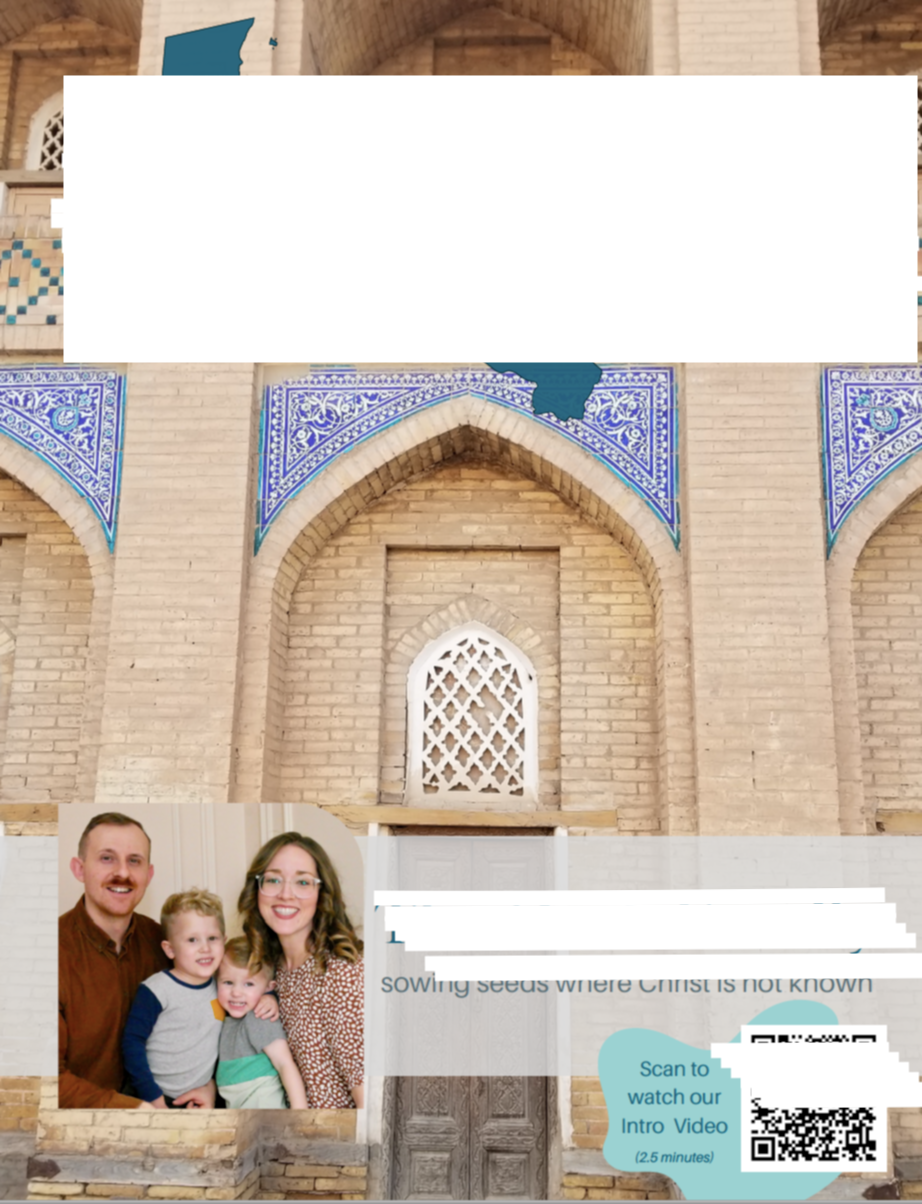
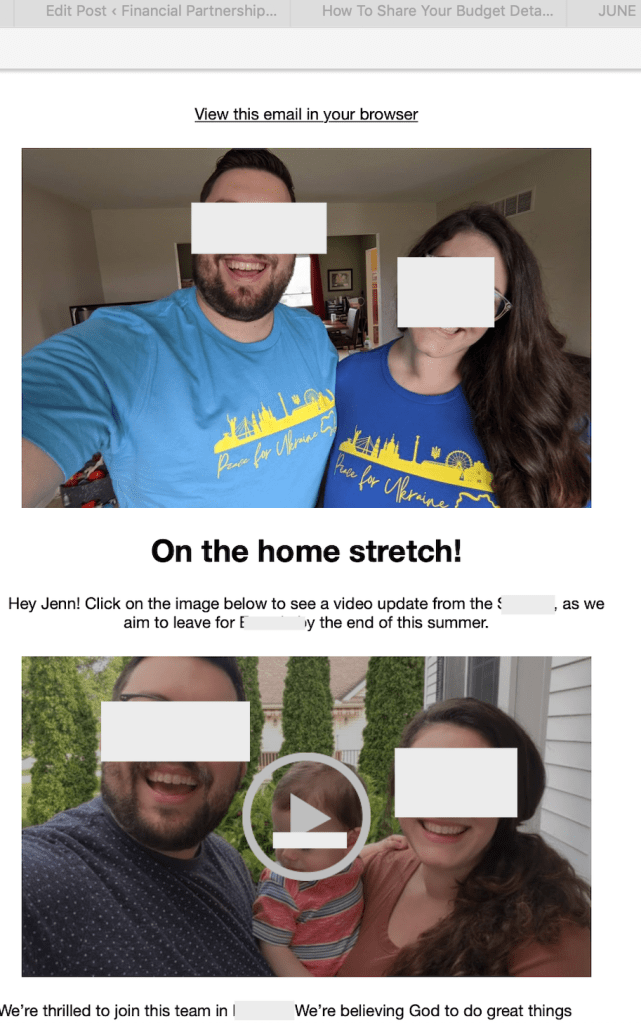
Lastly, below is an example of a good, but regular newsletter (in that it’s not overly fancy or hard to accomplish) that I recently got and thought I would share. *names and faces are blocked out for sensitivity. It’s also a bit chopped up but you get the idea) Here are a few things that I like about it:

  1. The video! We can’t see the actual here on the blog, so to sum up the content of it: it gives many more details on their ministry but does so quickly – it clocks in at 2:42. In the video the couple shares about one specific ministry win that recently happened. They also share that things are going well in their support raising season.They also announce in the video (while holding their adorable child!) that they will soon be doing a Facebook Campaign coming up to get them from 75% to 100% raised.
  2. They share with joy and passion!
  3. It’s a great example of a newsletter while support raising – It isn’t needy, communicates enthusiasm, is informative, and thanks the team.
  4. They mix up sharing with the video and some brief reading – which is such a nice way to engage with a newsletter.

This list of tips and do not’s is not comprehensive – just some of the things I believe are important to nail. I hope these thoughts on newsletters are helpful! Share your thoughts or tips in the comments! – JF

So You’re Doing Another Round of Support Raising? 9 Things To Get Started Early

This post was written originally in August 2018. But it was definitely worth a repost as a helpful little list of 9 things to do when entering back into a season of raising support. So if you are a worker who is reentering a season of raising support – this is for you! I hope you find it helpful! – JF

Recently, I attended a conference where I met with numerous workers who have lived off of support for a long time. Some of them had been in their assignments for over 15 years! Most of the workers I connected with are coming back home to enter into itineration and wanted some advice on how to best navigate a new successful season of support raising.

I found in my conversations that I was encouraging these workers to do several strategic things before they came back home, and I thought it would be helpful to share those ideas here. So, if you are already in your assignment and are gearing up for another season of raising up your team – this is for you! If you haven’t raised your support and haven’t made it to your assignment, tuck this post away for the future you! I hope these give you great ideas of where to start before you land back home. – JF

pre-itineration_31724110 (6)

I hope this gave you some helpful ideas! Below are some links with further information.

Here’s a link for more information on Connect Cards

Here’s a link for more information on Appointment Kits and Pastor Packets

Here’s a link for more information on Fundraising and Non-Fundraising Events

TEXT SAMPLES FOR FACE TO FACE APPOINTMENTS

TEXTING STILL ISN’T THE BEST WAY TO ASK FOR AN APPOINTMENT…BUT

I’m writing this post for a specific person. It may not be you, and that’s a-okay. This document is not for you if you are having success asking for face to face appointments via phone. I will always maintain that asking for an appointment via phone is far greater than asking via text message as it promotes relationship, and any time the word “finances” is read in a text it comes across like a billboard, generally drawing people away from responding. I stand by that thought and still agree with it. (read the link for more info!) Thus, if you are calling on the phone – pat yourself on the back and let me give you a high five from the internet. You don’t necessarily need to read any further. 

This post is for you if you are the person who is probably going to go ahead and text asking for an appointment anyway, even though your support raising coach and training has said it is 100% best to phone call and ask for face to face appointments. It is for you too if you are texting someone as a one off and don’t want to botch it, which I completely get.

That being said, I want to be clear that this post is not to condone texting for an appointment as the normal go-to, but knowing it will happen, at least if you text first you have examples of how to best word it. Okay! All that being said, let’s get into some samples. Well, in a minute.

WARNING LABEL TO THE SAMPLE TEXTS FIRST

  1. First off, an important distinction to be made here – THESE ARE TEXT MESSAGES…NOT social media direct messages (DMs). Yes, there is a difference and yes, it does matter
  1. DMs are never going to be as warm as a text message and 1,000% less warm than a phone call. (Pause here and think back to any times you have had people solicit you on FB Messenger en mass for donations. If you have ever had that done to you, you know it’s definitely not relational.)  If you don’t have someone’s phone number, DM and ask them for their contact info, but don’t DM any of these samples below.

***Here’s a sample asking for number and contact information on DM: 

“Hi Christy! Hey, how is Adam doing?? Heard he had a tough fall and have been keeping him in my prayers. I hope he is on the mend. Wanted to ask — could I get your contact info? Phone number, Email address, and mailing address? Zach and I are about to embark on a ministry journey and grabbing contact information. Thanks Christy.” 

  1. Don’t give too much information when sending a text message asking for a face to face appointment. Try to be as brief as possible while still giving needed information. Remember, you are asking for a face to face appointment (or in times of Coronavirus a Zoom appointment), not for them to join your team. You do not want to make an ask in written form or have your face to face meeting over text. Save the details for the appointment. It’s easy to make this mistake and not realize you are doing it, and then all of the sudden you are asking someone for financial partnership in a text. OOOPS. (that’s not a good thing) 
  1. It’s important to realize that there is a hierarchy of relationship when it comes to asking for appointments. Doing so over the phone or even in person is much warmer and relational than in a text. If you’re struggling with how to ask for an appointment – move down this list and start as high as you can! 
    • Hierarchy of warmth and relationship in asking for Face to Face Appointments:
      1. In person
      2. Phone call / Phone call + invitation letter first == these options are always best! 
      3. Invitation letter + Text message
      4. Text message
      5. Email
      6. DM

TEXT SAMPLES

TEXT SAMPLE 1:

“Hey Pete! Do you have time for a quick 2-3 minute phone call?”

(**Always my preferred option for a text message. Use the text to lead to the phone call. If they don’t answer you in a text, you still have the ability to call them later that evening or even the next day – just don’t wait too long. You can also try texting again.) 

TEXT SAMPLE 2: (*No invitation letter prior)

“Hey Taylor. Beau turned 1 years old?!?! WWHUUTT? The nerve of babies to grow. UGH. And how does time fly? Please answer life’s mysteries for me Taylor. I believe in you. 🙃

I don’t know if you’ve heard, but Zach and I are heading to Estonia to be workers with Assemblies of God World Missions. We are pumped. If you have no idea what I’m talking about: HA! 🤗 I would like to fill you in!! 

I’m reaching out because you recently came to mind. We are working on building up our financial and prayer partnership team and have to get to 100% before we can go to Estonia. I know you have been a major influence in my life and would love to connect about joining some aspect of our partnership team. 

Could we A. Zoom this week or next? (I’ll order us some Panera treats or Grub Hub while we meet if it works!) B. Grab coffee outside this week or next? C. Masks and coffee inside this week? 

Let me know what you think one way or another. Importantly, I want you to know that there’s no pressure. Except for you to solve life’s mysteries Tay. That I EXPECT. Love you, your friendship, and that darling 1 YEAR OLD. 

TEXT SAMPLE 3:  (*Invitation letter prior)

“Hi Rosie! I have been praying for you & Fred as you are recovering. My mom said you texted yesterday that you guys are on the mend- praise the Lord!💓 When you are feeling better, Zach and I would love to safely meet and share with you guys about our burden for Estonia, as well as invite you to partner with us, whether that be through prayer or finances. We are here until January 4th, so you just let me know when would be best. Much love to you guys!!❤️❤️”

TEXT SAMPLE 4: (*Invitation letter prior)

“Hey Ron and Kathie. This is Jenn Fortner. How are you all? Been thinking of you and of course Dustin recovering from COVID. I’ve been saying prayers since last time we spoke — How has he been since recovery? 

Would you be able to schedule a time to safely meet this week or next? Let me know if you are available and what works best for you, we are pretty flexible. We would love to connect, hear about how you all are doing, and share a bit more about what we are doing in ministry and see if it fits for you to join some aspect of our partnership team. 

Thanks guys. Most important note: Just want you to know we love you, your friendship, and praying that Dustin is well.”

NOTES

*some of these samples are written during COVID, so take “safely meet” etc out of equation once things go back to normal.

**One of these sample texts mentions “no pressure”. I left this phrase in because that can be helpful in some circumstances. I personally wouldn’t over-use anything that completely gets them out of considering financial support as an important option. I hear phrases from workers all the time like “prayer is more important” or saying during an appointment “consider support and pray about it” or “if you don’t want to it’s no big deal” — which are misleading statements and not always helpful. True, prayer is important but the best prayer partner is typically the one who is giving (Matthew 6:21). True you want someone to consider partnering but don’t throw that phrase into an appointment when now is the time to make the big ask, and they have been prompted to consider prior to your appointment. And finally, plainly said it’s not true that if they don’t want to support it’s not a big deal — even though we should hold yeses and no’s loosely in our hearts — it is a big deal if they join your team! Think through these phrases giving people outs carefully, and don’t overuse them. 


I hope this post and samples are helpful! – JF

Ghosting! When It’s Time to Make The Final Contact

Ghosting! It’s October so let’s talk about it now for obvious reasons.

You all know the scenario, chances are you’ve been there…

You reach out to a friend via phone and try to set up an appointment. No answer. You text them and ask if they have time for a quick phone call. Nope, nothing. Then you call again and leave a voicemail. Crickets. Then the process gets a little weird because you call again a couple of days later and still: NADA. Maybe you send another text several weeks after beginning the process, but you don’t know what to say. So you send something but don’t love it, bite your nails and then…na that wasn’t them that texted back…it was just MORE CRICKETS. And you’re wondering…did I just damage a relationship? What if I see them at Target? Do they shop at that one? Maybe I’ll drive to the one on the other side of town that’s farther away from their house. AWKWARD.

So what do we do with this whole ghosting MONSTER lurking under the bed? How do we appropriately handle the FEAR that rejection is happening before our eyes? I’ve got some ideas to combat the SCARY scenarios. Don’t SCREAM, let’s dive in (and okay, I’ll stop using the puns). There are 3 main things to keep in mind when you think you are being ghosted – let’s talk about them.

1. Don’t Jump to Conclusions

When you feel you are being ghosted don’t jump to conclusions. People are busy with their own lives, and your top priority is almost always NOT their top priority. They’ve got their own world swirling around them, so recognize that we have to meet people where they are at and contacting you back may not be at the top of their list. Don’t jump to the conclusion that if they aren’t Johny-On-The-Spot with getting back to you it doesn’t mean they aren’t interested. It could mean a variety of things such as one or some of the following:

  • they are bad with returning phone calls / messages / insert media you used
  • they are busy
  • it’s a hard week
  • it’s a hard year. ahem… it is 2020.
  • they are out of town / country
  • they intend to but just haven’t gotten there yet
  • they are distracted
  • their phone broke?
  • they have a new number
  • they are potty training their toddler and are laser focused unto getting rid of cloth diapers for ever and ever amen (wait… just me?!)

Thus before making the conclusion you are being ghosted, here are ask some important questions of yourself. If you answer “no” to any of these things – then try that thing before jumping to conclusions:

  • Am I using the right contact method to reach them? Have I tried multiple ways to get in touch?
  • Are they actually receiving my phone call / message?
  • Have I tried enough times over a period of time, and given them long enough to respond?
  • Have they already expressed interest in giving but have had trouble responding recently?

2. The Final Contact

If you have have sufficiently tried to reach out to someone but are getting no response (see list above) then you may consider making The Final Contact. The Final Contact essentially is communication that attempts to honor the relationship when someone isn’t responding, and lets that person know you will not be contacting them again about support. Now, that being said I have some pretty strong thoughts about The Final Contact and how it works / doesn’t work that I need to share before proceeding further:

  1. Consider all of the questions above carefully before doing The Final Contact.
  2. You should NOT be doing The Final Contact if you’ve only tried calling a person twice or even 3 times. It should be after you’ve made several attempts, tried several communication methods, and given them time to respond. Many people make the mistake of believing someone’s silence is rejection and give up too quickly due to fear. Be confident, and remember you don’t have to apologize for inviting someone to be a part of the Great Commission.
  3. If a Final Contact is given too early you run the risk of offending cherished relationships.
  4. If you move to the Final Contact too early you also run the risk of no support from them.
  5. It’s likely that after you make The Final Contact, you will hear from the person who has ghosted you. It happens often.
  6. In wording your Final Contact, keep the door open a smidge that you may have a future assignment / time you raise support, and perhaps you will reach out again in the future (see example below – this doesn’t need to be emphasized, just accommodated for).
  7. You don’t make The Final Contact if someone has answered your calls and methods of communication, only if they don’t (unless it’s a nuanced situation). Don’t make The Final Contact you’re out for any circumstance that gets awkward that you don’t want to follow up on. No no.


So HUGE WARNING HERE: Don’t do it too early. However, well timed Final Contacts can help in putting the relationship in good standing. So what does a good Final Contact look like? This example of a Final Contact is written by my friend Grant Hoel who is a support raising coach and in full time ministry with Chi Alpha.

Hi [Name], I hope everything is going well for you. I’ve been trying to get in touch with you recently to share about my upcoming ministry assignment to [City or Country] but I have been having trouble. It is possible that this is not the best method of communication for you or that you’ve been extremely busy and unable to get back to me. Or maybe you’re just not interested, and that’s okay. In any case, I wanted to let you know that this will be my last attempt to reach you in regards to this assignment. Also know that I really value your friendship and would love to catch up or hear how I can be praying for you at any time. If you are interested in talking about the ministry and how you could be involved, feel free to give me a call: (555) 555-5555. Either way, I look forward to catching up the next time I see you. Have a great week and God Bless.

Some thoughts straight from Grant on what a well-crafted Final Contact does:

  1. It provides the person the most charitable excuse for not returning your call.
    • “I know you’re probably super busy…”
    • “I understand that now may not be the best time for you…”
    • “You may not be able to give right now…” “And that’s OK!”
  2. Let’s them know that you will not be contacting them regarding support/financial partnership for this assignment.  You won’t bring it up unless they initiate it.
    • “So I just want to let you know that I won’t be contacting you again about this unless you bring it up.  If I’m wrong and you just haven’t been able to get back to me, just give me a call and we’ll pick up the conversation from there.”
  3. Affirms your relationship with them. 
    • “I just want you to know that I absolutely appreciate your friendship…” 
    • “Let me know if there is anything I can do for you or any way to pray for you…”
    • “I look forward to the next time we get to see each other…”

3. Don’t be Timid: Its The Great Commission (See Rejection post)

I get it, it can be SCARY to reach out to friends and family for support, and when that friend ghosts you in the process, it doesn’t feel good. But I think alongside having the Final Contact in our pocket, remembering that we are all called to the Great Commission as either goers or senders is one of the most important things to remember in the midst of asking for finances. Asking someone for financial support is okay and it’s even biblical. (If you doubt that to be true, here are some verses to check out) Also, what you are doing is downright cool and inspiring. Seriously. You don’t have to be ashamed about telling people about Jesus and you certainly aren’t the only one since the days of Moses who raised finances to do it.  You can be bold. You can be confident (and it actually helps). You don’t have to apologize for following God’s path, and you actually get to be an inspiration for those you connect with to follow their own paths with God! He’s actually the one that set it up for the christian worker to live off of support. If someone doesn’t join maybe someone else is supposed to. I can be as simple as that, if you let it be.

It’s hard to know what to do when a person isn’t responding to you, I hope some of these thoughts help in the process. Below is a song to help inspire you. As Grant put it to me when explaining his process on The Final Contact “Now may you confidently and effectively raise the funds you need to do the work in which God has called you. May you have even deeper and more meaningful relationships as a result of your support raising efforts.” – JF

10 Ways To Connect With Your Financial Partners (Without Taking Too Much Time)

Hey guys, I posted this 2 years ago and 5 years before that (with some changes of course), but I think this is one of the most important topics in the area of support raising there is and thus — here it is again! Easy ways to stay connected with your partners while you are busy in full time ministry! – JF

Here’s a statistic that Bill Dillon, a guru in the support raising world and author of People Raising, has that I think you’ll find potent:

For every 100 people that stop supporting you:

66% of people stop giving because they think you don’t care about them

15% are unhappy with your organization

15% transfer their giving somewhere else

4% move away or die

Woah.

When I train missionaries on how to raise their support I tend to stay away from the word “fundraising” for many reasons, and when I really think about it — this statistic is at the heart of all of my reasons. Basically,  No one wants to invest in something that yields no return. If an individual gives a worker monthly support and feels as though the worker could care less about their giving, they will likely go somewhere else with their giving dollars.

And in my opinion, they should.

Ouch! Why you ask? Because the reason donors are investing in the Great Commission is because they are called to be a vital part of the Great Commission too. And if they are called to be a part of the Great Commission, why should they be made to feel as though their “vital part” is on the sidelines and forgotten?

I believe that one reason we forget to invest in the relationships we have with our financial partners is because we forget (or perhaps don’t have the paradigm) that they are as vital to the work that we are doing as we (as ministers) are. That being said, many christian workers on financial support struggle in the area of continually connecting with their financial partners even if they have a high value for their relationships with them.

It makes sense. We are all busy. Ministers are typically very busy. I totally get it.

As much as I understand, I also believe it isn’t a valid excuse. There are so many easy ways to connect across continents in our world. As such, I would like to offer up 10 suggestions on how workers on financial support can continually, quickly, and easily connect with churches and individuals who financially invest in the kingdom work they are doing.

10 Ways to Connect

1. The Quarterly Newsletter

Here’s a no-brainer: Send your newsletters. You should do a minimum of four a year, but it’s probably better to do one every other month. Keep them short and talk way more about ministry than personal things. Include pictures of active ministry (no vacation spots). Here’s a great link from the Support Raising Solutions blog on creating great Newsletters.

2. Short Email or Letter

When you get on the field, pick 10-15 financial partners each month and email them a QUICK and SHORT personal hello/touch base. For example:

“Hi Sally, just wanted to touch base with you and see how you have been doing. You and Chuck are on our prayer list for this month and we are wondering if you have any updates or requests? Things here are going wonderful. We just finished with our building project and couldn’t be more excited to receive students this coming fall. There will be 10! We will definitely be busy with it but we are pumped! I am also really looking forward to getting back into teaching. Anyhow, hope you all are well and let us know how we can be in prayer for you.” – Jenn

See…how painful is that? It took me all of two minutes to write that… You may be saying, but what happens when they write back? If they do, take another minute of your day to promptly reply to those who responded to your email. If all 10 respond it will take you around 15-20 minutes to respond to everyone. Then, take the time to mention them in your prayers and follow up with that as you have time and God leads. Keep a simple notebook. Write them down. It will make all of the difference and mean so much to the people spending so much time praying for you.

Once you have gone through your 10-15 partners each month, circle back around your list. Put these on some sort of white board in your room or house to remind you, or put it into a calendar each month. Whatever you do, calendarize it in some way.

3. Postcards and Presents

Send small gifts or postcards to your financial partners. Tell them thank you for their continuing support.

imgres-1

I recently received a postcard from a friend vacationing in Costa Rica. That postcard remained on my fridge for 2 months for two reasons: (1) My friend thought of me from a far off destination and it made my day getting that postcard! (2) It was beautiful! Personally, I’m a sucker for a pretty print of any far off destination.

Small gifts do not have to cost much to mean a lot.

4. Stay Active on Social Media

  • If you don’t already have one, create a Facebook page. Create a secret group if you are going to a sensitive country. Stay active on it while you are on the field. Pictures, prayer updates, short videos, scripture verses, and praise reports are all fantastic. *If you are somewhere sensitive keep that in mind while posting and follow the rules of your organization.
  • Consider getting onto Instagram, Twitter, or TikTok as well! This is not for everyone, and typically I say to start with one social media outlet (probably Facebook) and do it well. However if you have the time and know-how try one or both of these. I love posting on Twitter and have a personal Instagram page as a creative outlet. Both have been effective in communicating with friends and helping me to network on a larger scale.
  • Another great thing to think about doing in your secret Facebook groups or if you have a ministry page is a Facebook Live. If you choose tdownloado do one before hand promote the time your event will be taking place, and take care to choose a time that works well for your financial partners. When you do a Facebook Live event, make it a guided Q&A and consider doing your Facebook Live in an interesting place. That Facebook Live will record as a video so anyone not able to make the time can view later!

  • Facebook message your financial partners or like their posts. Stay active on your personal page.

5. I’m Thinking Of You

Sometimes as I listen to audio sermons, worship sets, podcasts, or scriptures, I’ll check in with God and ask if He would like me to share any of those with my friends, family, or financial partners. If I feel prompted, I’ll send that sermon or verse to a friend on Facebook with a little message. These have to make sense and the sermons probably shouldn’t be overly convicting on major sins or anything. (Don’t imply that your friend has a problem). Use common sense. ie. Don’t send a message on tithing to a partner who hasn’t recently been giving.

6. The Church Letter or Video

Write a short letter to the churches that financially partner with you. Put a note in to the pastor to please read where he feels it appropriate to the congregation (small groups, prayer groups, Sunday school). Make-your-own-Video-1080x675If you don’t have time for a letter, create a quick video on your smart phone or computer and email it to the pastor. Ask the pastor to share that with his congregation or prayer group if possible.


7. Events

When you come back home, hold an event in key areas where your financial partners are. During the event provide desserts and coffee. Share stories from the field, answer any questions, tell them about your future plans, and thank them, thank them, and thank them.

These events can be as elaborate or simple as you want to make them. I would of course error on the side of taking care of your important guests by providing refreshments and some sort of dessert or snack – these also provide an incentive for your guests to come.

Create connect cards for those interested in giving for the first time.

8. Face to Face

In addition to the church event, when you come home set up one-on-one coffee times with pastors and friends and family that have supported you. Thank them and catch up on their lives while you were gone. Be relational and intentional. Really, this shouldn’t be optional!

9. FaceTime / Skype Meetings

Are you spending some time on FaceTime or Skype with your far away family and friends? Why not pick 6-12 financial partners per year to Skype or FaceTime while on the field? This is particularly good practice with financial partners that are giving sizable amounts or with churches and small groups that are partnering financially. Give them a real-time live update on where and how you are. Take them into an actual ministry event via Skype or FaceTime on your phone if you can. They will be floored at your thoughtfulness and most likely continue to financially partner you throughout assignments to come.

10. Text them!

download

There are multiple programs available that will allow you to set up video and picture messaging while on the field. If you have a urgent prayer request, why not send a group text message out to your financial and prayer partners with a picture detailing your prayer need? If you have a praise report, send a text and allow them to celebrate with you (of course, keep in mind time zone differences so that you are not texting them at 2:00am)!

In Closing

If you are a worker on financial support, I hope that these simple ideas to connect with your partnership base help you. Let’s remind our financial partners that they are important to us and to the Great Commission! Let’s keep our attrition rates up with our financial partners by spending just a little time letting them know that we care. Let’s value them! Let’s realize that they are vital part of what we do. Amen? Amen.

6 Support Raising Goals for 2019

Here are some goals to consider in making 2019 a fabulous ministry partnership development year:

GOAL #1: BE GREAT AT KEEPING UP WITH YOUR EXISTING FINANCIAL AND PRAYER PARTNERS. 

Start the year off right with a commitment to regular, quality communication with your existing support team.  Here are some tips on how to beef up your communication efforts this year:

  1. Spend some time organizing your social media, including any Facebook groups you’ve created for your partners. Develop an ongoing plan for regular posting this year. If your stuck for ideas, look at what other workers are doing who seem to have healthy support and social media a strong social media presence.
  2. This year, do more than just send a quarterly newsletter to your team. Move your communication beyond that, and find various ways to reach your team personally. Of course, keep doing the newsletter, but also think of ways to communicate individually with your support team members such as sending individual postcards, saying hi on Facebook Messenger, sending a text, sending a video, Skyping, etc. Statistically speaking, the majority of people who stop giving do so because they don’t think the person they are giving to cares about them. Remember, without your financial and prayer team you WOULD NOT be ministering to your particular population. Make them feel valued and it will make all of the difference to them, and ultimately to you. Strive to keep your financial partners informed and make them actual friends. Contact them personally, ask how they are doing, and how you can pray. Give personal updates. I PROMISE this is a BIG DEAL.
  3. Set weekly and monthly calendar reminders for ongoing communication with your team. Have ongoing reminders pop up on your phone / computer and rotate who gets a personal email (or whatever medium you choose), so that you have reached out at least twice a year personally to everyone on your support team. The communication can be comprised of a brief update of how you are, asking them how they have been doing, and if they have any personal prayer requests. It doesn’t have to be long to be effective.

GOAL #2: STAY (OR GET) ORGANIZED. This goal is pretty self explanatory. If you are struggling in an area of staying organized, get back on the horse. Being organized with records of who you have asked, who has given, when they have given, how much, etc. is important to have in the genesis of a lifestyle of partnership development. If you are organized you will have more time for ministry and more time for staying connected with your financial and prayer partnership team – it’s that simple.

GOAL #3: MAKE YOUR PRESENTATION GREAT. If you are regularly speaking inside church congregations or small groups, make sure what you are saying is as effective as it can be. Don’t have a mediocre presentation – make it great! Video yourself giving your next sermon or 5 minute window in front of a congregation. Spend some time going through that video and thinking of ways you could improve. Send it to a few trusted friends for a critique. Having their honest feedback could be what takes your presentation from “meh” to “YESSS!!” If you haven’t polished your presentation in awhile go through it with fresh eyes thinking of ways to improve. Maybe you could add a short video, or a visual of the population you serve? Maybe you could add a new effective story?

GOAL #4: PRAY FOR YOUR FINANCIAL AND PRAYER PARTNERSHIP TEAM. When was the last time you made prayer for your financial partnership team a regular part of your prayer life? Have you ever prayed for your team? If you haven’t taken the time to talk to God about your team, then start this year. There are multiple benefits of praying for your team that go beyond the obvious. For starters remembering your team in prayer will promote your desire to stay connected to them, naturally have you asking what is going on in their lives, and will remind you that they are a vital part of your ministry.

GOAL #5: SPEND MORE TIME LISTENING. Research states we retain around 25% of what we hear, and in an average conversation we spend around 60% of our time listening. We take the skill of listening for granted, but may I suggest let’s get really good at listening 2019! Be interested in other people above yourself, don’t listen with the intent to reply – listen with the intent to understand. It will make all of the difference in your communication and how others perceive you as a leader in ministry.

GOAL #6: USE VIDEOS. According to statistics found on the www.Cadre31.com website videos on landing pages increase conversions by 87%. Not only that, 65% of audiences are visual learners and visual data is processed 60,000 times faster by the brain than by text. Let the reader understand: videos are a big help in effectively communicating your visionIf you have not created a high quality video that communicates your ministry vision I highly suggest you make one in 2019.

May your 2019 be a year filled with happy and relational support raising!

tenor