What To Do If A Financial Partner Stops Giving

This post was originally done in 2020, and wanted to freshen it up! – JF

What happens if you are months into your assignment and you notice that the support of one of your financial partners has come to a screeching halt? Would contacting them be awkward? How would you word such a conversation? Here are some tips on how to deal when giving drops off:

  • If someone’s support drops off, try to deal with it relatively quickly. Don’t wait 4 or 5 months (or yikes…even longer) to reach out. I think waiting until the second month is okay, but I probably wouldn’t go beyond that if you can help it.
  • If someone stops their giving don’t assume that they don’t want to give any more. It could likely be a credit card expiration situation.
  • If someone’s support drops off contact that financial partner! Personally I would use email or phone call to connect, and I would stay away from less personal spaces like Facebook Messenger or text. Here’s a sample email or phone conversation:
    • Hey Paul! Hope you are doing well! Things here are going great as we continue building the school. We’ve made some huge progress within the past two months and it’s built up morale in the midst of some national unrest at times. It’s also lead to a lot of really great ministry moments recently that I’ll be sharing more in depth in my newsletter coming up next week. Excited to share more! How are you all doing ? Everything ok with you and your family? Would love to hear more. // I want to reach out because I noticed in May that your monthly support did not come in. I’m wondering if that is a credit card issue / expiration or if there are other circumstances? Let me know if you could either way. I would love to be praying if you have any specific prayer requests and thank you for the continued support in ministry, it has and does mean more than words can say. I’ll be attaching instructions to the bottom of this email if indeed it is a credit card change. Thank you Paul!” (*include giving information, instructions on credit card changes that are extremely user friendly, and your contact information)
  • If they don’t happen to answer, don’t give up, try to reach out in another way. And/or if you are emailing and don’t get a response, wait a week or so and pop in with a quick email that says something like “Hey Paul, just checking in. Did you happen to get the email I sent you on a couple of weeks ago in the beginning of June?”
  • If they answer back and let you know it’s a credit card expiration, I would respond by providing them again with the needed information to make the change. Do as much of the work as you possibly can for them, and make it AS SIMPLE AS POSSIBLE for them to complete the task.
  • If they answer that they won’t be continuing and their financial abilities have changed say something along the lines of:
    • “Hey Paul, thanks for letting me know about the situation that lead to a pause on the giving. It truly helps me. Thank you so much as well for your giving over X amount of time, words cannot say enough how grateful I am. If it’s okay I would love to touch base with you later on down the road and see if jumping back on would make sense after the challenges you are facing pass – and will be praying for you in the midst of it. I’m sure it’s a challenging time and I’m so sorry you have to walk through that (*or whatever helpful language works here based on relationship and challenge they are facing*). I’ll continue sending newsletters and thank you for your continued prayers. If you would like to not get those any longer let me know and I can take you off the list. Again, appreciate you and your family and will stay in touch.” 
    • If you send this back to them set yourself a calendar reminder to email or text them in a month or two just to simply check in and ask how they are doing. There should be no other agenda for that touch point unless they initiate it. Tell them you have been praying for them (and indeed – pray for them!) and let them know you were thinking of them.
  • Just as a reminder, stay relational with your partnership team! According to Bill Dillon’s statistics in his book People Raising, 66% of people stop giving because they don’t think that you care about them or their giving. Don’t be that worker that goes off to their assignment and forgets the team beyond you and behind you that makes it possible! If that is the case, you will likely have people drop off.

Ghosting and The Final Contact

Ghosting. You all know the scenario, chances are you’ve been there…

You reach out to a friend via phone and try to set up an appointment. No answer. You text them and ask if they have time for a quick phone call. Nope, nothing. Then you call again and leave a voicemail. Crickets. Then the process gets a little weird because you call again a couple of days later and still: NADA. Maybe you send another text several weeks after beginning the process, but you don’t know what to say. So you send something but don’t love it, bite your nails and then…na that wasn’t them that texted back…it was just MORE CRICKETS. And you’re wondering…did I just damage a relationship? What if I see them at Target? Do they shop at that one? Maybe I’ll drive to the one on the other side of town that’s farther away from their house. AWKWARD.

So what do we do with this whole ghosting MONSTER lurking under the bed? How do we appropriately handle the FEAR that rejection is happening before our eyes? I’ve got some ideas to combat the SCARY scenarios. Don’t SCREAM, let’s dive in (and okay, I’ll stop using the puns). There are 3 main things to keep in mind when you think you are being ghosted – let’s talk about them.

1. Don’t Jump to Conclusions

When you feel you are being ghosted don’t jump to conclusions. People are busy with their own lives, and your top priority is almost always NOT their top priority. They’ve got their own world swirling around them, so recognize that we have to meet people where they are at and contacting you back may not be at the top of their list. Don’t jump to the conclusion that if they aren’t Johny-On-The-Spot with getting back to you it doesn’t mean they aren’t interested. It could mean a variety of things such as one or some of the following:

  • they are bad with returning phone calls / messages / insert media you used
  • they are busy
  • it’s a hard week
  • it’s a hard year.
  • they are out of town / country
  • they intend to but just haven’t gotten there yet
  • they are distracted
  • their phone broke?
  • they have a new number
  • they are potty training their toddler and are laser focused unto getting rid of cloth diapers for ever and ever amen (wait… just me?!)

Thus before making the conclusion you are being ghosted, here are ask some important questions of yourself. If you answer “no” to any of these things – then try that thing before jumping to conclusions:

  • Am I using the right contact method to reach them? Have I tried multiple ways to get in touch?
  • Are they actually receiving my phone call / message?
  • Have I tried enough times over a period of time, and given them long enough to respond?
  • Have they already expressed interest in giving but have had trouble responding recently?

2. The Final Contact

If you have have sufficiently tried to reach out to someone but are getting no response (see list above) then you may consider making The Final Contact. The Final Contact essentially is communication that attempts to honor the relationship when someone isn’t responding, and lets that person know you will not be contacting them again about support. Now, that being said I have some pretty strong thoughts about The Final Contact and how it works / doesn’t work that I need to share before proceeding further:

  1. Consider all of the questions above carefully before doing The Final Contact.
  2. You should NOT be doing The Final Contact if you’ve only tried calling a person twice or even 3 times. It should be after you’ve made several attempts, tried several communication methods, and given them time to respond. Many people make the mistake of believing someone’s silence is rejection and give up too quickly due to fear. Be confident, and remember you don’t have to apologize for inviting someone to be a part of the Great Commission.
  3. If a Final Contact is given too early you run the risk of offending cherished relationships.
  4. If you move to the Final Contact too early you also run the risk of no support from them.
  5. It’s likely that after you make The Final Contact, you will hear from the person who has ghosted you. It happens often.
  6. In wording your Final Contact, keep the door open a smidge that you may have a future assignment / time you raise support, and perhaps you will reach out again in the future (see example below – this doesn’t need to be emphasized, just accommodated for).
  7. You don’t make The Final Contact if someone has answered your calls and methods of communication, only if they don’t (unless it’s a nuanced situation). Don’t make The Final Contact you’re out for any circumstance that gets awkward that you don’t want to follow up on. No no.


So HUGE WARNING HERE: Don’t do it too early. However, well timed Final Contacts can help in putting the relationship in good standing. So what does a good Final Contact look like? This example of a Final Contact is written by my friend Grant Hoel who is a support raising coach and in full time ministry with Chi Alpha.

Hi [Name], I hope everything is going well for you. I’ve been trying to get in touch with you recently to share about my upcoming ministry assignment to [City or Country] but I have been having trouble. It is possible that this is not the best method of communication for you or that you’ve been extremely busy and unable to get back to me. Or maybe you’re just not interested, and that’s okay. In any case, I wanted to let you know that this will be my last attempt to reach you in regards to this assignment. Also know that I really value your friendship and would love to catch up or hear how I can be praying for you at any time. If you are interested in talking about the ministry and how you could be involved, feel free to give me a call: (555) 555-5555. Either way, I look forward to catching up the next time I see you. Have a great week and God Bless.

Some thoughts straight from Grant on what a well-crafted Final Contact does:

  1. It provides the person the most charitable excuse for not returning your call.
    • “I know you’re probably super busy…”
    • “I understand that now may not be the best time for you…”
    • “You may not be able to give right now…” “And that’s OK!”
  2. Let’s them know that you will not be contacting them regarding support/financial partnership for this assignment.  You won’t bring it up unless they initiate it.
    • “So I just want to let you know that I won’t be contacting you again about this unless you bring it up.  If I’m wrong and you just haven’t been able to get back to me, just give me a call and we’ll pick up the conversation from there.”
  3. Affirms your relationship with them.
    • “I just want you to know that I absolutely appreciate your friendship…” 
    • “Let me know if there is anything I can do for you or any way to pray for you…”
    • “I look forward to the next time we get to see each other…”

3. Don’t be Timid: Its The Great Commission (See Rejection post)

I get it, it can be SCARY to reach out to friends and family for support, and when that friend ghosts you in the process, it doesn’t feel good. But I think alongside having the Final Contact in our pocket, remembering that we are all called to the Great Commission as either goers or senders is one of the most important things to remember in the midst of asking for finances. Asking someone for financial support is okay and it’s even biblical. (If you doubt that to be true, here are some verses to check out) Also, what you are doing is downright cool and inspiring. Seriously. You don’t have to be ashamed about telling people about Jesus and you certainly aren’t the only one since the days of Moses who raised finances to do it.  You can be bold. You can be confident (and it actually helps). You don’t have to apologize for following God’s path, and you actually get to be an inspiration for those you connect with to follow their own paths with God! He’s actually the one that set it up for the christian worker to live off of support. If someone doesn’t join maybe someone else is supposed to. I can be as simple as that, if you let it be.

It’s hard to know what to do when a person isn’t responding to you, I hope some of these thoughts help in the process. Below is a song to help inspire you. As Grant put it to me when explaining his process on The Final Contact “Now may you confidently and effectively raise the funds you need to do the work in which God has called you. May you have even deeper and more meaningful relationships as a result of your support raising efforts.”

– JF

Sample Text for Follow Up

Yesterday I was working with a guy I coach on crafting the perfect text for follow up. As we worked together, Erik of Take The Hill commented that “this is art!” I definitely laughed as we were putting a lot of time into the perfect text, but he has a point, it’s absolutely art! Crafting the perfect text for follow up after someone has verbally committed to support can be a real challenge, am I right?!

Thus, with Erik’s permission I’d like to share with you the sample text we came up with. (Thanks Erik!) Before I do, a few things to mention:

  1. When we wrote this we were specifically thinking of partners that Erik had already reached out to for follow up. Essentially, Erik had face to face appointments with each of the recipients within the last month or two, and followed up with each after to get the partner to start their giving. However, for whatever reason the partner had not responded / was dragging their feet getting the commitment in. I believe that in most cases, if a financial partner says they are going to give, they most likely will, it’s just a matter of communicating effectively and time.
  2. That being said, this text is not an example for the first follow up bid, but more like the 2nd or 3rd.
  3. The text assumes that the financial partner has said a definite yes to partnership. At the end you will want to change the wording for those who were a little unsure during an appointment.
  4. This is not an ask for someone you have not met with personally and made an ask to! It may go without saying, but just in case: texting in general should not be used for an ask for monthly partnership – that’s reserved for face to face (or Zoom if you have to) appointments.
  5. This text is a great example of creating what I call a “short percentage goal” as outlined in this blog post. To distill that blog post quickly – a short percentage goal provides the new financial partner of a goal that is a few weeks away, creating a sense of timing and communicates that you will benefit by having them turn in their commitment soon. Essentially, a potential financial partner does not know that turning in their gift sooner rather than later greatly benefits you unless you tell them. A good time to do that is during the appointment close, and this text reinforces it.

Okay, with no further ado – here’s the sample text for you to help craft your own:

Hey X, just checking in. As we approach the end of the month I’m trying to dot my I’s and cross my T’s. If everyone who’s verbally committed will complete the giving process or pledge — we’ll be at 50% by November 1, which would be a HUGE win for X ministry!

(the paragraph below maybe separate text or separate paragraph)

Just for reference, here’s the link if needed (include link). If you can, it would be so helpful to us to fill it out. If you’re not able to right now, no worries, just let us(me) know if you can what you’re thinking. Either way, we(I) love you (guys) and we(I) are(am) honored to have you on our(my) team ((or we’d love to have you on our team— if not sure of their commitment).

BONUS! If this is the 2nd or 3rd bid, what do you do if they don’t respond to this text? Well, in that case you would still have room to circle back around to the subject. Let’s suggest we try texting again 2-4 weeks later with something like the following (this will be a little dependent on how your organization does giving – but you can fill in the blanks):

Hey X. Dunno if you saw my text a couple of weeks ago? I’ll try and call you soon if that works better. Are you all still wanting to give monthly? I am currently at 75% and am excited to get to 100% quickly – aiming for the first of the year. If you’re still wanting to give, but don’t want to start your giving until I get to 100%, that’s absolutely fine! Just let me know if I can go ahead and fill out a pledge form on your behalf – that will help me get that percentage closer to 100% – and I’ll let you know when to start. If you want to start now – that’s great too! Either way, if you can, let me know what you are thinking. Sorry to bog you down with a request – I know life is busy! Hope you and X are doing great. Let me know if you have any questions!

I hope this helps! Searching for more thoughts on wielding texting in the support raising process? You can find more here.

THE CLOSE: How to Close Appointments Like a Pro

Having a great Close to your Face to Face Appointments is almost as important as having a great Ask. What do I mean by the “Close”? Essentially, closing your appointment comes right after The Ask and includes elements like next steps, setting expectations, and getting the financial partner on-boarded to start their giving.

Do you know if your closing your appointments well? Let me ask you a few questions so we can gauge it together:

  • Are you having trouble getting verbal commitments turned in to actual gifts? Do you feel like your chasing your tail?
  • Are you having issues with new partners giving to your organization correctly? Are they seamlessly giving without any hiccups, misdirection of funds, or accidentally just giving one time instead of monthly?
  • Do you think your new monthly partners have clear next steps and expectations of how you will communicate with them?
  • Do you feel like after you’ve done your appointment the real challenge comes in getting ahold of them to turn it in? (why yes! I am aware this question is a bit redundant to the first question!)

If you’ve answered yes to any of these questions – your Close may need a little work and tweaking. Or a lot… It could need a lot of tweaking. I find in the workers that I coach if the Close is not in ship-shape, the process of follow up can become extra cumbersome and challenging. Here are some quick tips to help you tighten up your Close and get those new partners on-boarded to your team.

3 FOLD COMMITMENT:

First things first! While closing your face to face appointment set clear expectations to your new financial partner with a commitment to your team. My commitment suggestion comes in 3 parts: (1) work hard on assignment, (2) communicate regularly, (3) pray for your team.

Imagine you just started giving 100$ a month to a new missionary. As a giver, you would probably like to know what to expect after you start your giving. Right? Right. Therefore, let your shiny new partners know how you will be communicating with them – is it through newsletters and a Facebook Secret Group? Is it via email? WhatsApp or iMessages or Direct Messages? Do you have a TikTok or Instagram account dedicated to your ministry? Do you have a Secret Facebook Group? How often are you doing your newsletters? This is all helpful information to include during the Close of your appointment. I like to do this in my 3 fold commitment to them. It goes a little sum’ like this:

“As a team member I would like to make a 3 fold commitment to you. First, I promise to work hard while I’m on the field, reaching the X people for Christ and working diligently to make relationships with the X people through X Y and Z. Secondly, I promise to keep you updated regularly. Though I won’t be able to connect as consistently via phone because of the connection in X country, I will be keeping my team updated regularily through bi-monthly newsletters and my Secret Facebook Group. The Facebook Group is titled X and I will send you an invitation to it tonight, so be on the lookout. My hope is to shoot out updates there every week. Please feel free to comment or like things there, but keep in mind even though it’s “secret” I still need to be sensitive to not giving too much information due to X country. I also intend to email you from time to time, which leads me to number 3! Thirdly, I would love to pray for you on a continual basis and will be reaching out via email from time to time asking for prayer requests. Please keep me updated as well with any prayer requests as time goes on. My desire is for this to really be a team, as I simply cannot do what I am doing without you. Any questions about that?”

SET GIVING EXPECTATIONS:

“Yes” comes with a wide variety of nuances. It’s like a buffet out there guys. Some will say they need to pray about an amount prior to committing, others will say they will commit 75$ and turn it in tomorrow morning, still others will just say they will turn it in “soon”. No matter their response – make sure to ask two things: (1) If they know the amount and (2) when they would like to turn it in by.

This is important for two reasons:

  1. Because it gives you a frame of reference as to when to expect their commitment turned in by.
  2. Because it helps you know how to respond and set up your follow up accordingly, which can be varied. For instance, if they say they will turn it in this week then your response could be “Great Shelly, that’s going to be so helpful to get to my goal of 50% by the end of the month. If I don’t see it come in by the end of the week I’ll shoot you out a text (you may ask if they prefer text or phone call) to see if you need a reminder or have any questions about how to set it up – does that work okay?” Or, say for instance they indicate they need to pray about the amount. You can then respond with “Great Shelly, do you think a couple of days would be sufficient for that or would you need more time?” (Shelly says a couple of days is sufficient) Then, “Okay, I will text you for follow up Wednesday to see where you’re at after a couple of days to pray If I don’t reach you, I may try and call to reach you. Does that work for you?

SHORT PERCENTAGE GOAL:

Setting a short percentage goal is a little trick I’ve been proselytizing lately. So what does setting a percentage goal mean? Let me explain by setting the stage for this one:

Sally has just said yes to joining your monthly partnership team and has told you she will get it turned in this week. A month has gone by and unfortunately you didn’t do a good job on your close with creating follow up expectations or creating percentage goals. Whomp. To combat situations like this in the future, when Sally tells you she is going to join your partnership team at 100$ a month and will get signed up this week, the next thing you say to Sally is “Oh my Sally! This is so great as it helps me get to my goal of 75% by the end of May! If you can get that turned in this week that would get me closer to that goal and of course closer to 100% by August. I really appreciate it.” See what I did there? I created a short percentage goal to let Sally know it matters when she gets her monthly commitment turned in. A lot of new financial partners don’t know that you will never be able to get to 100% unless they turn in their commitment (though this can vary based on your organization), and the reason is because you haven’t told them! Thus, make sure to communicate clearly (and gently…and nicely, you know what I mean) what your needs are. Creating a short goal that is less than a month away is perfect for getting a little urgency in and communicating that you are working toward getting to 100% in a timely manner. Doing so will help you get commitments turned in efficently.

SET FOLLOW UP EXPECTATIONS:

As a support raising coach I have seen that setting clear follow up expectations can make or break your season of support raising. Essentially you want to do 3 things while setting follow up expectations during your appointment:

  1. GIVING EXPECTATIONS: As above, ask them when they would like to give and how much. (If they are praying / thinking it over this still applies just tweak it)
  2. SHORT PERCENTAGE GOAL: As above, give them a short percentage goal and communicate your needs for having them turn it in.
  3. COMMUNICATE AND CALENDARIZE FOLLOW UP: If they are praying about an amount or unsure of their giving, set a time frame and let them know you will follow up with them. An example could be this: “Great Sally! Thank you so much for praying about a commitment. How much time do you think you need to pray about it? A couple of days? (*Sally says yes) “Okay, how about I text you on Friday and find if you’ve come to any decisions? Would that be okay?” (*Sally says yes) “Great, and if I don’t get ahold of you Sally I may try to call. Thank you so much for praying!” The same process works if they say yes and they get it turned in in a couple of days, just change the wording a bit to something like this: “Okay, if I don’t happen to see it come in by Friday or Saturday I will shoot you a text and see if you need a reminder or any help getting it set up. I’m so thankful Sally and appreciate you being a part of this team. Your giving now will help me reach my short goal of getting to 50% by the end of the month, and 100% by August! Thank you!”

A text to Sally for follow up would look something like this: “Hey Sally! Thanks so much for praying about joining my partnership team. I really loved our time together and am so grateful. Have you come to any decisions? Let me know either way and I appreciate you!”

**Please note, it’s always best to get a new financial partner on-boarded during the appointment, so shoot for that when they choose that entree of the buffet table! It’s like getting the steak! Or maybe like getting the soft serve ice cream after dinner when you were a (big) kid. Remember buffets?!?!**

GIVING INSTRUCTIONS:

Have you ever tried to give a reoccurring gift to a worker/ministry and felt like you were doing rocket science? Unfortunately the process isn’t always easy, and yet again comes with another buffet of options for the giver. Online? On the phone? Via check? It’s likely there are multiple ways your new financial partner could give, and typically not everyone will want to set it up the same way. Your job is to make it as easy as possible for your new financial partner to give. To do this, provide a short sheet of giving instructions. It doesn’t have to be fancy to be helpful! If you don’t know various ways that someone can give to your organization, learn all of the processes and make sure you understand how each works.

So I hope these were helpful! Now you’ll be pro level closing your appointments and getting new financial partners on-boarded to give! Recap:

  • 3 Fold Commitment
  • Giving Expectations
  • Short Percentage Goals
  • Follow Up Expectations
  • Giving Instructions

Aaaaannnnd Closed.

Ghosting! When It’s Time to Make The Final Contact

Ghosting! It’s October so let’s talk about it now for obvious reasons.

You all know the scenario, chances are you’ve been there…

You reach out to a friend via phone and try to set up an appointment. No answer. You text them and ask if they have time for a quick phone call. Nope, nothing. Then you call again and leave a voicemail. Crickets. Then the process gets a little weird because you call again a couple of days later and still: NADA. Maybe you send another text several weeks after beginning the process, but you don’t know what to say. So you send something but don’t love it, bite your nails and then…na that wasn’t them that texted back…it was just MORE CRICKETS. And you’re wondering…did I just damage a relationship? What if I see them at Target? Do they shop at that one? Maybe I’ll drive to the one on the other side of town that’s farther away from their house. AWKWARD.

So what do we do with this whole ghosting MONSTER lurking under the bed? How do we appropriately handle the FEAR that rejection is happening before our eyes? I’ve got some ideas to combat the SCARY scenarios. Don’t SCREAM, let’s dive in (and okay, I’ll stop using the puns). There are 3 main things to keep in mind when you think you are being ghosted – let’s talk about them.

1. Don’t Jump to Conclusions

When you feel you are being ghosted don’t jump to conclusions. People are busy with their own lives, and your top priority is almost always NOT their top priority. They’ve got their own world swirling around them, so recognize that we have to meet people where they are at and contacting you back may not be at the top of their list. Don’t jump to the conclusion that if they aren’t Johny-On-The-Spot with getting back to you it doesn’t mean they aren’t interested. It could mean a variety of things such as one or some of the following:

  • they are bad with returning phone calls / messages / insert media you used
  • they are busy
  • it’s a hard week
  • it’s a hard year. ahem… it is 2020.
  • they are out of town / country
  • they intend to but just haven’t gotten there yet
  • they are distracted
  • their phone broke?
  • they have a new number
  • they are potty training their toddler and are laser focused unto getting rid of cloth diapers for ever and ever amen (wait… just me?!)

Thus before making the conclusion you are being ghosted, here are ask some important questions of yourself. If you answer “no” to any of these things – then try that thing before jumping to conclusions:

  • Am I using the right contact method to reach them? Have I tried multiple ways to get in touch?
  • Are they actually receiving my phone call / message?
  • Have I tried enough times over a period of time, and given them long enough to respond?
  • Have they already expressed interest in giving but have had trouble responding recently?

2. The Final Contact

If you have have sufficiently tried to reach out to someone but are getting no response (see list above) then you may consider making The Final Contact. The Final Contact essentially is communication that attempts to honor the relationship when someone isn’t responding, and lets that person know you will not be contacting them again about support. Now, that being said I have some pretty strong thoughts about The Final Contact and how it works / doesn’t work that I need to share before proceeding further:

  1. Consider all of the questions above carefully before doing The Final Contact.
  2. You should NOT be doing The Final Contact if you’ve only tried calling a person twice or even 3 times. It should be after you’ve made several attempts, tried several communication methods, and given them time to respond. Many people make the mistake of believing someone’s silence is rejection and give up too quickly due to fear. Be confident, and remember you don’t have to apologize for inviting someone to be a part of the Great Commission.
  3. If a Final Contact is given too early you run the risk of offending cherished relationships.
  4. If you move to the Final Contact too early you also run the risk of no support from them.
  5. It’s likely that after you make The Final Contact, you will hear from the person who has ghosted you. It happens often.
  6. In wording your Final Contact, keep the door open a smidge that you may have a future assignment / time you raise support, and perhaps you will reach out again in the future (see example below – this doesn’t need to be emphasized, just accommodated for).
  7. You don’t make The Final Contact if someone has answered your calls and methods of communication, only if they don’t (unless it’s a nuanced situation). Don’t make The Final Contact you’re out for any circumstance that gets awkward that you don’t want to follow up on. No no.


So HUGE WARNING HERE: Don’t do it too early. However, well timed Final Contacts can help in putting the relationship in good standing. So what does a good Final Contact look like? This example of a Final Contact is written by my friend Grant Hoel who is a support raising coach and in full time ministry with Chi Alpha.

Hi [Name], I hope everything is going well for you. I’ve been trying to get in touch with you recently to share about my upcoming ministry assignment to [City or Country] but I have been having trouble. It is possible that this is not the best method of communication for you or that you’ve been extremely busy and unable to get back to me. Or maybe you’re just not interested, and that’s okay. In any case, I wanted to let you know that this will be my last attempt to reach you in regards to this assignment. Also know that I really value your friendship and would love to catch up or hear how I can be praying for you at any time. If you are interested in talking about the ministry and how you could be involved, feel free to give me a call: (555) 555-5555. Either way, I look forward to catching up the next time I see you. Have a great week and God Bless.

Some thoughts straight from Grant on what a well-crafted Final Contact does:

  1. It provides the person the most charitable excuse for not returning your call.
    • “I know you’re probably super busy…”
    • “I understand that now may not be the best time for you…”
    • “You may not be able to give right now…” “And that’s OK!”
  2. Let’s them know that you will not be contacting them regarding support/financial partnership for this assignment.  You won’t bring it up unless they initiate it.
    • “So I just want to let you know that I won’t be contacting you again about this unless you bring it up.  If I’m wrong and you just haven’t been able to get back to me, just give me a call and we’ll pick up the conversation from there.”
  3. Affirms your relationship with them. 
    • “I just want you to know that I absolutely appreciate your friendship…” 
    • “Let me know if there is anything I can do for you or any way to pray for you…”
    • “I look forward to the next time we get to see each other…”

3. Don’t be Timid: Its The Great Commission (See Rejection post)

I get it, it can be SCARY to reach out to friends and family for support, and when that friend ghosts you in the process, it doesn’t feel good. But I think alongside having the Final Contact in our pocket, remembering that we are all called to the Great Commission as either goers or senders is one of the most important things to remember in the midst of asking for finances. Asking someone for financial support is okay and it’s even biblical. (If you doubt that to be true, here are some verses to check out) Also, what you are doing is downright cool and inspiring. Seriously. You don’t have to be ashamed about telling people about Jesus and you certainly aren’t the only one since the days of Moses who raised finances to do it.  You can be bold. You can be confident (and it actually helps). You don’t have to apologize for following God’s path, and you actually get to be an inspiration for those you connect with to follow their own paths with God! He’s actually the one that set it up for the christian worker to live off of support. If someone doesn’t join maybe someone else is supposed to. I can be as simple as that, if you let it be.

It’s hard to know what to do when a person isn’t responding to you, I hope some of these thoughts help in the process. Below is a song to help inspire you. As Grant put it to me when explaining his process on The Final Contact “Now may you confidently and effectively raise the funds you need to do the work in which God has called you. May you have even deeper and more meaningful relationships as a result of your support raising efforts.” – JF

Follow Up: 3 Practical Tips

As a support raising coach the question I probably get asked the most is about how to do effective follow up after a face-to-face appointment. Follow up tends to run the gamut of scenarios, thus I get a wide range of questions on the topic. From my experience, here are some of the main questions on follow up:

  • How do I follow up with someone who said they would like to give but hasn’t turned in their gift yet? It’s been a month! How long should I wait? What should I say?
  • How do I keep follow up from being awkward?
  • How do I follow up if they said they would pray about becoming a monthly partner, but weren’t sure during the appointment?
  • They keep saying they will turn it in but never do! What do I do?

Follow-up likely consists of one of the following scenarios:

  • You are following up with a financial partner who said they would like to give, but they are praying about an amount.
  • You are following up with a financial partner who said they would like to give and already knows the amount, but for whatever reason just doesn’t get the commitment actually turned in.
  • You are following up with a potential financial partner who said they didn’t know if they would like to give or not, and needs to pray about it and look at their finances.

It’s likely you’ve faced at least one of these scenarios if not all of them. I’ve been there, it can feel awkward to try to re-connect with a potential financial partner and get them to actually start their giving – but TRUST ME it doesn’t have to be.

Here are 3 loaded practical tips for good follow up no matter what scenario you find yourself in:

1. Good Follow-Up Starts At The Appointment!

Start setting yourself up for good follow-up during the appointment by following the two C’s:

COMMUNICATE: If your potential partner needs time to make a decision make sure they understand that you will be following up with them. Clearly describe the next steps with them before you walk away from the meeting. This is so important. Essentially unless the answer to your ask for support is “no”, you absolutely must communicate your intention to follow up with them, during the appointment. If an individual says they would like to join your team, but isn’t ready to start immediately, then ask if they have an idea when they would like to start their giving and ask if they know how much they’d like to give. Communicate with them that it helps you to know when they set it up so you can keep your own records. Once you get the approximate time they’d like to start tell them you’ll follow up with them if you don’t see anything go through around that time, to make sure they have what they need to get it set up. (It really doesn’t come across as pushy, just communicative, particularly if you think through your wording before the appointment. **Pro Tip: If this makes you nervous, write out your wording for various scenarios on the front side of your appointment and get your language down. It truly is important to communicate expectations during the appointment and not just let it go.)

CALENDARIZE: Give a clear time frame for follow up. Tell them when you will be contacting them by suggesting a specific date and time. You can call or text them for follow up, and it may be helpful to ask them what their preference is.

Here’s a sample conversation on follow up during an appointment using the two C’s:

Worker: Thanks so much Jeanie for becoming a monthly partner, we are so excited and blessed to have you as a part of our team! Do you have an idea yet of how much you’d like to give and when you’d like to get it set up? 

Jeanie: No, not yet. I need to go and look at my finances to figure out how much. 

Worker: That totally makes sense. If you could let me know when you do sign up that would be so helpful to me, so I can keep my own records and make sure it aligns with headquarters. Do you have an idea yet of when you’d like to get started? 

Jeanie: I’ll need to look at it, but probably in a week or so. 

Worker: Cool. I’ll shoot you a text to follow up if I don’t see a text from you in let’s say two weeks… Would that be enough time? Just find out if you have everything you need to get signed up and have an amount, and so I can make sure everything goes in correctly. We are so grateful.

So your aware too – we will be communicating what is happening while we raise up the rest of our team and once we get to the field via newsletters. We will send those out at least once a quarter, and we also have a secret Facebook group that we will keep regular updates on. It’s called XXX and I’ll add you tonight, so be looking for it. We also pray regularly for our partnership team, so once I get to the field you can expect me to email you several times to find out how we can be praying a little more specifically. We are really excited to have you alongside of this journey. Do you have any questions? 

2. Follow-up Is Normal. Stick With It!

The need to follow up with individuals after face-to-face appointments is not uncommon at all. When someone pledges to give, but doesn’t get started immediately it can often be put on the back-burner. Let’s be honest: Them starting their support is not weighing on their mind near as much as it is yours! Their good intentions can get buried by busyness or tight finances. But, if an individual says they are going to give, let’s give them enough dignity by taking them at their word and believing the best. Let’s not let paranoia slip in and assume the worst. It may just be as simply as reminding them or finding the simplest/quickest way they can start giving. Never blame them. Ultimately it is up to us to help them bridge that gap from the saying to the doing!

It may take several follow-up calls, text messages, or emails before they actually sign up or get started. That’s okay, don’t grow weary. Let them know you understand they are busy.

3. Idea’s on Wording to Get Rid of The Awkwardness!

Here are some ideas for avoiding discomfort or clumsiness when you make that next follow-up call:

  • You are calling because you were not clear about following up during the appointment:

“Hi Robert. Hope I am catching you at a good time. I sure enjoyed our lunch together. As I thought about how we ended our time, I realized I may not have been as clear as I should have been on the next steps. It seemed like you definitely wanted to support us, but I don’t think I was specific enough on exactly how and when to get started. Can I fill you in on that?

  • You are calling to make sure your records are accurate:

“Hey Jeanie, I’m working on getting an accurate reflection of where our support level is at for the upcoming ministry in Spain, and to make sure my records align with what the office has. I actually haven’t seen the first gift come through from you yet – wondering if that is something you have already done or if it’s something your still interested in doing?”

  • You are following up via text after doing great with the two C’s during the appointment.

“Hey Jeanie, hope you are having a good evening. Just following up after our dinner a couple of weeks ago, thanks again for your time and for joining our team. We are so grateful. Really, there are no words! I know I said I would shoot you a text to follow up – I haven’t seen anything come in yet so wanted to make sure I hadn’t missed anything come through on our end. If we haven’t missed anything – have you had a chance to pray about an amount and start time? And is support something you are still wanting to do? If you need it I can text you the giving link and answer any questions.” 

If you did a good job with the two C’s of follow up during the appointment (Communicate & Calendarize) there will be virtually no awkwardness when you do the actual follow up. You’re simply making good on the commitment you made. If you didn’t make a plan for follow up with the two C’s during the appointment, absolutely follow up anyway – using number 1 and 2 above are two great ways.

Other Quick Tips on Follow Up:

  • Provide all the information they need to sign up during the appointment and follow up.
  • Communicate with potential partners your target date for starting your assignment. This will help create a sense of your need, urgency, and your preferred time in which to start their giving.
  • Don’t procrastinate following up. If you say you will call at a certain time, do it!
  • Following up with potential partners IS NOT OPTIONAL. You will miss out on support if you do not “put the ball in your court” and follow up.
  • Call back on the exact day and time you said you would. If you are not faithful, they will not feel the need to be faithful!
  • Make it as easy as possible for them to give. Provide simple ways for people to give in the shortest time possible. This may be texting them a link to your donation website or finding other creative ways to make committing simple.
  • Ask your potential partner what their preferred mode of communication is for following up, texting or calling are usually the norm.
  • Lastly, make sure to make time to ask how they are doing and use the conversation as an opportunity to build a stronger relationship. Starting and maintaining a personal connection with them is what will keep them investing and praying over the long haul!

Connect Cards

After a wonderful conversation with an individual about your ministry assignment, have you ever given someone a prayer card PRAYING that they will remember to contact you? Have you ever spoken at your home church, small group, or fundraising event and gotten stuck at your back table talking to a particularly chatty individual? All the other people scurry to lunch before your conversation ends and you feel the wave of missed opportunities that just passed? Whomp.

Insert a wonderful tool to help combat: connect cards!

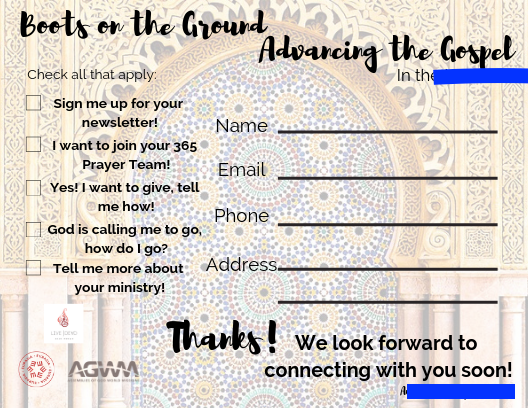
What’s a connect card you ask? It’s a stack of individual cards you put on your display table, chairs of an event, and/or attach to Sunday morning’s bulletin. Connect cards give you the ability to follow up with interested people after a service or event is over, and is an effective tool all about facilitating more face-to-face appointments and building relationships with the body of Christ. Connect cards can serve as a way to “keep the ball in your court” by grabbing interested people’s contact information instead of just giving them a prayer card and hoping they remember to contact you.

Below there are some examples of connect cards from various workers I coach. (thanks guys!)

Now, don’t go off quite yet and make your own. I want to explain something important first: keep in mind that connect cards are only appropriate in certain circumstances.

“Connect cards are only meant for events, services, and small groups where you have gotten permission to connect personally with individuals about giving.”

Connect cards should only be used when they fall in accordance with a pastor / leader’s protocol on giving. Don’t assume that these cards can be placed on chairs of a congregation without communication or sneakily stuck into bulletins on a Sunday morning without communication / permission prior. Connect cards are only meant for events, services, and small groups where you have gotten permission to connect personally with individuals about giving (or if you are hosting a fundraising event that you are hosting on your own).

Why is this so important? A lot of churches do their missions / ministry giving by collecting offerings and disbursing where the church leadership collectively decides. That means if you were to come into that congregation and ask all the people inside to give to you personally, it may mess up what the pastor, board, and leadership of the congregation has decided to give to. You DO NOT want to be that person. #boo

Thus, connect cards are preferably only when you ask the pastor / leader “how does your congregation do missions / ministry giving?” If they say you may connect with individuals inside of the congregation on your own, connect cards come into play.

Connect cards are ideal when speaking to your home church (after you’ve figured out the protocol with your pastor on giving), small groups, fundraising events, and the like. If you do use connect cards, make sure to explain them from the platform in which you are speaking from – letting everyone know how to fill them out and what they are for.

I hope these help you as you seek to build out new relationships as you interact with the body of Christ! See the examples below and have fun building yours! I do have a contact who makes connect cards for workers, if your interested in getting one made – contact me and I’ll get you in touch! -JF

Connect Card side 1Connect Card side 2 copypostcard-3.5inx5.5in-h-frontpostcard-3.5inx5.5in-h-front

Connection Form PDF copy


Turning Verbal Commitments into Actual Gifts- It Doesn’t Have to Be Awkward!

Back in March I did a post on Follow Up here on the blog that I got a lot of great feedback on. I recently did an edit of the post and Support Raising Solutions just put it up on their blog. You can check it out here.

Here’s a quick excerpt:

How do I best follow-up with someone who has said  they will give… but hasn’t started giving yet?

My guess is you’ve probably faced this question more than once, seeing this is the dilemma I’m asked about most often as a coach. The 2nd question I get the most? “How do I keep follow-up from being awkward?”

Follow-up can consist of reconnecting with those who are verbally committed, but who need time to pray/consider after an appointment, or for some reason haven’t started their giving yet. I agree, it can feel awkward to try to re-connect with them to get them to start their giving – but it doesn’t have to be. Here are some practical tips for changing verbal commitments into actual gifts:

Good follow-up starts at the appointment.

Start setting yourself up for good follow-up during the appointment by following the two C’s:

To see the rest visit https://supportraisingsolutions.org/turning-verbal-commitments-actual-gifts-doesnt-awkward/.

Follow Up: How to Change Verbal Commitments Into Actual Commitments

As a coach, the question I probably answer the most is how do I follow up with people who have said they will give, but haven’t started giving yet?

Having to follow up with verbal commitments is normal, and the need for it is frequent. It can also be one of the more awkward things we do in raising up our financial partnership teams – but it doesn’t have to be. Below are some tips for changing verbal commitments into written ones, and how to do it correctly. 

follow-up-graph_903_2f3569adce6e29c7cf6aceefc5c1893653411e32

I hope this infographic helps you in your follow up! Don’t forget to smile through the phone if your calling – it makes a difference. – JF

GUEST POST – Let’s Be Real: Why Ministry and Fund Raising Follow Up is So Important

Before we get into this amazing post, I (Jenn Fortner), just want to say how thankful I am for another Pastor Chris guest post. In this post Pastor Chris continues to challenge us with his wisdom in a huge area of ministry partnership development: follow-up. If you didn’t get to read his first guest post you can find it here.You can also read Chris’s full bio below. Enjoy! – JF

Are You Doing Proper Follow-Up?  This is a critical question regarding your success as a christian worker.  As a christian worker or missionary you are going to find many people interested in speaking to you about Jesus, but they may not always be ready to make a commitment.  They may not be prepared to forsake Islam or their family’s religion of many generations because you told them a nice story.  Successful ministry work requires faithful and patient follow-up with that person who has shown some interest.  The man who pumps my gas gave his life to Jesus, but only after I spoke with him many times.  He had to know more than my “story” about Jesus… he had to know ME. Was I a worthy person to carry such a story to him?  Could I be trusted?  Did I really believe the message I was sharing with him?

The first place you learn and practice how to do follow-up is while raising your financial support.  You may think raising money and sharing the gospel are vastly different but they are not.  If you are unable to look a pastor square in the eyes and say, “I need your support to fulfill God’s call on my life” – then you will find it difficult to look another man, with another religion, square in the eyes and say to him, “I need you to abandon everything you have been taught and follow Jesus!

Before you get to meet that man and share the gospel with him – you must meet many pastors and individuals who will help send you to the field of your calling.  You will face a lot of rejection along the way.  Your success will depend on how YOU HEAR rejection.  Yes, you read that correctly… it is up to YOU how YOU hear rejection.  When a pastor says to you, “I’ve just taken on several other families and our budget cannot support another one right now” – What do you hear?  Do you hear “NO”?  Or do you hear “NOT NOW”?

I have been serving on the field for many years.  I have raised a lot of funds.  I have done a lot of asking. I do not remember in all of those times of asking that I have ever heard a “NO”. If you hear “NO” when you ask (or if you are hearing “I DO NOT WANT TO SUPPORT YOU”), then I believe you are hearing incorrectly.  Most people you share your vision with likely believe in you, and admire what you are doing.  However, everyone is not going to be willing, AT THE MOMENT YOU ASK, to support you.  This is where follow up becomes a key to your success.

Successful sales people will tell you the one difference between them (the successful ones) and the others (the unsuccessful ones) is performing proper follow up.  Salesmen are pushed by their organizations to close the deal on the first meeting.  When they are not able to do that (close the deal) they allow the potential client to drift off to a competitor, while they go looking for a new potential client.  This is a HUGE mistake.  Recent studies have shown that most sales come much later than originally thought and after multiple contacts.

In an article entitled – Shocking Sales Statistics as it Relates to Follow Up – the author shares these statistics:

48% of sales people never follow up with a prospect
25% of sales people make a second contact and stop
12% of sales people make more than three contacts

– – – – – – – – – – – – – – – – – – – – – – – – – – – – –

2% of sales are made on the first contact
3% of sales are made on the second contact
5% of sales are made on the third contact
10% of sales are made on the fourth contact
80% of sales are made on the fifth to twelfth contact

follow up

Look at that last line.  80% of all sales come between 5 and 12 contacts. Amazing!!! I do not know how those statistics compare to fund raising, but I believe they would be very similar.

How can you apply this information to your fundraising campaign? Here are some ideas:

1.Change the way you HEAR rejection

Unless a “NO” is a very emphatic “NO” – you must learn to hear it as “not now.

2.Develop a Contact & Follow-up Strategy

Every contact with a potential supporter does not need to be an “ask”.  In fact if it is, you may become obnoxious and pastors will run when they see you.  This is true when presenting the gospel on the field also… every time you meet that guy or gal you are sharing with – you cannot ask them to accept Jesus; however, there will be the right time when you can.  Every time you meet a pastor you cannot ask for money, but there will be the right setting when you can.

3.Set a Goal to Work your Strategy

If you are raising your support for the first time set a goal to contact every pastor in your district multiple times (of course always follow the protocol within your organization / your role on this one).  Contacts can be any kind of contact: a newsletter, a Facebook post, a postcard, a formal letter, an invite to coffee or lunch, greeting him/her at a district function, etc. Create a spreadsheet and track how many times you have contacted each pastor.  Look for the ones you have had little contact with and try to increase your connection with them.

Doing these things will help keep you moving towards your goal of reaching the field and sharing the gospel with the people God is calling you to.

Ye have not… because ye follow up not!

Begin today putting together a Follow-Up & Contact Plan that works for you!

-Pastor Chris

Want more on these subjects? Here are some suggestions:

Dealing with the Monster of Rejection

6 Tips for Connecting with Pastors

Effectively Communicate with Your Financial Partners