

Raising support for your monthly budget and being in need of project funds can be… well, daunting. Like trying to bake two pies at once BUUUTTT they are both filled with different stuff and one takes more time than another to bake and you have curious hangry toddlers in the room and possibly a husband that wants to lick the bowl because thats just what he just…does. Wait….just me? Where did we go there? Anyway, you get it. Doable, but you might lose a little sanity in the process. But take heart: you are not alone. Many have baked those pies, fumbled through it, learned a few lessons, and somehow came out peachy with actual monthly support and project funding. (Miracles do happen. And now I’m hungry)
If you’re trying to figure out how to ask for both without sounding like a human GoFundMe campaign, this one’s for you.
1. Get Clear on the Ask: Monthly vs. Project Funds
Monthly = the messenger / people
Project = the pathway
The Gospel requires flesh and blood. The work of ministry—especially in hard-to-reach places—demands presence and proximity. Project funds can build a building, but monthly support puts a missionary in that building.
In most circumstances I think it’s a good idea to keep your main ask for MONTHLY SUPPORT when you approach churches. Generally speaking monthly support is harder to get, and keeping the main thing the main thing will help you know where to start and focus. When you speak about your need – share that your biggest need is monthly support and share your heart and passion for those you are serving. Let that guide you. Then, when that is made known, tell the pastor how you want to minister – which is the project. And from there, you can pull out a business proposal (short with bullet points of specific dollar needs) and let the pastor know of that need as well.
When churches hesitate to support missionaries monthly but are eager to fund projects, there’s often a disconnect—not a lack of generosity, but a lack of understanding. It’s up to us to bridge that gap with grace and clarity, and perhaps quality print pieces or other materials that break down the specifics.
2. How to Reach Out to Pastors
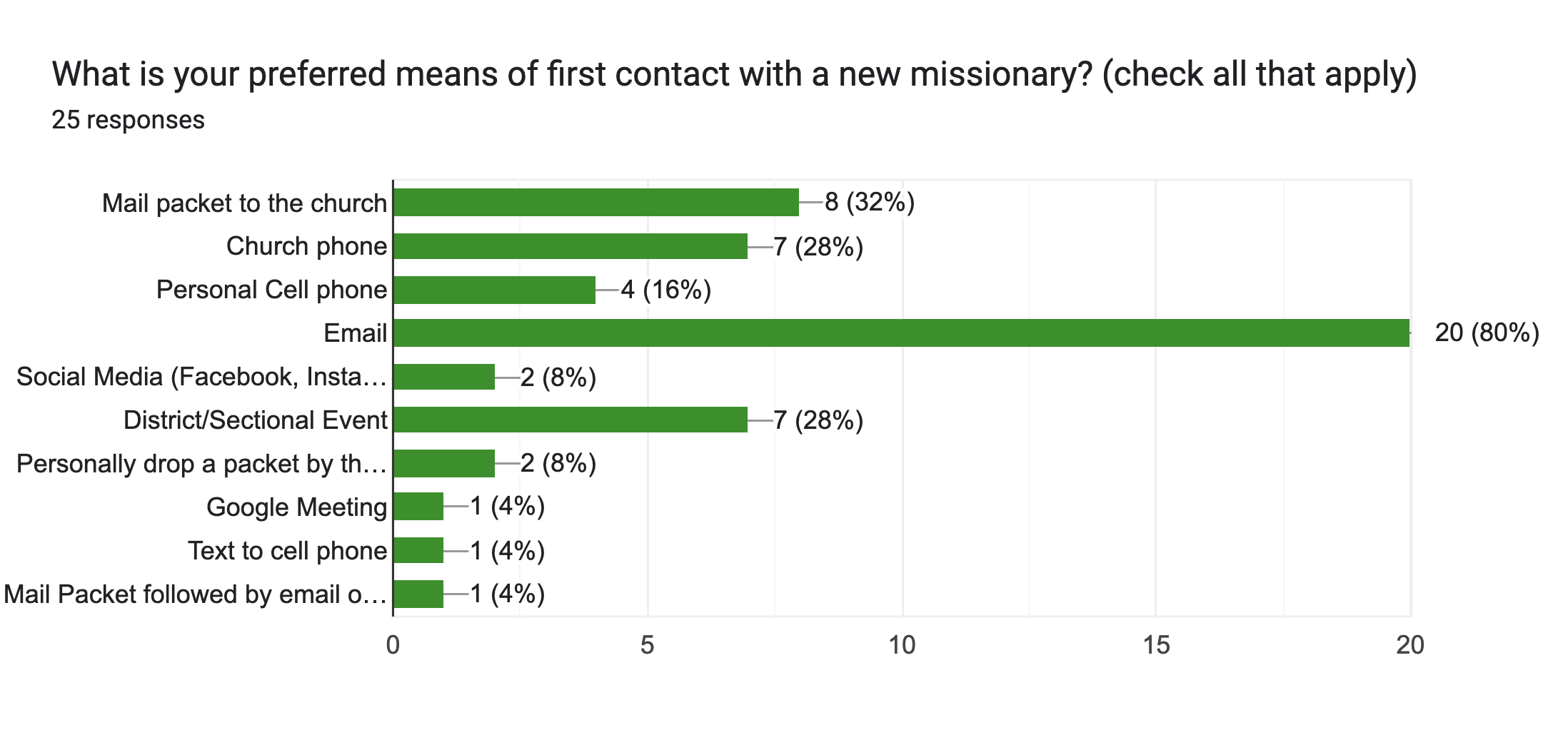
Every pastor is a little different in the ways they prefer to be reached out to. There is one clear winner – at least according to this survey that was just started while I am fresh typing this post – and that is email. I still believe how to reach out to a pastor varies due to numerous factors. In some districts/ church cultures – Old-fashioned phone calls work best to initially reach a pastor. I suggest if you try to reach a pastor via phone and they don’t answer, After phone follow up with a short but nicely made email packet. (Key phrase: not a novel. Keep it simple and informative). In other districts beginning with a mailed pastors packet and then following up with a phone call may make the most sense. It could also be that what works for one church does not work for another. Stay flexible and tweak your strategy of reaching out to new churches / pastors based on your experience and what you find works best in your area.
3. Touch Points Galore (aka Holy Persistence)
We’re talking 15+ touches per church. Sometimes that’s what it takes. Stay persistent without being overbearing. Never be demanding or carry entitlement in the process. Serve and love and expect that these pastors and churches are busy shepherding their flock.
4. Start with an ask for a coffee
“I’m in the area—can I drop by for 5 minutes?”
You don’t need a service every time. You need connection. And coffee. Always coffee.
5. Heart Then (Get Down to) Buisness
Consider getting a business coach to help you develop your overall plan if you haven’t already done so. Tighten up any loose ends of how any project you may be pioneering may start and be comprised of, your costs, infrastructure, etc. (honestly, I’m not the expert here — but business planners / coaches can be!) – and then be ready to be flexible. Have a plan, and make it well thought out. BUT don’t be so tied to it in your pitch that everything goes wrong if the business morphs over time. Lead with your heart — then hand them the spreadsheet.
What’s at the heart of your business plan / project?!?! You. Your calling. Your why. Your passion. Again, we ask first for monthly support and then follow with the business (mostly). The heart of why you are there should lead you, then you can provide the details.
5. Handling the “We Only Do Projects” Response Like a Pro
Cool. We get it. Some churches just give project funds.
If you don’t have a project you are trying to fund immediately, here’s a potential response:
“Awesome! Thank you! If you give to project funds and are interested – here are 3 holes we need plugged in order to stay long term in X ministry / country. (gives fancy sheet that includes some of the following:)
- THIS THING AT THIS COST (Language learning classes?)
- THIS OTHER THING AT THIS OTHER COST (beds for hostel!)
- THIS LITTLE THINGY AT A SMALLER COST (a laptop! a desk! kids something or other)
- THIS HUGE THING WITH A LARGE COST (tuition for kids school? cost of an administrative assistant that is local)
If you do have a project you are trying to fund, respond by giving them a sheet with #5 (heart then business!).
No matter your response, when you share, I’ll say it again – share your heart – and not with your financial need plastered so in front of it that they can’t see your passion. Hopefully, they become kingdom-ly invested while informed. And some of those project-givers? Ended up giving monthly later on. Go figure.
Remind them gently and remind your own heart: Presence matters. Proximity matters. And projects are the pathway and are great too.
6. Use organization tools like Donor Elf
Some of the workers I train use Donor Elf while in a season of itineration because:
- It’s connected to a large amount of ministries
- It pings you when someone’s giving lapses
- It saves your sanity 🙂
Pro tip: Add every contact. Take notes. If you have a spouse split the workload with your spouse. Do support raising work with roommates or others on your team also raising support. High-five each other often.
In Summary:
- Make a business plan. Know it but flex with it.
- Make monthly support your first goal, then share your project fund needs
- Lead with your heart and passion, not your plan
- Email people. Maybe call people. (I know, terrifying.) Or call people than email. Or email and then call. Or snail mail and then call. But probably emailing and calling is in there somewhere.
- Be well thought out in what you need. Use bullet points and specifics.
- Let pastors into your story.
- Drink coffee.
- Eat the pies (? I don’t know if that works here but I’m keeping it)
- Repeat.
You’ve got this. Go raise support like a boss. I mean baker.

 Financial Partnership Development