Don’t Stop Til You Get Enough: 5 Lessons from 2 Successful Support Raisers

Here’s a beginning question everyone asks when raising support: How do I effectively ask individuals to support me monthly? The answer to that question has a lot of moving parts, to start here’s a simple answer, it is this:

AS RELATIONALLY AS YOU POSSIBLY CAN.

I want to reinforce this sentence by telling you about the journeys of two different missionaries whom I coach. Both recently raised their finances in record time. Let me tell you a little about them:

The Jones Family. The Jones Family is a family of four who raised their extensive overseas budget within 6 months. SIX MONTHS! Let me tell you, that is a feat for a family of four! 

Sally. Sally is a single woman, and a 21 year old college grad. Sally raised her budget within 5 months. She had never raised finances for a missions trip before, and particularly felt nervous that most of her friends were just out of college – and broke.

How did the Jones family and Sally do it? Well, the main successful commonality between them is this: they were always relational in their approach. So here are some things we can learn from The Jones family and Sally in their journeys  to raising their budgets relationally and successfully:

1. They set weekly goals and stuck to them. When raising your finances, knowing your vision is valuable and so is determination. Both the Jones family and Sally set weekly goals (that were obtainable) for themselves based on their vision and held onto those goals with determination. They hit their goals 90% of the time.

Take away: As you raise your finances, set weekly goals for yourself and find a way to make yourself accountable to them. Before you do, think about what you can handle each week and when you want to get to 100% before you set them. Typically I tell missionaries I coach that they need to make initial contact with at least 5-10 people each week – initial contact entails that they have either sent an invitation letter (setting up the face-to-face appointment) or they called someone asking for a face-to-face appointment.

2. They didn’t take short cuts. They met face-to-face with people. The Jones family and Sally both strived for each “ask” to be face-to-face, even if that meant traveling a little to see people and ask them in person. They didn’t merely call people, send out bulk newsletters, or Facebook blasts – they took time to ask people in the most relational way possible.

jackson-moonwalk

Take away: I’m not saying Facebook posts or newsletters are bad things. Both are effective tools when used accurately. However, those tools become detriments when missionaries try to make them the main way they do their personal asks. Whenever possible, try to meet with your potential partners face-to-face. If it’s not possible face-to-face, try meeting with them over Skype or Google Hangouts. When you ask, have a well thought out presentation and concretely ask for financial support.

3. They asked for a range or specific amount. When the Jones family and Sally did their financial asks they boldly asked for a range of monthly support or a specific amount.

Take away: Don’t leave your financial needs nebulous and in the hands of your potential partners to guess. That’s awkward for them. Tell them what you need and provide them with parameters. A couple of reasons for this: (1) It will greatly help your friends and family to know what you need, particularly if they aren’t used to giving to a christian worker. (2) People will default to the least amount possible, so you want to ask them for an amount that stirs their faith.

If you are asking for a range make your range comfortable for you to ask for, but also not too low. Also when providing a range make a graph to explain if necessary. When asking for a specific amount, make sure to stay silent while they respond to what you just asked them. You don’t need to apologize or provide nervous “filler.”

Fundraising Pyramid Image[1]

4. They believed they were asking their potential partners to invest in the Great Commission, not just their ministry assignment. Perspective in raising support is a powerful thing, if not one of the most important ingredients to success (or lack there of). Sally and the Jones Family believed that when they asked their friends and family for financial support, they were involving them in more than just their need for money. They were involving them in the Great Commission and thus were not apologetic about it.

Take away: If you aren’t at that point in your thinking / perspective you, you are not alone. But I do challenge you to ask God to change your perspective. Spend time in the word and seek understanding on support raising in the Bible. There are over 700 direct statements in the Bible about finances, find some of them and study. As you read ask yourself why God set up the Christian worker to live off of support, and why He wants you to do it as well. (Some places in the Bible to start reading: Philippians, Nehemiah, 2 Kings 4, and 1 Corinthians 16 or check out my workbook and buy a complete Bible study on fund-raising.)

5. They didn’t stop when it got challenging. Both the Jones Family and Sally were both hesitant to begin the process of raising their support. They also both had real fears and genuine obstacles, just like you probably do. Even though they were hesitant and ran into hard weeks while raising their budgets: they kept going and continued to ask.

Take away: Don’t let fear, a bad week, obstacles, or a “no” keep you from asking. Remember, when you invite people onto your team in a relational way, really you are asking them to get more involved in the Great Commission. When you run into a hard week (and you will, I promise you are not alone) just keep going and continually ask God for help along the way. He will provide what you need if you keep moving forward — but the key is you have to keep moving forward.

So as you look over these 5 take aways think about how you can invest and create your team relationally. As you do, you’ll find yourself growing in ministry and more happily (and quickly) raising your support.

What do you think as you hear The Jones Family and Sally’s stories? How can you raise your finances as relationally as possible?


tumblr_lh6qjalpgw1qauweoo1_500

End of the Year Giving: The Facebook Campaign

During November and December try to focus on some good ways to reach out to individuals and utilize the best two giving months of the year.

If you are down the road in raising your finances enough (close to 80% raised) doing a Facebook campaign in the month of November or early December could be perfect in utilizing this window and helping you reach 100% (I DO NOT RECOMMEND FACEBOOK CAMPAIGNS BEFORE 80%).

You may have already read the previous post on this subject from last year: “How to Create a Successful Facebook Campaign and Other Glorious Facebook Information.”   

https://www.google.com/amp/s/jennfortner.com/2015/03/10/how-make-your-own-facebook-campaign-and-other-glorious-facebook-information/amp/?client=safari
If not, let me give you a summary. A Facebook Campaign essentially is getting together a team of 10-15 people who post daily on their Facebook walls, on your behalf, for around 10 days. You create the campaign with video content, give-a-ways, graphics, and a monthly goal you would like to reach over the duration of the Facebook Campaign. The end result is reaching out to a wide audience that may not have ever heard about you or your ministry any other way – and may be really eager to support someone in the ministry field.

If this is something that interests you, watch the videos below for more information and then read the very important tips:


Here are key things to keep in mind as you develop your Facebook campaign and develop any new relationships that come from it:

1. It is VERY IMPORTANT while doing your FB campaign to stay abreast on all likes and comments that come to you campaigners pages. Check them every day, more than once a day. Return comments with Private Messages (PM) and likes with PM when it feels appropriate. It is your job to connect further with the people responding, and if they have commented or liked but haven’t given, chances are with a personal message from you they may.

2. It is also VERY IMPORTANT to create great graphics and videos. No half-way doing this thing or results will be minimal. With a little work, the results will be fantastic.

3. it is VERY IMPORTANT to create a reasonable goal. (see video)

4. It is VERY IMPORTANT to follow up with your new financial partners after the Facebook campaign. Never let someone give to you without trying to get to know them. Attrition rates for someone giving to you on a monthly basis that you don’t know are statistically low – so beat that by building a relationship with your new financial partners. Do this by emailing them, calling them, Facebook messaging them. Whatever you do, ask them questions about themselves. Of course don’t overwhelm them – make them feel safe as they probably don’t know you well. Use common sense. Think about what would make you feel connected if you were in their shoes.

5. Think about creating a Facebook secret group with your campaigners and some prayer partners in the group. In that group you can post your posts for the campaigners every day. There should be around 15-20 campaigners and perhaps somewhere around 10-15 prayer partners in this group. (Your prayer partners will probably catch a burden and start funding you monthly if they aren’t already on your team)

6. It is VERY IMPORTANT that you communicate well with your campaigners from the very beginning. Tell them your goal and how many days, and communicate that you want them posting every day. ALSO VERY IMPORTANT to find out how they can best receive the post information from you. Some people post on Facebook from their phones – so a text may be better. Some people may do better with you giving them content in an email. Some may remember just fine by only getting it through your secret group. Find out what works best for them so they don’t miss a post. Make it easy for them.

I hope these tips help you create a solid Facebook campaign with new financial partners that you minister to along the way!

images

Connect Cards are Awesome.

Have you ever spoken at your home church, small group, or fundraising event and gotten stuck at your back table talking to a particularly chatty individual? All the other people scurry to lunch before your conversation ends and you feel the wave of missed opportunities that just passed?  Whomp.

Insert a wonderful tool to help combat: connect cards!

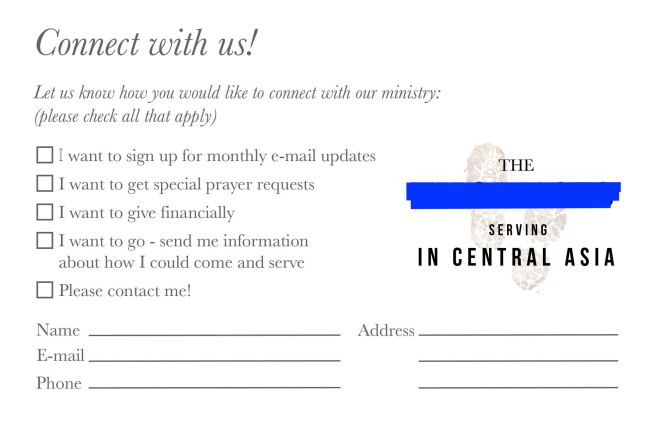
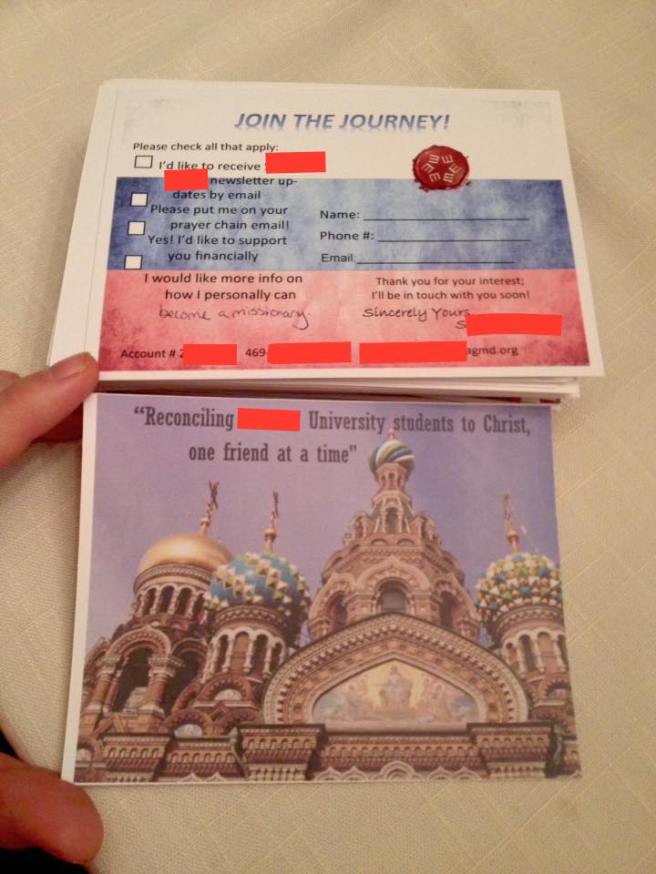
What’s a connect card you ask? It’s a stack of cards you put on your display table, chairs of an event, and/or attach to Sunday morning’s bulletin. Connect cards give you the ability to follow up with interested people after a service or event is over, and is an effective tool all about facilitating more face-to-face appointments and building relationships with the body of Christ. Below there are some examples of connect cards from various workers I coach. (thanks guys!)

Now, don’t go off quite yet and make your own. I want to explain something important first – here we go – pay attention: keep in mind that connect cards are only appropriate in certain circumstances.

“Connect cards are only meant for events, services, and small groups where you have gotten permission to connect personally with individuals about giving.”

Connect cards should only be used when they fall in accordance with a pastor / leader’s protocol in giving. So don’t assume that these cards can be placed on chairs of a congregation without communication or sneakily stuck into bulletins on a Sunday morning. Connect cards are only meant for events, services, and small groups where you have gotten permission to connect personally with individuals about giving.

Why is this so important? Well, a lot of churches do their missions / ministry giving by collecting offerings and disbursing where the church leadership collectively decides. That means if you were to come into that congregation and ask all the people inside to give to you personally, it may mess up what the pastor, board, and leadership of the congregation has decided to give to. You DO NOT want to be that person. #boo

Thus, connect cards are preferably only when you ask the pastor / leader “how does your congregation do missions / ministry giving?” If they say you may connect with individuals inside of the congregation on your own, ONLY THEN do connect cards come into play.

Connect cards are ideal when speaking to your home church (after you’ve figured out the protocol with your pastor on giving), small groups, fundraising events, and the like. If you do use connect cards, make sure to explain them from the platform in which you are speaking from – letting everyone know how to fill them out and what they are for.

I hope these help you as you seek to build out new relationships as you interact with the body of Christ! See the examples below and have fun building yours!

Connection Form PDF copypostcard-3.5inx5.5in-h-front

14316802_10157439182320503_316598276514332702_n.jpg2016092295161241-copy


The Phone Call Mind Map

Most of the time, you will be asking individuals on the phone for face-to-face appointments to invite them onto your partnership team.

Phone calls can be daunting for anyone. For some of you (particularly for younger generations) phone calls can just be down-right scary.

One worker I coach found the phone call to be very daunting. To combat this she made a Phone Call Mind Map to help her move through her phone call script. I found the map extremely helpful when thinking through some of the scenarios we may face while making phone calls asking for appointments. Thus, I created one like her’s including some of the typical responses workers get when making phone calls.

Just so you know, I’m fully aware that it looks like a mess.

However you may find it helpful to print off and have near you while you begin making phone calls, especially those of you that are new-er to the process. Phone calls require the caller to go with the flow in some respects, but it does help to be prepared.

Below the mess are two things:

  1. Some important things to remember when making your phone calls.
  2. A basic phone call script / outline.

I hope you find this helpful!

the-phone-call-mind-map (14)


PHONE SCRIPT

WHAT DO I KNOW ABOUT THIS PERSON  (i.e. hobbies, job, sports, family, name of spouse and kids…)  If a referral, who referred this person?

_________________________________________________________________

GREETING, INTRODUCTION, RAPPORT

_________________________________________________________________

TRANSITION TO THE APPOINTMENT

_________________________________________________________________

ASK FOR APPOINTMENT (MAKE SURE TO TALK ABOUT DESIRE FOR FINANCIAL PARTNERSHIP)

_________________________________________________________________

CONFIRM TIME, DATE, PLACE OF APPOINTMENT

_________________________________________________________________

CLOSING AND THANKS  (Details, dates, times, write directions on the back).

_________________________________________________________________