
Effective Strategies for Raising Support While Overseas


How to Raise Support While Still on the Field

Raising support while actively serving overseas can feel daunting. How can we raise support relationally while being separated by time zones and ocean water? The good news is—with the right strategies, it can absolutely work. Whether you’re far away on assignment or involved in full-time ministry locally, these tips can help you strengthen your support base and grow your network with confidence.

Top Tips for Raising Support While Overseas

Here are some key strategies to help you stay well-supported, even while you’re serving on the field:


1. Ask Existing Supporters For An Increase

One of the simplest and most effective ways to raise additional support is by asking current supporters for a small increase—typically 5–10%—as long as they haven’t made an adjustment recently. A personalized message (likely emailed) that acknowledges their ongoing commitment with a hearty amount of thanks and explains the current need can open the door to increased giving. It’s a strategic first step that often yields results without the need to expand your network right away.

Keep in mind, these asks are best if you haven’t requested an increase recently or asked them for support within the last 6–12 months. This approach is mainly intended for churches and individuals who have supported you for over a year.

Here’s a quick email template you can take and make your own:


Subject: Hello from Sweden + Support Update

Hi Pastor Ed,

I’m writing from Sweden! I hope all is going well there. I wanted to pop in quickly and share a few updates with you.

First off, thank you to you and 1st Assembly for continually supporting Zach and me as we’ve moved through various assignments in Sweden over the past six years. You all make what we do in CITY/MINISTRY possible, and we couldn’t do it without our team. We love and value you and are so thankful for your ongoing partnership.

Second, I wanted to let you know that we have plans to extend our term another year (🥳), and we’re reaching out to our existing partnership team to ask for prayer and support in this effort. We’re needing about $1,000 in additional monthly support and $12,000 in special gifts to make the extension happen.

If you know of any other churches or pastors who might be open to connecting with us, please let us know. And if 1st Assembly feels led to increase or give a special gift, we’d love to hear from you.

Just to give perspective—if every church on our team increased their monthly support by 10%, we’d already be halfway to our goal!

As always, thank you so much. We’ll continue to keep you posted via newsletters and social media. We’re attaching our most recent update below.

We’d also love to hear what’s happening at 1st Assembly. Stay in touch!

Many blessings,
Jenn (and Zach) Fortner
jfortner@eurasia
Sloane and Merrick

Giving #: ________
Sign up for Prayer Alerts: link__
[Attached Newsletter]


2. Use a Multichannel Approach

This is just a general tip that may come in handy as you think through ways to push out information on your financial need. Using multiple communication channels—newsletters, social media, phone calls, texts, videos, and Zoom—is key to effective support raising – period. Different people prefer different types of communication, so using a mix helps you reach a broader audience in ways that resonate with them. A multichannel approach increases the chances that your message will be seen, remembered, and acted on. So, if you are putting a goal of $1,000 increase in monthly support as you present your need in newsletters also use the same messaging in any social media (that you can based on security), phone calls or text messages (to existing partners telling them of your need), Zoom, emails, etc. I suggest starting with a great graphic and concise copy that you can sprinkle into all of your. communication pieces. Then, text or call or email your existing partners and let them know of your need (this may coincide with asking for increases – or point 1.)


3. Stay Connected and Communicative

As you grow into your role as someone who lives off of financial support, communication with your existing partnership team should become part of your regular lifestyle—not just something you do when you’re actively raising support.

While group updates are important, nothing replaces personal connection. Reach out to key supporters via direct emails, texts, phone calls, or Zoom. Just because you’re overseas doesn’t mean you can’t maintain meaningful relationships. These touchpoints deepen relationships and create opportunities for further engagement and support.

There are tons of great tools out there for staying in touch, especially when itineration time is limited. Use them to check in, express appreciation, and ask for small increases when appropriate.

Need ideas? Check out:
10 Easy Ways to Personally Connect With Financial Partners Without Taking Too Much Time


4. Expired Credit Cards

If a financial partner’s giving stops suddenly, don’t assume they’ve pulled their support. Often, the issue is something as simple as an expired credit card. A quick, friendly message to check in can resolve the issue quickly.

If you don’t follow up, you may unknowingly leave money on the table. Many partners are grateful for the reminder and are happy to update their info once they know there’s a problem.

Here’s a sample template from another worker you may use as you communicate with anyone who has lapsed on their giving:

We pray you are doing well!

I spent some time today catching up on our financial stuff and it looks like the last time you gave was on 8/20/24. Are you wanting to continue giving each month, or are you needing to adjust your monthly commitment? 🙂

(If you didn’t realize your giving stopped, the most common issues are either your card on file expired or you had a “deadline” for your giving from when you originally signed up to give.) If either of these were the reason your giving stopped, let us know and we can help walk you through how to restart your giving.

Regardless of if you’re able to keep giving, we are so thankful for your financial sacrifice thus far. Please let us know what you plan to do so we can keep our financial records up to date!☺️

We love you and are praying for you!

C&C


5. While on Assignment, Make It a Ministry Team Effort

Support raising doesn’t have to be a solo act. Creating intentional time with your ministry team—or even just a roommate or fellow worker—to work on support together can be a game-changer.

Set up a “support raising work party.” Think: cookies, coffee, laptops, thank-you notes, postcards, and good vibes. Working alongside others helps make the task less overwhelming and more enjoyable. (Bonus points if you take time to pray for your supporters as a group.)

Whether it’s writing updates, reaching out to lapsed supporters, or brainstorming fresh ideas, doing it in community builds momentum, accountability, and encouragement.

6. Try a Facebook / Social Media Campaign

You may try in your multichannel approach to existing partners to do a social media campaign. This would include coming up with a specific goal (10 partners at $50 a month), creating a great graphic, creating posts, and getting together a team of campaigners who can post on their walls on your behalf – spreading your need farther than you could get on your own. This is a bit of an older post that explains the basics in more detail.


What’s Next? Action Steps to Try

Feeling inspired? Keep in mind, creating a concrete goal and thinking through your overall strategy before jumping in may be helpful – but here are some simple things you can do to begin!

  • Draft an email template to use when a financial partner’s giving stops—having it ready will save you time.
  • Post a heartfelt “just because” thank-you to your support team on social media or via your newsletter or text.
  • Take 10 minutes this week to pray intentionally for a segment of your supporters, then send them a message letting them know. (then, see if you can repeat that every month)
  • Schedule with your ministry team on assignment (or a roommate or anyone you know who is also on financial support!) a regular team session focused on prayer and partnership development.
  • Personally connect with your supporters in a different way than you have before—maybe even by postcard!
  • Host a Zoom webinar from the field to share updates and answer questions to your existing partnership team. Record it and share it widely (as you are able to based on security)
  • Draft an email to send to pastors and then another to send to individuals supporting you asking for an increase. Don’t forget to include in the email the ask of referrals as well!
  • Start thinking through who may help you do a social media campaign, keeping in mind your need for security!

Effective Peer-to-Peer Fundraising Tips for Gen Z

Here’s an idea particularly for those of you who may be struggling with individual asks / struggling to get that last bit of monthly or cash support in.

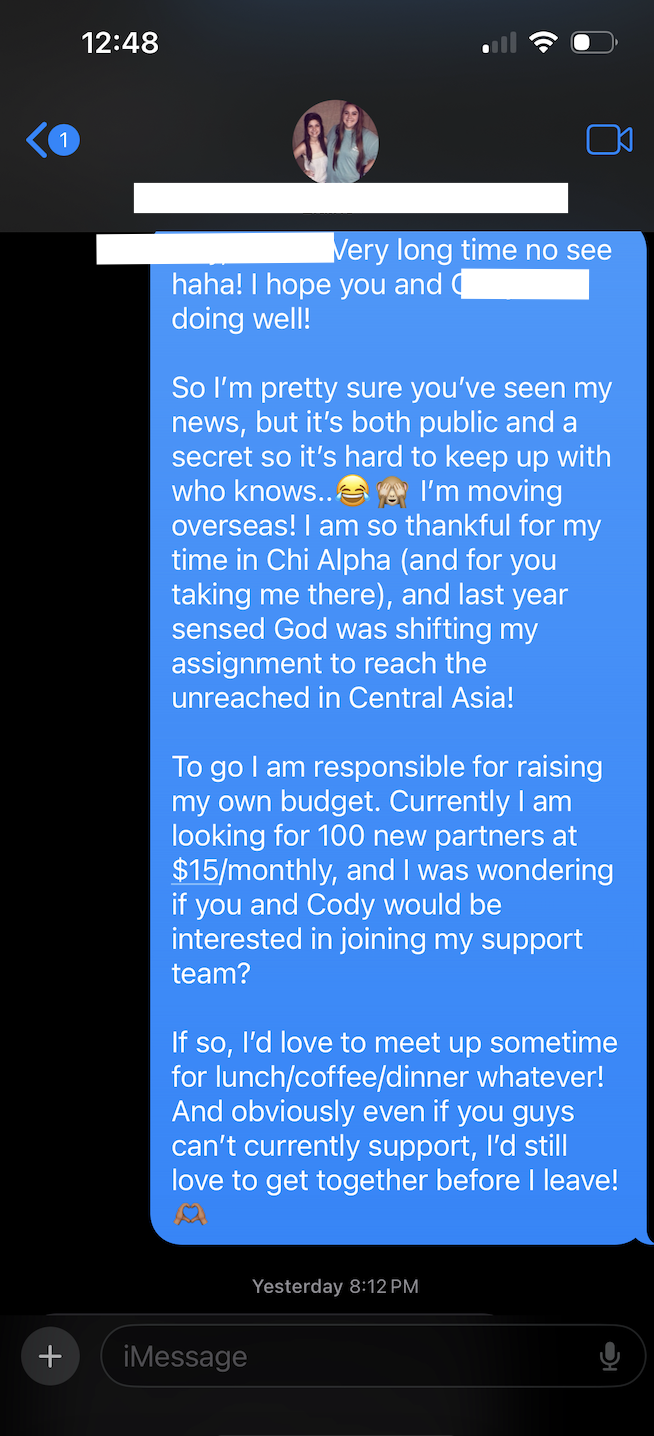
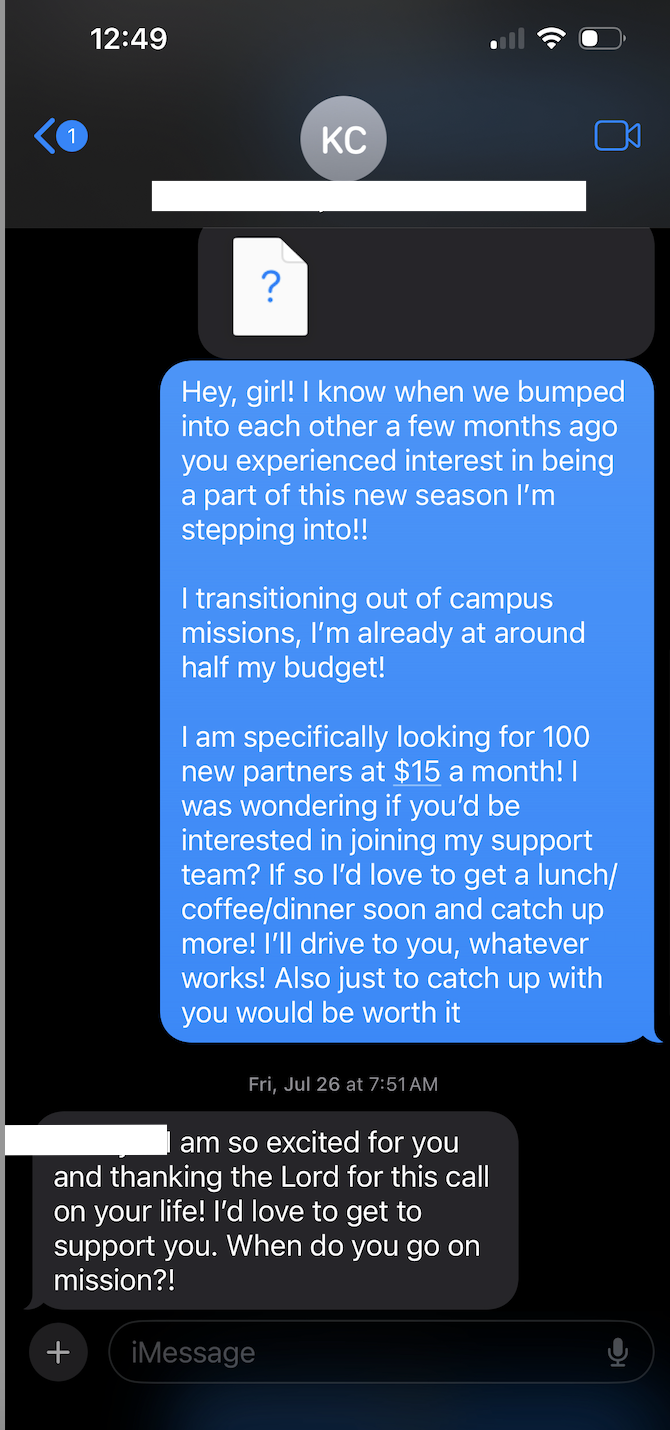
I recently talked with an worker who is doing a support raising push with individuals and doing it a little differently than what I have classically taught. She is doing the push with potential supporters who are more peer to peer relationships – (everyone is in their early 20’s) and making an ask of a 100 new supporters at $15 a month. Also, she is making the push all via text messages – which is definitely different from what I normally teach! (See below for examples). 

I’m bringing it to your attention however because I have seen this be fairly effective in various circumstances. I want to come out of the gate and say I don’t believe this is the new way to do it. Nor is it how I think most asks should be made of individuals. Do not hear me saying that! However, I do think though, in situations where you are facing more of a Gen Z peer to peer dynamic or with a segment of individuals who have not been responsive to other asks — this may be appropriate and effective to try. 

Now, for you It could be this translates to a demographic of potential supporters who you have tried to connect with and haven’t been able to get ahold of them, or maybe they are more of your peers and you haven’t asked for support yet from them, or maybe its a different segment of individuals that feels appropriate to your circumstance. Whatever the case, this may fit for you and may not — it’s simply just an idea that I wanted to to throw out there and see if it’s helpful. I would also encourage you to change that number to whatever the math works out best for you for an overall goal (some of you that may change the goal to cash support) – 100 new supporters at $15 is just her example. Honestly, I’d probably take that number higher while still being attainable. Something like $25 or $35.

I hope this little idea is helpful to you! – JF

POSTCARDS! Find Ways To Connect With Your Team to Say Thank You

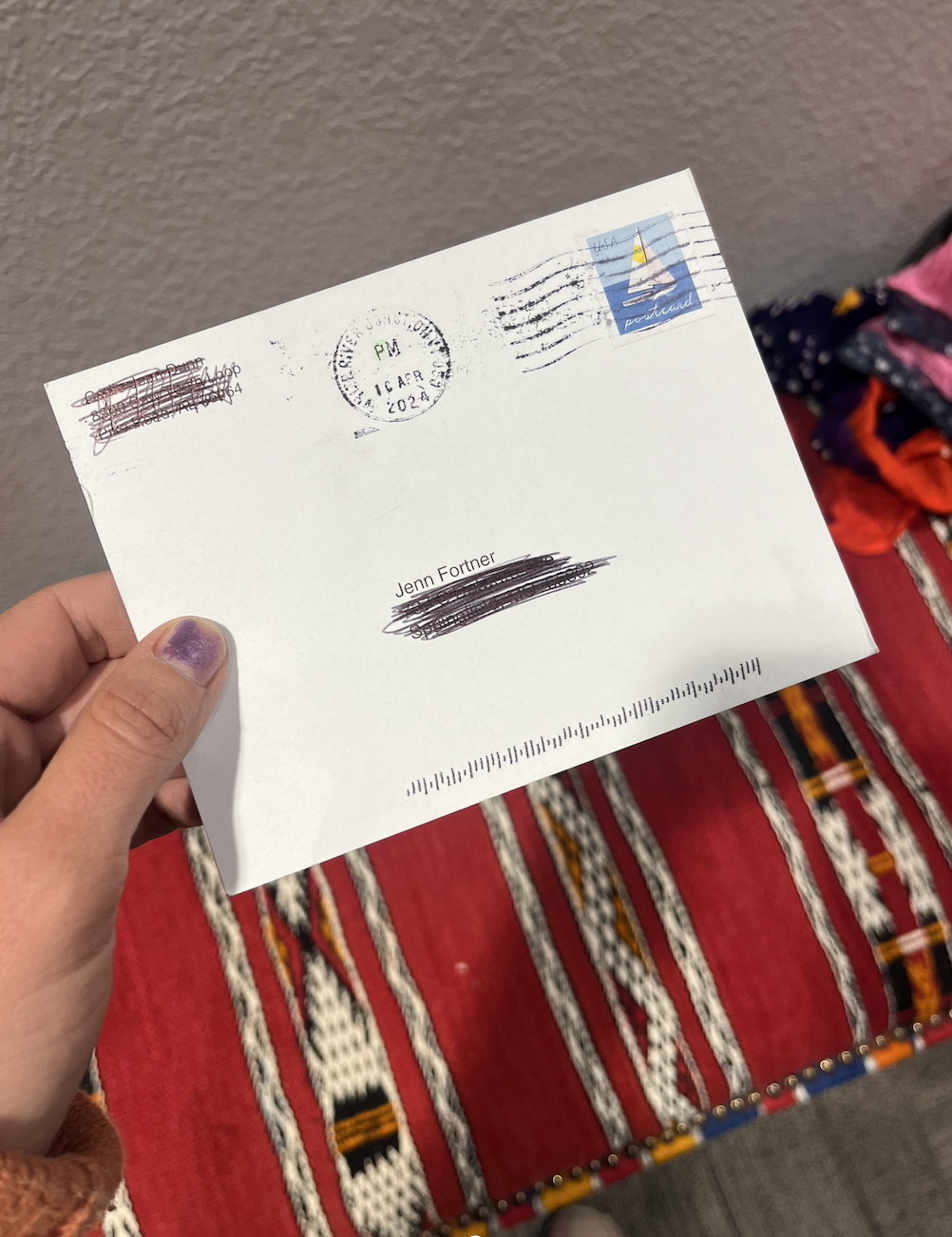
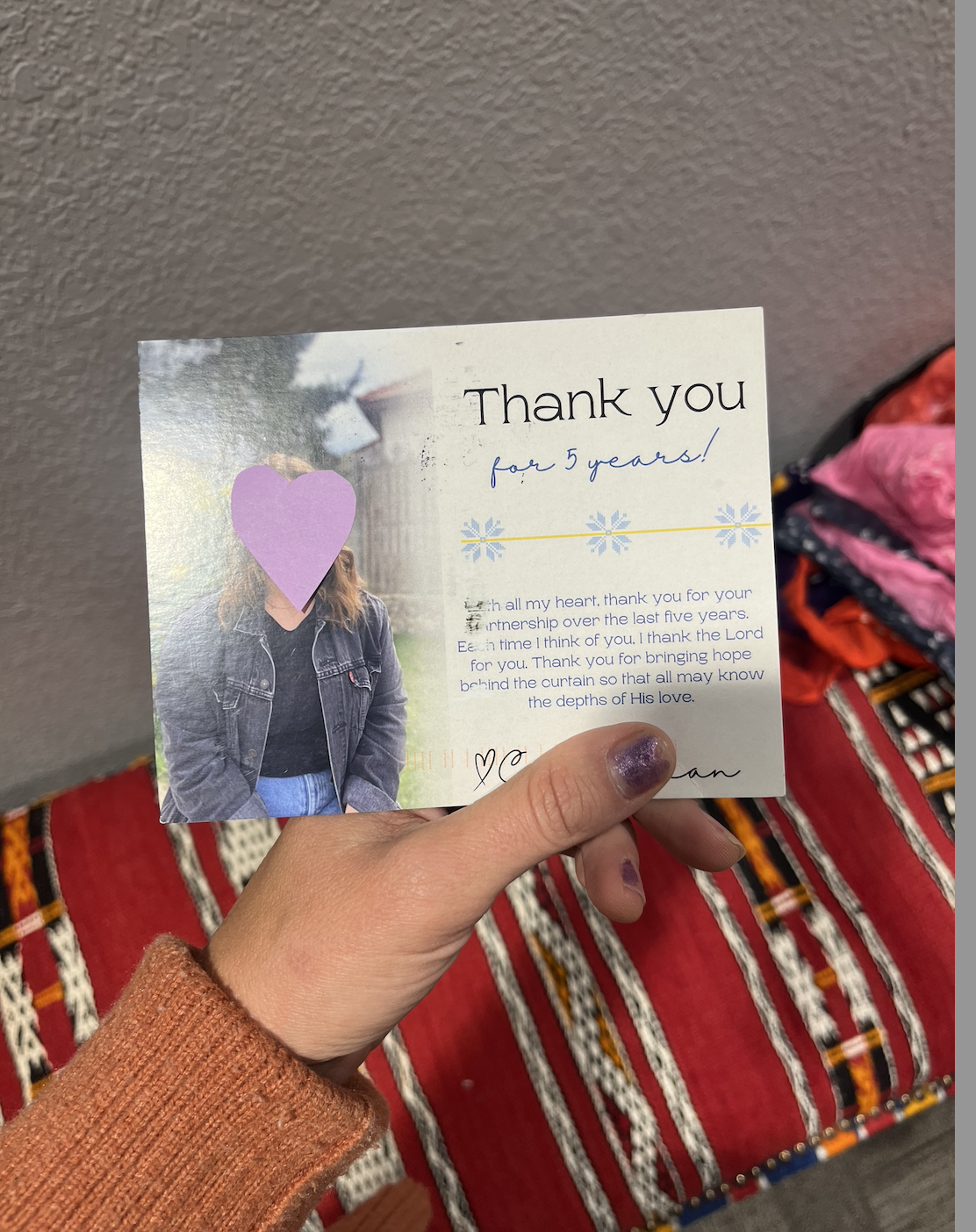
Just coming in with a quick idea / thought. I got a postcard from a worker I have coached over the years in the mail today. As soon as we saw it, my husband and I commented on how simple and effective it was – making us both feel like we were cared for and thought of. Notice that this one isn’t even handwritten but the wording is SO INTENTIONAL and drives home the point of gratefulness.

What could you do to show your partnership team that they matter to you? How could you show them that you are grateful for sending you? That you are thankful for making it possible for your population to be ministered to? How could you show them that you care? Could you incorporate postcards with your support raising journey? Showing your thankfulness and reaching out to your team truly makes all the difference. So let this be a reminder / a push — find ways to connect and say thank you to your team!!

Connect Cards and QR Codes

I’ll tell you a little secret: being proactive is the sauce in support raising. Being proactive to me means putting the ball in your court. Always. A few tools I’d like to highlight in the world of proactive support raising are connect cards and QR codes. Both are geared toward giving individuals an immediate ability to respond as well as capture vital contact information to continue engagement and foster relationships.

Think about it – have you ever given someone a prayer card PRAYING that they will remember you AND remember to give? Have you ever spoken at a church, small group, or event and been caught in conversation with a chatty individual – leaving you with a great conversation but not a lot of personal connections with others from the congregation leading to support? Have you ever wanted more engagement and haven’t known how to go about it? Or have you wanted to expand your network and not known how?

Connect cards and QR codes can be part of the answer. Below I will explain both, give you ideas on how to utilize them, and provide you with a few examples.

CONNECT CARDS

Connect Cards are a lovely way to capture contact information from individuals interested in following along with your ministry whether that’s in prayer support, financial support, or getting your communication pieces (newsletter, social media, etc.). Think of them as individual index cards that are on your display table after a church service, or even on the chairs of an event you are speaking at. These printed cards give you the ability to follow up with interested people after a service or event is over, and can be an effective tool in facilitating more face-to-face appointments and building relationships with the body of Christ. Connect cards can serve as a way to “keep the ball in your court” by grabbing interested people’s contact information instead of just giving them a prayer card and hoping they remember to contact you. It’s better than a newsletter sign up sheet because it doesn’t create a bottle neck effect, and can be a bit more customizable. It’s also helpful that it’s printed, in that sometimes you loose people who won’t scan a QR code for whatever reason. I personally like to offer digital and printed opportunities to respond.

Now, I know this super duper fancy example I made on Canva in 10 minutes is tempting you to go off immediately and make your own. BUT…don’t. Yet. Keep reading. I want to explain something important first: keep in mind that connect cards are only appropriate in certain circumstances.

“Connect cards are only meant for events, services, and small groups where you have gotten permission to connect personally with individuals about giving.”

Connect cards should only be used when they fall in accordance with a pastor / leader’s protocol on giving. Do not make the mistake of assuming that these cards can be placed on chairs of a congregation without communication prior. Connect cards are only meant for events, services, and small groups where you have gotten permission to connect personally with individuals about giving (or if you are hosting a fundraising event that you are hosting on your own).

Why is this so important? A lot of churches do their missions / ministry giving by collecting offerings and disbursing where the church leadership collectively decides. That means if you were to come into that congregation and ask all the people inside to give to you personally, it may mess up what the pastor, board, and leadership of the congregation has decided to give to. You DO NOT want to be that person.

If you do use connect cards, try to explain them from the platform in which you are speaking from – letting everyone know how to fill them out and what they are for. The whole point is to contact the individual who filled it out afterward personally. I would shoot for contacting them within 24 hours of getting the card back, usually with a quick text message telling them how you are responding to them. If they checked they are interested in getting your newsletter, respond by telling them where to expect it and when. If they checked they are interested in giving, provide immediate information such as your giving link and ask if they may be available for a face to face (if appropriate) or would like any additional information.

QR CODES

QR Codes can be used in a variety of ways. Here are some that I have witnessed:

  • On a printed piece on a display table (see below) with multiple scans for various information
  • On a Powerpoint Slide behind a speaker that links to a fill out form (Google forms are great for this!) for a newsletter or more information.
  • Printed on connect cards themselves so that if the individual wants to sign up electronically that is also an option. Or perhaps with additional information.
  • QR Codes on print pieces that lead to the worker’s ministry page or link tree.
  • So many others!

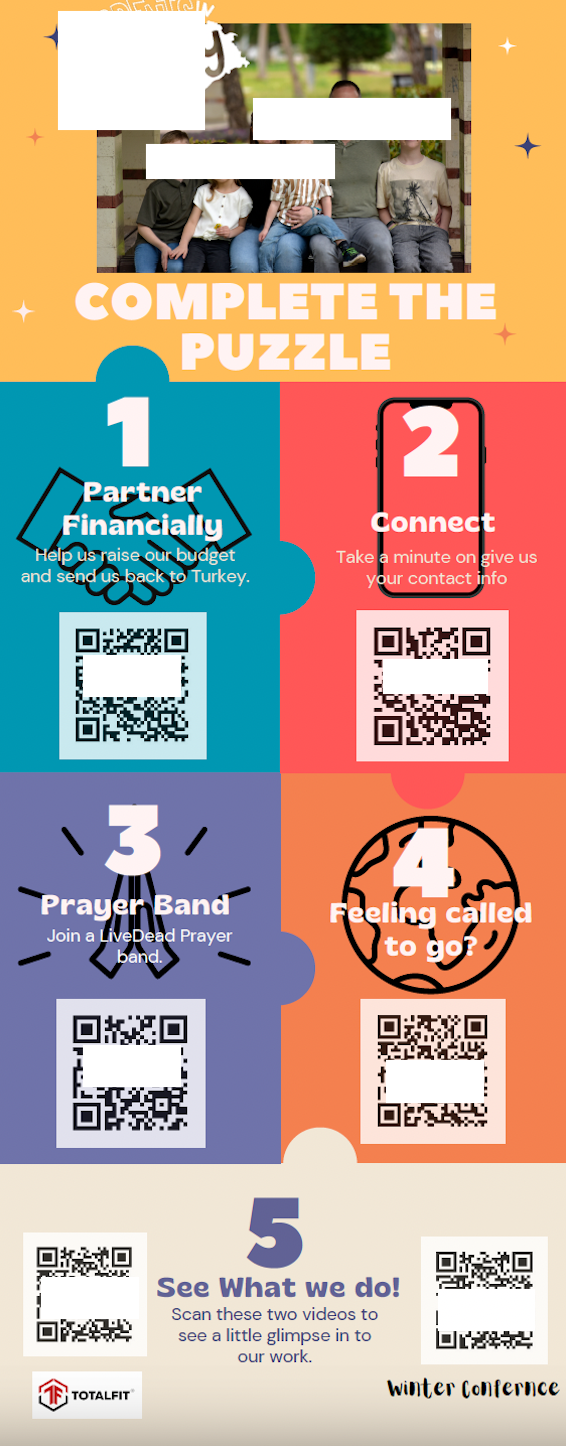
QR Codes can have many purposes, but my main thought in mentioning them is to get you thinking about ways in which you can provide a way to immediately respond to you and your ministry. Think proactively. Think of ways to maximize on every opportunity you are given, and how to foster relationship with the church and individuals you come in contact with. Whether the QR code sends them to your giving link, or additional information on a ministry page, or some where else, I suggest making it easy for them to navigate once they land and the least amount of work possible to lead them there (think fewer clicks).

Below are just a couple of examples of QR codes from workers. I hope this post gets your wheels turning on ways in which to facilitate pathways for the body of Christ to be involved and moving forward in the great commission (that’s what it’s all about!).

6 Things To Consider In 2023

Happy 2023 everyone! Guys, I love January. There’s nothing like a fresh start. Did anyone out there do New Years resolutions or spend some of the last few weeks goal setting? I personally love taking time in the new year to look over my vision statement and goal set for the year. If you did, I would challenge you to find something to add to those goals as it relates to partnership development. Novel idea right?! If you are in full time ministry and live off of support, working on your financial partnership development is a VITAL part of your life. How you view it and treat it are fundamental to your success and longevity as a minister.

That being said, are you slipping into any bad habits? Is your communication strong with your partnership base, or has it slipped to the dusty corners of your to-do wishlist? When was the last time you wrote a newsletter? When was the last time you reached out to an old friend or prayed for them just because? Could you do anything new to stand out? Try something new? Could your vision statement or your print pieces use a little refinement? How’s your attitude as it concerns raising support? Do you love and nurture your support team or tend to neglect involving them in your ministry?

My intention is not to overwhelm you if you have slipped into a few bad habits, but maybe adopting a few of these small changes (or coming up with ideas of your own) could make 2023 and beyond easier and more enjoyable as it relates to ministry and your partnership development. Here are a few ideas to consider:

1. In 2023, PERSONALLY connect with everyone on your partnership team on a quarterly basis. 

Consider bumping up your communications with your partnership team. Perhaps create a goal to reach out directly to every partner (churches and individuals) on a quarterly basis. Here are some ways to consider reaching out:

  • Direct Message on your social media app of choice
  • Emails
  • Short video from your phone
  • Text message or WhatsApp
  • postcard
  • Written letters

Reaching out to a supporter personally doesn’t have to be lengthy to be effective. Some ideas:

  • Just say hi. Let them know you were thinking of them
  • Ask how they are doing and how you can pray for them
  • Share a podcast or a sermon if they come to mind
  • Share a verse you love and are studying
  • Say happy birthday
  • text a picture of a ministry event with a quick thank you.

These little habits of regular communication make a big difference!

Here’s an idea, if you’ve never sent postcards from your city or country maybe 2023 is the time to do it! Chunk your list and make a goal of sending 10-20 postcards out a month.

2. In 2023, learn how to close your appointments well and do great follow up to make your life easier.

Here’s a blog post to help with that.

3. In 2023, refine your public speaking skills.

Are you going to be doing a lot of public speaking while on itineration? Mark it as a chance to develop or refine your skills by studying the subject and applying a few new tips. Here’s a short list of some quick reads on the subject:

4. In 2023, be bold.

“As you ask remember that you are asking on behalf of the lost, so with that in mind BE BOLD, and walk forward in faith. It’s not for you but for His glory. Don’t let rejections stop or discourage you…because ultimately it is all for the lost. It will come in from a different source! Keep praying, fasting, and sabbath-ing throughout it all!” – Anonymous Overseas Worker

4. In 2023, keep the sabbath.

Dunno who needs to hear this but — keep that sabbath day holy! Okay? Okay.

5. In 2023, refine your vision statement.

Knowing who you are, how you were called, and what you want to do in ministry is important, right? Right.

“A mission statement is not something you write overnight… But fundamentally, your mission statement becomes your constitution, the solid expression of your vision and values. It becomes the criterion by which you measure everything else in your life.”  Stephen Covey

We know mission statements are important, but it can be challenging to find the time and energy to sit down and refine one’s mission statement. I would argue though, taking that time to blow the dust off of your mission statement (whether that’s a personal or a team missions statement) is crucial to success.

“People are working harder than ever, but because they lack clarity and vision, they aren’t getting very far. They, in essence, are pushing a rope with all of their might.”  Stephen Covey

Even businesses struggle to maintain their vision statements, and recent research has showed that over half of employees (52%) cannot recite their business’s vision. All the while, a recent report shows that “sense of purpose” in work is the second most important criteria for millennials considering a job. Interesting.

If you want more information on vision statements and why they are so important to success, I’d recommend picking up a copy of 7 Habits of Highly Effective People. (Personally it is one of my favorite books EVER and goes in depth on the subject.)

6. In 2023, rebrand.

Have you been thinking for awhile it’s time to take your “brand” to the next level? Maybe it’s reordering new prayer cards that feature your newest child, or taking your Case Document and Connect Cards to the next level. Or maybe it’s thinking through a new newsletter template or features that align with your Facebook Group posts and website.

I’d say anything you can do to stand out, look professional, and raise the bar with quality communication and materials really does make a difference! Make 2023 the year to do it! The picture below is an example of a packet given to pastors that really stands out. Notice the fancy envelope and the beautiful graphics.

41426729_1841685095868872_6401998987796152320_n

I hope these help spark some ideas for you! Happy 2023! -JF

Newsletters

There are so many great blog posts out there on newsletters. A couple of my favorite posts are actually found on the same blog, Support Raising Solutions. One post is by Phil Sineath from 2020 that takes care to emphasize important layout and design notes as well as language and content to include (you should check it out!), and another goodie waaaay back in 2006 from Steve Shadrach that shares what good newsletters and bad newsletters look like. I also love this one from Scott Morton on Two Things Your Giving Partners Want to Know. I’ve also talked about newsletters here on the blog, but it’s been a minute, so I’d like to share a post dedicated to the mammoth standard of Christian worker support raising communication.

First, I’d like to briefly share some things I believe are important NOT to do in a newsletter.

What Not to Do Newsletters:

  1. Do not write super long paragraphs / pages about what you are learning. It sounds harsh…but short ones = AWESOME. Long ones = NO DICE. And always share what GOD is doing.
  2. Do not forget your contact information, giving link / giving information, QR code (if you have one) — or any needed additional information. Make sure your contact information is up to date, and also is what you will be using if you are going abroad. Lastly, make sure your contact information is also easy to read (as in not teeny tiny font or in colors hard to read or notice). ***Bonus — QR codes including your Linktree or other online places to share additional information are a nice touch and easy for the reader to use. ***Bonus Bonus — always use your branding and/or your organizations branding.
  3. Do not add everyone to your newsletter list before asking them personally to be a part of your team. If you do that, the buy in / engagement will likely be low and you may end up with general feelings of non-relationship from your potential partners. Wait until you’ve asked them to be a part of your team, or they have heard from you at a church service and signed up personally for your newsletter (see connect cards).
  4. Do not use vacation-like photos, keep photos as ministry active as possible.
  5. Do not make it boring. Consider doing something different (but still accessible) for your newsletter. Video newsletters are awesome (if you do one, don’t make it long). If you go for a video newsletter: (1) know what you are going to say in advance, (2) pick an interesting background that represents what you are doing, (3) don’t make the background of your video a noisy street where hearing the audio is going to be a challenge.
  6. Do not stick to newsletters as your only form of communication. In this day and age where we have easy global access, merely emailing your team once a quarter with a generalized email newsletter is not going to cut it as your only form of communication. Get beyond the newsletter. I love this quote and I believe it’s so true: “Relational connection is now a STANDARD measurable of worker effectiveness.” – Randy Jumper of First NLR. That being said, here are 10 easy things you can do to stay in touch and show you care in micro ways.
  7. Do not share every budget detail number. I’d stick to percentages.
  8. Do not make your newsletter an attachment in an email. NOPE. Use programs like Mailchimp or Constant Contact (just give it a google if you are looking for more options – there are a lot) to make the newsletter more accessible as well as personalized (“Thank you Jenn” vs “Thank you support team”)
  9. Do not assume your newsletter won’t go into their spam folder. Check with your supporters to make sure they are getting your newsletter, or when you are signing them up for it send them a text and tell them to be on the lookout for it and check their spam folder. Perhaps post in your hidden Facebook group or other communication that you have recently sent one out – and to let you know if they did not receive it.
  10. Do not write a boring subject line. “Summer Newsletter” is not as effective as “Hey Jenn, how’s your summer going so far?” (yes, you can customize subject lines in many newsletter programs)

Second, a couple of notes on newsletters I think are important to highlight:

Newsletter Tips

  1. Use your newsletter to communicate your passion for your ministry, not as a woe-as-me-fest. Stay positive, not negative. Every newsletter should convey what God is doing and has done.
  2. Say thank you a lot and often. Thank your team for being a part of what God is doing. Remind them how thankful you are for them.
  3. Stay consistent. If you say your going to do a newsletter every other month – stick to it. Newsletters truly don’t have to be long to be effective.
  4. Do short e-blast newsletters from time to time (beyond your usual newsletter cycle). I love to hear successes from workers just because. Maybe a building finally got built and you share a thank you and a picture, or a person whom you care about and have been walking with came to Christ. Or maybe you reached 75% raised and you’re pumped — so share it briefly with your team. Quick videos of thanks and praise reports are generally a good idea.
  5. In your newsletter – use “we” language instead of “I” language. Your team is alongside of you and you are doing this work TOGETHER. You could not be doing it without them, and you are in many ways representing the churches and individuals that support the work – by being the boots on the ground they are not / can’t be / don’t know they should be yet – so cut out any “I” language and replace it with inclusive “we” language.

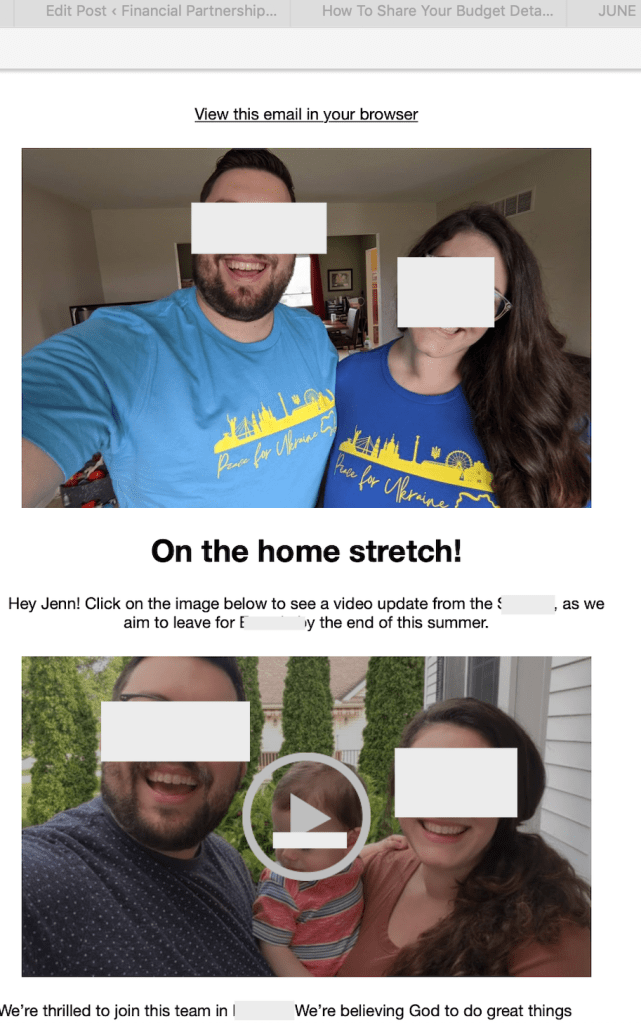
Lastly, below is an example of a good, but regular newsletter (in that it’s not overly fancy or hard to accomplish) that I recently got and thought I would share. *names and faces are blocked out for sensitivity. It’s also a bit chopped up but you get the idea) Here are a few things that I like about it:

  1. The video! We can’t see the actual here on the blog, so to sum up the content of it: it gives many more details on their ministry but does so quickly – it clocks in at 2:42. In the video the couple shares about one specific ministry win that recently happened. They also share that things are going well in their support raising season.They also announce in the video (while holding their adorable child!) that they will soon be doing a Facebook Campaign coming up to get them from 75% to 100% raised.
  2. They share with joy and passion!
  3. It’s a great example of a newsletter while support raising – It isn’t needy, communicates enthusiasm, is informative, and thanks the team.
  4. They mix up sharing with the video and some brief reading – which is such a nice way to engage with a newsletter.

This list of tips and do not’s is not comprehensive – just some of the things I believe are important to nail. I hope these thoughts on newsletters are helpful! Share your thoughts or tips in the comments! – JF

Support Raising Stand Out: Try Video Messaging

Standing out amongst a crowd is a good thing when it comes to support raising. Many ministry workers I talk to are continually looking for impactful ways to make themselves memorable. One great way to stand out is by making a strong first impression with well written and branded communication pieces. However, many ministry workers become frustrated with the lack of response they receive from their carefully crafted communication pieces, wondering where they might have gone wrong with only fractions of pastors and individuals responding to written pieces such as newsletters, emails, and texts.

I think I have a fun suggestion to solve for X.

Recently I got into a conversation with a worker that I coach (let’s call her Kate), and she mentioned she started video messaging pastors and individuals instead of using standard emails (she also substitutes video messages for texts, and some phone calls).

After she mentioned this I did what any good coach would do, and reverted to a classic coaching phrase “Say more about that“, (…honestly I was a little worried she was going way too far off the beaten path in her communication) and she began to explain how she had been using video messaging instead of using boring ole emails. To quote Kate:

I’m a X (omitted for security purposes) district ministry worker with Assemblies, and no one really knows who I am because I’ve never been in full time ministry before. My hope is that sending a video first to pastors puts a face to the name. Having something outside of the box helps and shows that, hey! I’m a human!”

To get specific, Kate is using a video messaging service called Bombbomb.com. BombBomb’s tagline boasts “Get more replies, save valuable time, and add a human touch with BombBomb video email and video messages.” Think about it: Have you have sent correspondence to a pastor/church or individual only to hear nothing back? Have you felt bombarded by emails and quickly skim or don’t even read many of your emails? Have you sent text messages out that read like books (tl;dr = too long don’t read) that haven’t gotten desired responses?

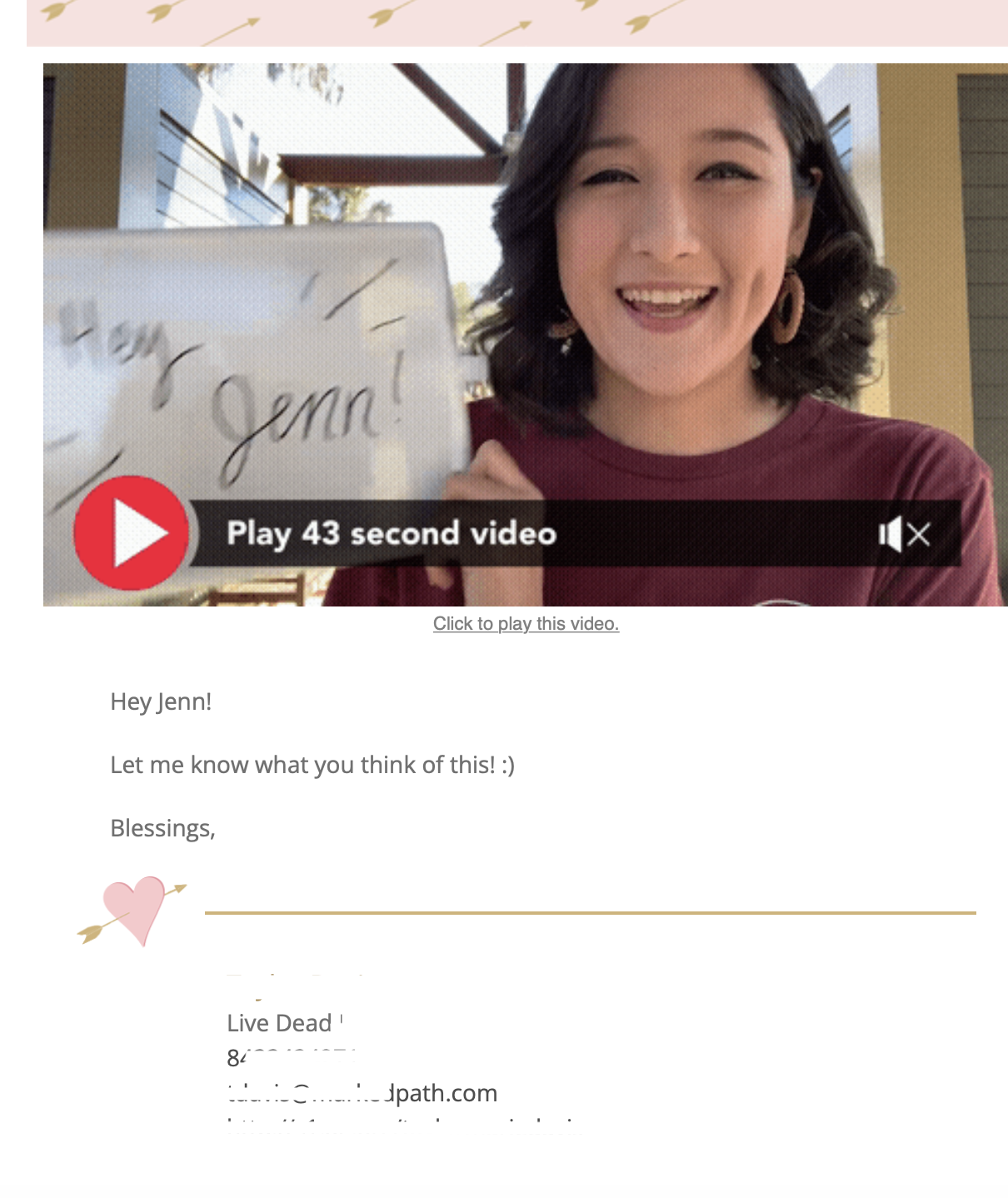
So why does video messaging work? Well, the thing that makes BombBomb so effective is that it embeds the video message with a gif-like link in the body of the email (you can also send these out as text messages!). It moves and shakes and gets readers attention instead of just having bland words in an email. The other thing that makes it so effective is that the video is personalized to the person. For instance, in Kate’s video to me there was a banner of Valentine’s Day (I got this in early February, they rotate the banners based on holidays, seasons, and preferences) and Kate brilliantly held up a personalize sign of my name that became the thumbnail / gif of the video. It made me instantly want to watch it and find out what she had to say TO ME. Not only that, I knew immediately from the banner that it was a 43 second video (you never want to make videos long!) so I knew it was going to be taking too much of my time. Here’s a screen shot of the email (some details omitted for security purposes):

So how did this experiment in video messaging work out for Kate’s support raising? Well, as Kate began sending this videos out to pastors that she had never met before, she started getting instant responses. With BombBomb, you can ask the recipient to record their own video back or respond to the email – which gives them a fun and/or a quick easy way to respond.

Interested? Here are creative some ways you could use a video messaging service such as BombBomb to stand out in your support raising:

  1. Emailing pastors / churches / missions boards instead of sending emails for an introduction
  2. Texting individuals and groups reminders for events
  3. Texting individuals, groups, pastors, or businesses for personalized communication
  4. Newsletters
  5. Follow up from a connect card
  6. As a thank you for someone beginning their support
  7. Quick prayer updates to supporters
  8. Saying a personalized “hi” to supporters while on the field
  9. There are probably a lot more that you can think of!

** Just a quick side-bar here: I don’t believe texting or emailing for face to face appointments with individuals should replace the phone call and this post is not about condoning that. However, if you are reaching out to individuals and numerous churches or businesses this idea could be perfect for you to help communicate in some of the ways above.

Kate has decided after trying BombBomb.com for free that she is gladly going to pay for the BombBomb Plus program (FYI there is a free option for Non-Profits!). She is going to switch her actual newsletters over from e-newsletters on Mailchimp to video newsletters via BombBomb (with BombBomb Plus you can send videos out to multiple people at a time). What a fresh take on a newsletter! Kate is also using BombBomb to follow up with groups.

Here’s Kate sharing some details on follow up with groups:

I shared at a (church) service yesterday! I’m putting all those individuals I talked with or gave me back connect cards in a group on BombBomb. Today or tomorrow, I’ll send that group a BombBomb campaign video email and say thank you, welcome to the journey, here’s what to expect now, and here’s monthly giving info, etc. I’m trying to find new ways to incorporate BombBomb in follow up tasks.”

What do you think? I think it’s BRILLIANT. Thinking outside of the box and standing out is becoming more and more important to the workers I coach, and I love that this is a unique and easy way to do that. Also, side note = bombbomb.com services are free for non-profits!

Have you tried video messaging? What are some ways you are thinking outside the box? What are some ways you are utilizing technology? Post it in the comments! I hope this idea sparks ideas that encourage you to stand out!

Click the link below to watch the full video that Kate sent me!

Great Idea: Use LinkTree For Support Raising

Do you ever wonder which link to use when directing people online to find out more about you and your ministry? Do you direct them straight to your giving site? Social media? Or perhaps to a website you maintain or your organization maintains? If you have multiple platforms and have a hard time deciding what is best — what if you didn’t have to choose?

Enter Linktree! And as their tagline boasts: it’s the only link you’ll ever need!

I’m not completely new to Linktree. It’s likely you are not either, and like me you have seen it utilized a few places. I’ve noticed them in a few of my friend’s Instagram bios, in some businesses, or even on various influencers pages who maintain multiple websites. I’ve also seen it used as a QR code link for large events. But I’ve never thought of it as a support raising tool until last week, when I heard a ministry couple (here I will call them the Meritt family) share their strategy using Linktree when speaking at various church services. So no… this isn’t a sponsored post in case you’re wondering! I just thought it was a really great idea worth sharing.

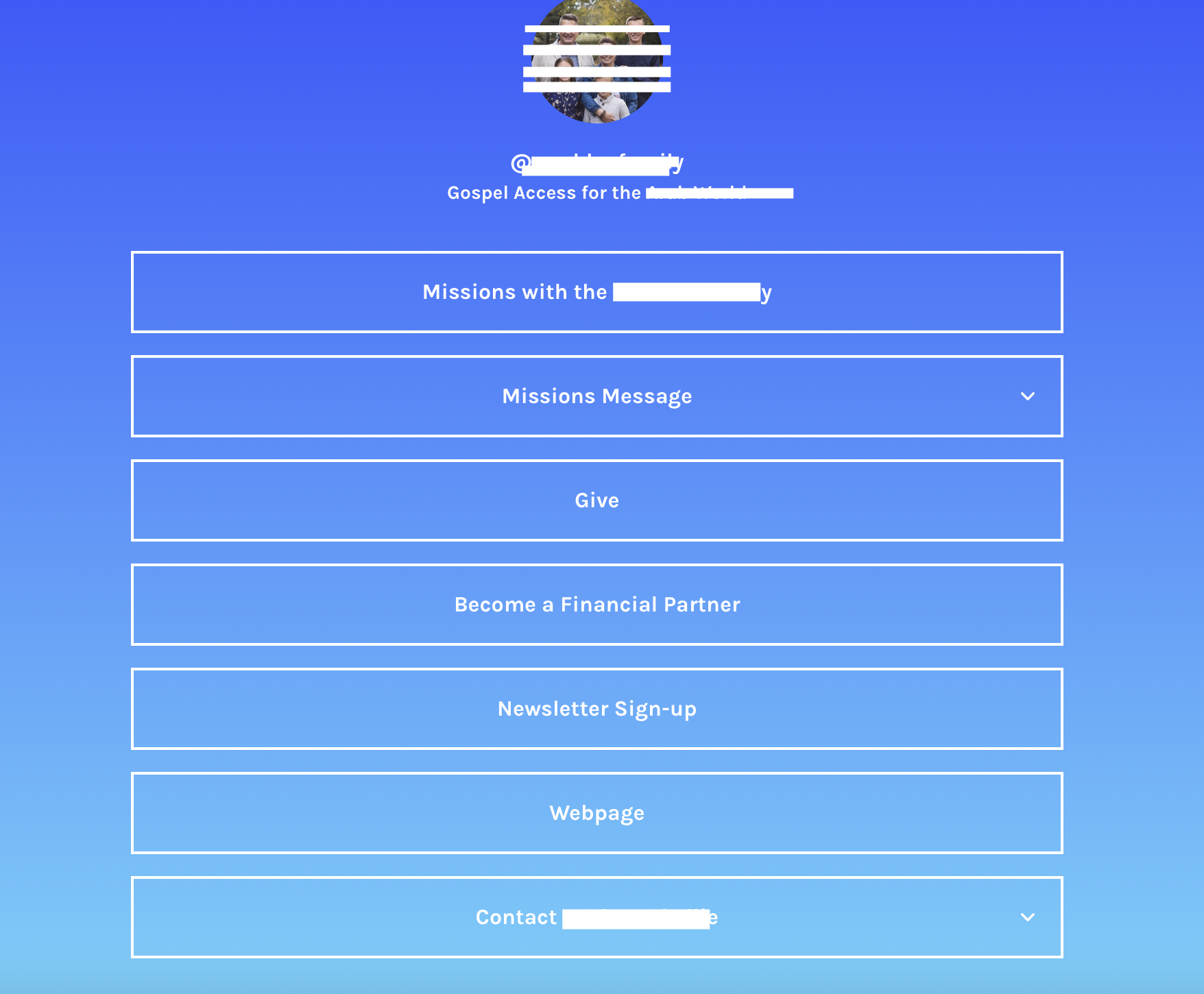
For those of you who aren’t aware of it, let me share what Linktree is. Essentially it’s a website you create that the user can click on whatever content/link you see fit – creating a simple hub of information. In this instance, it’s a landing page you can send someone to learn more about you and your ministry. Here’s an screen shot of the Meritt’s Linktree landing page:

Meritt family’s Linktree main page. Including (listed in order) their personalized organizational website, a sample missions message on You Tube, their giving site, another way someone can set up a monthly partnership, a newsletter sign up page, their personal website, and ways to contact them.

The Meritt’s Linktree has some very valuable information all in one simple hub. Examples of what else could be included on this Linktree or others like it would be social media pages, organizational information, various helpful websites, and a well maintained blog (there are likely a lot more I’m not thinking of!).

For the Meritt’s Linktree — I’d love to draw attention to what a great idea it is to have a sample missions message on YouTube; particularly as they often travel to speak at churches within our denomination.

Meritt family’s Linktree homepage, but the “Missions Message” button clicked on to give a 47 minute message on missions.

Here is a list of a few ways you may consider using Linktree in your support raising strategy:

Back of the Meritt family’s prayer card, that includes branding, email address, phone number, and QR code for their Linktree.
  • As your link in the signature of your emails.
  • For QR codes / printed materials on display tables at church services, events, etc.
  • As your link for a text message or email to individuals after a fundraising event, small group event, or face to face appointment (or during!).

I hope this idea of using Linktree for your QR codes and links is helpful! Do you have any other ideas for ways to utilize Linktree? Put it in the comments!

So You’re Doing Another Round of Support Raising? 9 Things To Get Started Early

This post was written originally in August 2018. But it was definitely worth a repost as a helpful little list of 9 things to do when entering back into a season of raising support. So if you are a worker who is reentering a season of raising support – this is for you! I hope you find it helpful! – JF

Recently, I attended a conference where I met with numerous workers who have lived off of support for a long time. Some of them had been in their assignments for over 15 years! Most of the workers I connected with are coming back home to enter into itineration and wanted some advice on how to best navigate a new successful season of support raising.

I found in my conversations that I was encouraging these workers to do several strategic things before they came back home, and I thought it would be helpful to share those ideas here. So, if you are already in your assignment and are gearing up for another season of raising up your team – this is for you! If you haven’t raised your support and haven’t made it to your assignment, tuck this post away for the future you! I hope these give you great ideas of where to start before you land back home. – JF

pre-itineration_31724110 (6)

I hope this gave you some helpful ideas! Below are some links with further information.

Here’s a link for more information on Connect Cards

Here’s a link for more information on Appointment Kits and Pastor Packets

Here’s a link for more information on Fundraising and Non-Fundraising Events

TEXT SAMPLES FOR FACE TO FACE APPOINTMENTS

TEXTING STILL ISN’T THE BEST WAY TO ASK FOR AN APPOINTMENT…BUT

I’m writing this post for a specific person. It may not be you, and that’s a-okay. This document is not for you if you are having success asking for face to face appointments via phone. I will always maintain that asking for an appointment via phone is far greater than asking via text message as it promotes relationship, and any time the word “finances” is read in a text it comes across like a billboard, generally drawing people away from responding. I stand by that thought and still agree with it. (read the link for more info!) Thus, if you are calling on the phone – pat yourself on the back and let me give you a high five from the internet. You don’t necessarily need to read any further. 

This post is for you if you are the person who is probably going to go ahead and text asking for an appointment anyway, even though your support raising coach and training has said it is 100% best to phone call and ask for face to face appointments. It is for you too if you are texting someone as a one off and don’t want to botch it, which I completely get.

That being said, I want to be clear that this post is not to condone texting for an appointment as the normal go-to, but knowing it will happen, at least if you text first you have examples of how to best word it. Okay! All that being said, let’s get into some samples. Well, in a minute.

WARNING LABEL TO THE SAMPLE TEXTS FIRST

  1. First off, an important distinction to be made here – THESE ARE TEXT MESSAGES…NOT social media direct messages (DMs). Yes, there is a difference and yes, it does matter
  1. DMs are never going to be as warm as a text message and 1,000% less warm than a phone call. (Pause here and think back to any times you have had people solicit you on FB Messenger en mass for donations. If you have ever had that done to you, you know it’s definitely not relational.)  If you don’t have someone’s phone number, DM and ask them for their contact info, but don’t DM any of these samples below.

***Here’s a sample asking for number and contact information on DM: 

“Hi Christy! Hey, how is Adam doing?? Heard he had a tough fall and have been keeping him in my prayers. I hope he is on the mend. Wanted to ask — could I get your contact info? Phone number, Email address, and mailing address? Zach and I are about to embark on a ministry journey and grabbing contact information. Thanks Christy.” 

  1. Don’t give too much information when sending a text message asking for a face to face appointment. Try to be as brief as possible while still giving needed information. Remember, you are asking for a face to face appointment (or in times of Coronavirus a Zoom appointment), not for them to join your team. You do not want to make an ask in written form or have your face to face meeting over text. Save the details for the appointment. It’s easy to make this mistake and not realize you are doing it, and then all of the sudden you are asking someone for financial partnership in a text. OOOPS. (that’s not a good thing) 
  1. It’s important to realize that there is a hierarchy of relationship when it comes to asking for appointments. Doing so over the phone or even in person is much warmer and relational than in a text. If you’re struggling with how to ask for an appointment – move down this list and start as high as you can! 
    • Hierarchy of warmth and relationship in asking for Face to Face Appointments:
      1. In person
      2. Phone call / Phone call + invitation letter first == these options are always best! 
      3. Invitation letter + Text message
      4. Text message
      5. Email
      6. DM

TEXT SAMPLES

TEXT SAMPLE 1:

“Hey Pete! Do you have time for a quick 2-3 minute phone call?”

(**Always my preferred option for a text message. Use the text to lead to the phone call. If they don’t answer you in a text, you still have the ability to call them later that evening or even the next day – just don’t wait too long. You can also try texting again.) 

TEXT SAMPLE 2: (*No invitation letter prior)

“Hey Taylor. Beau turned 1 years old?!?! WWHUUTT? The nerve of babies to grow. UGH. And how does time fly? Please answer life’s mysteries for me Taylor. I believe in you. 🙃

I don’t know if you’ve heard, but Zach and I are heading to Estonia to be workers with Assemblies of God World Missions. We are pumped. If you have no idea what I’m talking about: HA! 🤗 I would like to fill you in!! 

I’m reaching out because you recently came to mind. We are working on building up our financial and prayer partnership team and have to get to 100% before we can go to Estonia. I know you have been a major influence in my life and would love to connect about joining some aspect of our partnership team. 

Could we A. Zoom this week or next? (I’ll order us some Panera treats or Grub Hub while we meet if it works!) B. Grab coffee outside this week or next? C. Masks and coffee inside this week? 

Let me know what you think one way or another. Importantly, I want you to know that there’s no pressure. Except for you to solve life’s mysteries Tay. That I EXPECT. Love you, your friendship, and that darling 1 YEAR OLD. 

TEXT SAMPLE 3:  (*Invitation letter prior)

“Hi Rosie! I have been praying for you & Fred as you are recovering. My mom said you texted yesterday that you guys are on the mend- praise the Lord!💓 When you are feeling better, Zach and I would love to safely meet and share with you guys about our burden for Estonia, as well as invite you to partner with us, whether that be through prayer or finances. We are here until January 4th, so you just let me know when would be best. Much love to you guys!!❤️❤️”

TEXT SAMPLE 4: (*Invitation letter prior)

“Hey Ron and Kathie. This is Jenn Fortner. How are you all? Been thinking of you and of course Dustin recovering from COVID. I’ve been saying prayers since last time we spoke — How has he been since recovery? 

Would you be able to schedule a time to safely meet this week or next? Let me know if you are available and what works best for you, we are pretty flexible. We would love to connect, hear about how you all are doing, and share a bit more about what we are doing in ministry and see if it fits for you to join some aspect of our partnership team. 

Thanks guys. Most important note: Just want you to know we love you, your friendship, and praying that Dustin is well.”

NOTES

*some of these samples are written during COVID, so take “safely meet” etc out of equation once things go back to normal.

**One of these sample texts mentions “no pressure”. I left this phrase in because that can be helpful in some circumstances. I personally wouldn’t over-use anything that completely gets them out of considering financial support as an important option. I hear phrases from workers all the time like “prayer is more important” or saying during an appointment “consider support and pray about it” or “if you don’t want to it’s no big deal” — which are misleading statements and not always helpful. True, prayer is important but the best prayer partner is typically the one who is giving (Matthew 6:21). True you want someone to consider partnering but don’t throw that phrase into an appointment when now is the time to make the big ask, and they have been prompted to consider prior to your appointment. And finally, plainly said it’s not true that if they don’t want to support it’s not a big deal — even though we should hold yeses and no’s loosely in our hearts — it is a big deal if they join your team! Think through these phrases giving people outs carefully, and don’t overuse them. 


I hope this post and samples are helpful! – JF