I’m so excited to announce to you a brand new podcast for anyone support raising: Funded & Sent
Funded & Sent is a podcast specifically designed to walk ministry leaders and staff through the support raising process. It’s hosted by myself (Jenn Fortner) and my colleague and long time support raising coach Josh Sears, and each episode breaks down an aspect of support raising practically and provides proven strategies for building a healthy support team. We talk about everything from creating your contact list to having effective appointments with individuals and pastors.
The podcast can be listened to from start to finish (beginning with Episode 1 at the bottom of your podcast feed) or you can pick and choose topics based on where you need guidance, help, and fresh ideas. The goal is equip ministry workers that are new to the process, feeling stuck, or needing a refresher as they begin a new season of raising support — and to prepare each worker to be funded and sent into the calling God has placed on their life!
As I type this, we are working on outlines for at least 3 episodes dedicated to all things support raising with churches, including interviews with 2 amazing pastors who are going to share insight on how to best reach out to churches, what makes pastors excited and what makes them pause when it comes to ministry leaders support raising – and more. But for now, the first 8 episodes are up and ready to go! We are excited about what this podcast will be and resourcing more christian ministers to full support! If you like it, please give it a review and let us know! – JF
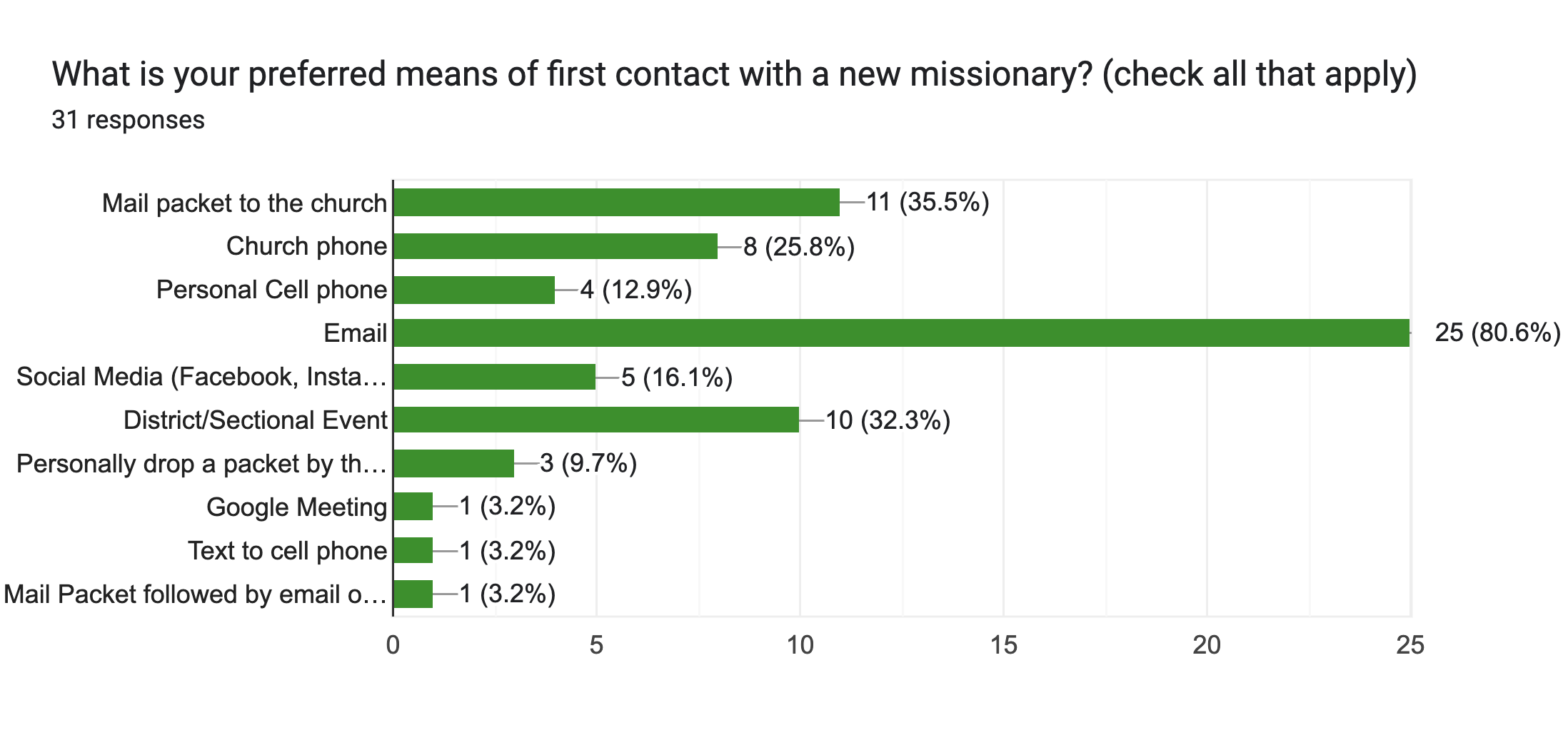
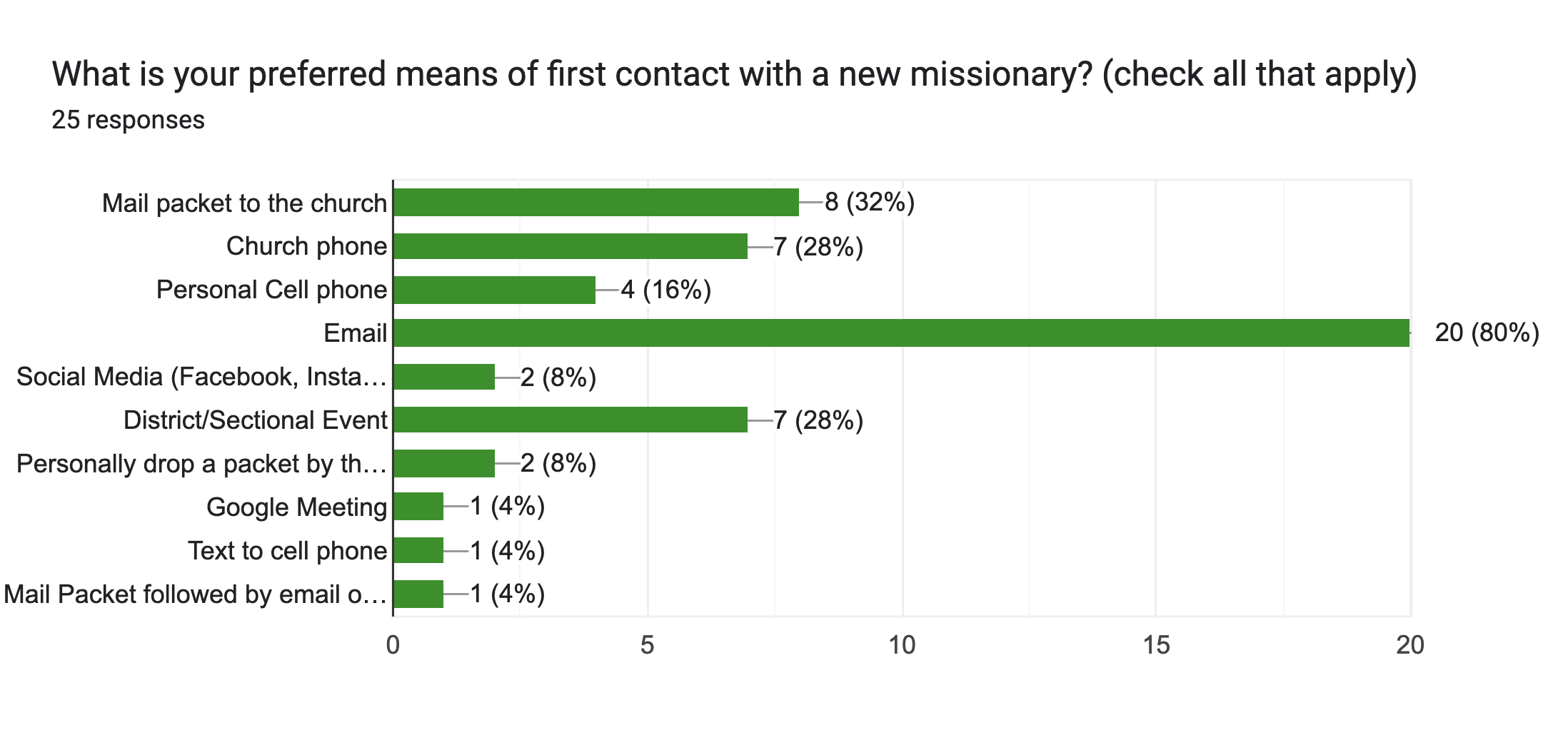
In a recent survey to a segment of Assemblies of God pastors, we found out that 80% of pastors we surveyed preferred getting an email as their first contact with a new missionary.
That being said, here are several samples that may help in sending emails to pastors for potential connection. Notice these emails are all brief, provide ample contact information, and include something like a pastors packet or one-sheet for the pastor’s further reference.
A few tips with emails:
If they don’t write back within a week, follow up with a quick email. It can say something like this:
“Hey Pastor Pete, I’m writing in reference to the email that I sent last week. I don’t mean to bug you, but I didn’t know if it got lost in the shuffle or if you saw it. Hope you are having a great week and would love to hear from you if you get a moment to respond! Thank you Pastor!” (include the previous email below as reference)
If they don’t respond via email, call their office or administrator.
If they don’t respond via email or the first phone call to the office, try calling again. (and additional times spaced out)
Try sending a snail-mailed pastors packet and then calling again / emailing again.
Keep all emails short, sweet and to the point. If you want to share ministry details, do so in an attached one-sheet.
Stay away from any impression that makes you come across as entitled to hear back from the pastor.
Feel free to include QR codes or links to your signature at the bottom with more information – like a Link.tree or Epistle newsletter feed.
TO A PASTOR YOU HAVE NOT MET
Hi Pastor Greg,
My name is Jenn Fortner and I am a newly approved Missionary Associate with the Southern Missouri District. I am going overseas for a two year assignment to Estonia with Assemblies of God World Missions on a Live Dead team.
We haven’t had the chance to connect yet but I am emailing to ask if perhaps we could. I would love to buy you a cup of coffee or come and bring one to you at your office. I wouldn’t take too much of your time — but could we somehow connect further and see if there are any ways I could serve your church and share more about missions?
Thank you for taking the time to read and I so appreciate you and 1st Assembly. I’m attaching a quick one-sheet that gives a bit more information about me and the ministry in Estonia, including a brief reference from my home church pastor at Solid Rock in Springfield, MO.
My name is Jenn Fortner. I am a newly approved (and excited!) Missionary Associate to Estonia. I would love to connect with you and your church further about Estonia and the Assemblies of God ministry that I am endeavoring to be a part of. Could we schedule a time to connect further? Whatever works best for you I will find a way to work into my schedule – whether thats Zoom, coffee, or me coming to your office with coffee. Thanks for taking the time to consider! Attached I have a quick one-sheet that gives a bit more information about myself and the ministry in Estonia. I so appreciate you and 1st Assembly of God.
It was so good meeting you at the recent District Council in April. To remind you – my name is Jenn Fortner and I am a Missionary Associate to Estonia for a two year term with Assemblies of God World Missions. Thanks for taking the time to connect further and being willing to set something up. I am writing for that reason! Could we find a time to connect further in the next couple of weeks? I would be happy to travel to your office and buy you a cup of coffee, Zoom, or even just speak over the phone. I don’t want to take up too much of your time but would love to share with you some details on Estonia and see if there are any opportunities to serve your church and connect further.
Thanks for taking the time Pastor Pete. I look forward to hearing from you!
Texting vs. Phone calls for face to face appointments — if you have been reading my blog on support raising or listening to me teach on support raising over the years — guess what? My thoughts have changed! I still maintain that asking for an appointment via phone is superior to asking via text message as it promotes relationship, and any time the word “finances” is read in a text it comes across like a billboard, at times drawing people away from responding. But a big fat caveat to that is this –texting to ask for an appointment totally makes more sense in a lot of situations. I have come to experience that there is nuance involved and we simply have to account for it. Also, text messaging for appointments with individuals needs a certain degree of finesse to pull off and come across relationally minded. With that in mind – here are some helpful sample texts for face to face appointments!
WARNING LABEL TO THE SAMPLE TEXTS FIRST
First off, an important distinction to be made here – THESE ARE TEXT MESSAGES…NOT social media direct messages (DMs). Yes, there is a difference and yes, it does matter.
DMs are never going to be as warm as a text message and 1,000% less warm than a phone call. (Pause here and think back to any times you have had people solicit you on FB Messenger en mass for donations. If you have ever had that done to you, you know it’s definitely not relational.) If you don’t have someone’s phone number, DM and ask them for their contact info, but don’t DM any of these samples below.
***Here’s a sample asking for number and contact information on DM:
“Hi Christy! Hey, how is Adam doing?? Heard he had a tough fall and have been keeping him in my prayers. I hope he is on the mend. Wanted to ask — could I get your contact info? Phone number, Email address, and mailing address? Zach and I are about to embark on a ministry journey and grabbing contact information. Thanks Christy.”
Don’t give too much information when sending a text message asking for a face to face appointment. Try to be as brief as possible while still giving needed information. Remember, you are asking for a face to face appointment, not for them to join your team. You do not want to make an ask in written form or have your face to face meeting over text. Save the details for the appointment. It’s easy to make this mistake and not realize you are doing it, and then all of the sudden you are asking someone for financial partnership in a text. OOOPS. (that’s not a good thing)
It’s important to realize that there is a hierarchy of relationship when it comes to asking for appointments. Doing so over the phone or even in person is much warmer and relational than in a text. If you’re struggling with how to ask for an appointment – move down this list and start as high as you can!
Hierarchy of warmth and relationship in asking for Face to Face Appointments:
In person
Phone call / Phone call + invitation letter first == these options are always best!
Invitation letter + Text message
Text message
Email
DM
NUANCE details. Just a few things to remember!
If you are reaching out to a boomer or a millennial for support — try calling! They will likely see it as more relational. You can always move into texting them if they don’t answer the phone after trying a few times.
If you are reaching out to a peer whom you text often – go ahead and text.
If you are reaching out to a person you haven’t spoken to in awhile, try sending an invitation letter first and then texting.
If you are trying to reach a pastor/church– this is a different process all together! Go to the search bar and type in “pastor” and you’ll find a lot of articles on the subject.
TEXT SAMPLES
TEXT SAMPLE 1:
“Hey Pete! Do you have time for a quick 2-3 minute phone call?”
(**Always my preferred option for a text message. Use the text to lead to the phone call. If they don’t answer you in a text, you still have the ability to call them later that evening or even the next day – just don’t wait too long. You can also try texting again.)
TEXT SAMPLE 2: (*No invitation letter prior)
“Hey Taylor. Beau turned 1 years old?!?! WWHUUTT? Its curious to me how time can move so fast. Congrats and I hope this year has been truly wonderful.. Hey – I don’t know if you’ve heard, but Zach and I are heading to Estonia to be workers with Assemblies of God World Missions. We are pumped. If you have no idea what I’m talking about: HA! 🤗 I would like to fill you in!! We are working on building up our financial and prayer partnership team and have to get to 100% before we can go to Estonia. I know you have been a major influence in my life and would love to connect about joining some aspect of our partnership team. Could we potentially grab coffee sometime this week or next? I’d love to chat with you more before we move, tell you what we are doing, and see if it’s a good fit for you to join some aspect of our team – whether thats prayer, finances, or getting our newsletter and communication pieces regularly. Let me know either way — and no pressure. We so appreciate and love you guys!
TEXT SAMPLE 3: (*Invitation letter prior)
Hi Rosie! Its been a minute. How are you guys? Hope you are doing well and congrats again on Emmerson’s graduation. 💓 Hey question — Zach and I would love to share with you guys about our move and ministry in Estonia, as well as invite you to partner with us, whether that be through prayer or finances or just staying in touch with our newsletter/communication pieces. We are here until January 4th, so you just let me know when would be best and if you are available / interested. Much love to you guys!!❤️❤️”
TEXT SAMPLE 4: (*Invitation letter prior)
““Hey Sam! Jenn Fortner here – hope you are doing well. I know it’s been a long time since the 1st Assembly days. I hope you all have been well. Hey – Zach and I are in the process of moving to Jordan for a 2 year term (probably longer) as workers overseas. We are spending time before we go building up our team of partners – comprised of those who are praying, giving, or possibly both. You and Jacob came to mind when we were thinking of people we would love to pray with us. Would you be available for coffee sometime in the next couple of weeks? My treat. I’d love to sit down and share details as well as just get a chance to catch up before we go. Thoughts?ing that Dustin is well.”
NOTES
**One of these sample texts mentions “no pressure”. I left this phrase in because that can be helpful in some circumstances. I personally wouldn’t over-use anything that completely gets them out of considering financial support as an important option. I hear phrases from workers all the time like “prayer is more important” or saying during an appointment “consider support and pray about it” or “if you don’t want to it’s no big deal” — which are misleading statements and not always helpful. True, prayer is important but the best prayer partner is typically the one who is giving (Matthew 6:21). True you want someone to consider partnering but don’t throw that phrase into an appointment when now is the time to make the big ask, and they have been prompted to consider prior to your appointment. And finally, plainly said it’s not true that if they don’t want to support it’s not a big deal — even though we should hold yeses and no’s loosely in our hearts — it is a big deal if they join your team! Think through these phrases giving people outs carefully, and don’t overuse them.
Raising support for your monthly budget and being in need of project funds can be… well, daunting. Like trying to bake two pies at once BUUUTTT they are both filled with different stuff and one takes more time than another to bake and you have curious hangry toddlers in the room and possibly a husband that wants to lick the bowl because thats just what he just…does. Wait….just me? Where did we go there? Anyway, you get it. Doable, but you might lose a little sanity in the process. But take heart: you are not alone. Many have baked those pies, fumbled through it, learned a few lessons, and somehow came out peachy with actual monthly support and project funding. (Miracles do happen. And now I’m hungry)
If you’re trying to figure out how to ask for both without sounding like a human GoFundMe campaign, this one’s for you.
1. Get Clear on the Ask: Monthly vs. Project Funds
Monthly = the messenger / people Project = the pathway
The Gospel requires flesh and blood. The work of ministry—especially in hard-to-reach places—demands presence and proximity. Project funds can build a building, but monthly support puts a missionary in that building.
In most circumstances I think it’s a good idea to keep your main ask for MONTHLY SUPPORT when you approach churches. Generally speaking monthly support is harder to get, and keeping the main thing the main thing will help you know where to start and focus. When you speak about your need – share that your biggest need is monthly support and share your heart and passion for those you are serving. Let that guide you. Then, when that is made known, tell the pastor how you want to minister – which is the project. And from there, you can pull out a business proposal (short with bullet points of specific dollar needs) and let the pastor know of that need as well.
When churches hesitate to support missionaries monthly but are eager to fund projects, there’s often a disconnect—not a lack of generosity, but a lack of understanding. It’s up to us to bridge that gap with grace and clarity, and perhaps quality print pieces or other materials that break down the specifics.
2. How to Reach Out to Pastors
Every pastor is a little different in the ways they prefer to be reached out to. There is one clear winner – at least according to this survey that was just started while I am fresh typing this post – and that is email. I still believe how to reach out to a pastor varies due to numerous factors. In some districts/ church cultures – Old-fashioned phone calls work best to initially reach a pastor. I suggest if you try to reach a pastor via phone and they don’t answer, After phone follow up with a short but nicely made email packet. (Key phrase: not a novel. Keep it simple and informative). In other districts beginning with a mailed pastors packet and then following up with a phone call may make the most sense. It could also be that what works for one church does not work for another. Stay flexible and tweak your strategy of reaching out to new churches / pastors based on your experience and what you find works best in your area.
3. Touch Points Galore (aka Holy Persistence)
We’re talking 15+ touches per church. Sometimes that’s what it takes. Stay persistent without being overbearing. Never be demanding or carry entitlement in the process. Serve and love and expect that these pastors and churches are busy shepherding their flock.
4. Start with an ask for a coffee
“I’m in the area—can I drop by for 5 minutes?”
You don’t need a service every time. You need connection. And coffee. Always coffee.
5. Heart Then (Get Down to) Buisness
Consider getting a business coach to help you develop your overall plan if you haven’t already done so. Tighten up any loose ends of how any project you may be pioneering may start and be comprised of, your costs, infrastructure, etc. (honestly, I’m not the expert here — but business planners / coaches can be!) – and then be ready to be flexible. Have a plan, and make it well thought out. BUT don’t be so tied to it in your pitch that everything goes wrong if the business morphs over time. Lead with your heart — then hand them the spreadsheet.
What’s at the heart of your business plan / project?!?! You. Your calling. Your why. Your passion. Again, we ask first for monthly support and then follow with the business (mostly). The heart of why you are there should lead you, then you can provide the details.
5. Handling the “We Only Do Projects” Response Like a Pro
Cool. We get it. Some churches just give project funds.
If you don’t have a project you are trying to fund immediately, here’s a potential response:
“Awesome! Thank you! If you give to project funds and are interested – here are 3 holes we need plugged in order to stay long term in X ministry / country. (gives fancy sheet that includes some of the following:)
THIS THING AT THIS COST (Language learning classes?)
THIS OTHER THING AT THIS OTHER COST (beds for hostel!)
THIS LITTLE THINGY AT A SMALLER COST (a laptop! a desk! kids something or other)
THIS HUGE THING WITH A LARGE COST (tuition for kids school? cost of an administrative assistant that is local)
If you do have a project you are trying to fund, respond by giving them a sheet with #5 (heart then business!).
No matter your response, when you share, I’ll say it again – share your heart – and not with your financial need plastered so in front of it that they can’t see your passion. Hopefully, they become kingdom-ly invested while informed. And some of those project-givers? Ended up giving monthly later on. Go figure.
Remind them gently and remind your own heart: Presence matters. Proximity matters. And projects are the pathway and are great too.
Some of the workers I train use Donor Elf while in a season of itineration because:
It’s connected to a large amount of ministries
It pings you when someone’s giving lapses
It saves your sanity 🙂
Pro tip: Add every contact. Take notes. If you have a spouse split the workload with your spouse. Do support raising work with roommates or others on your team also raising support. High-five each other often.
In Summary:
Make a business plan. Know it but flex with it.
Make monthly support your first goal, then share your project fund needs
Lead with your heart and passion, not your plan
Email people. Maybe call people. (I know, terrifying.) Or call people than email. Or email and then call. Or snail mail and then call. But probably emailing and calling is in there somewhere.
Be well thought out in what you need. Use bullet points and specifics.
Let pastors into your story.
Drink coffee.
Eat the pies (? I don’t know if that works here but I’m keeping it)
Repeat.
You’ve got this. Go raise support like a boss. I mean baker.
Raising support while actively serving overseas can feel daunting. How can we raise support relationally while being separated by time zones and ocean water? The good news is—with the right strategies, it can absolutely work. Whether you’re far away on assignment or involved in full-time ministry locally, these tips can help you strengthen your support base and grow your network with confidence.
Top Tips for Raising Support While Overseas
Here are some key strategies to help you stay well-supported, even while you’re serving on the field:
1. Ask Existing Supporters For An Increase
One of the simplest and most effective ways to raise additional support is by asking current supporters for a small increase—typically 5–10%—as long as they haven’t made an adjustment recently. A personalized message (likely emailed) that acknowledges their ongoing commitment with a hearty amount of thanks and explains the current need can open the door to increased giving. It’s a strategic first step that often yields results without the need to expand your network right away.
Keep in mind, these asks are best if you haven’t requested an increase recently or asked them for support within the last 6–12 months. This approach is mainly intended for churches and individuals who have supported you for over a year.
Here’s a quick email template you can take and make your own:
Subject: Hello from Sweden + Support Update
Hi Pastor Ed,
I’m writing from Sweden! I hope all is going well there. I wanted to pop in quickly and share a few updates with you.
First off, thank you to you and 1st Assembly for continually supporting Zach and me as we’ve moved through various assignments in Sweden over the past six years. You all make what we do in CITY/MINISTRY possible, and we couldn’t do it without our team. We love and value you and are so thankful for your ongoing partnership.
Second, I wanted to let you know that we have plans to extend our term another year (🥳), and we’re reaching out to our existing partnership team to ask for prayer and support in this effort. We’re needing about $1,000 in additional monthly support and $12,000 in special gifts to make the extension happen.
If you know of any other churches or pastors who might be open to connecting with us, please let us know. And if 1st Assembly feels led to increase or give a special gift, we’d love to hear from you.
Just to give perspective—if every church on our team increased their monthly support by 10%, we’d already be halfway to our goal!
As always, thank you so much. We’ll continue to keep you posted via newsletters and social media. We’re attaching our most recent update below.
We’d also love to hear what’s happening at 1st Assembly. Stay in touch!
Many blessings, Jenn (and Zach) Fortner jfortner@eurasia Sloane and Merrick
Giving #: ________ Sign up for Prayer Alerts: link__ [Attached Newsletter]
2. Use a Multichannel Approach
This is just a general tip that may come in handy as you think through ways to push out information on your financial need. Using multiple communication channels—newsletters, social media, phone calls, texts, videos, and Zoom—is key to effective support raising – period. Different people prefer different types of communication, so using a mix helps you reach a broader audience in ways that resonate with them. A multichannel approach increases the chances that your message will be seen, remembered, and acted on. So, if you are putting a goal of $1,000 increase in monthly support as you present your need in newsletters also use the same messaging in any social media (that you can based on security), phone calls or text messages (to existing partners telling them of your need), Zoom, emails, etc. I suggest starting with a great graphic and concise copy that you can sprinkle into all of your. communication pieces. Then, text or call or email your existing partners and let them know of your need (this may coincide with asking for increases – or point 1.)
3. Stay Connected and Communicative
As you grow into your role as someone who lives off of financial support, communication with your existing partnership team should become part of your regular lifestyle—not just something you do when you’re actively raising support.
While group updates are important, nothing replaces personal connection. Reach out to key supporters via direct emails, texts, phone calls, or Zoom. Just because you’re overseas doesn’t mean you can’t maintain meaningful relationships. These touchpoints deepen relationships and create opportunities for further engagement and support.
There are tons of great tools out there for staying in touch, especially when itineration time is limited. Use them to check in, express appreciation, and ask for small increases when appropriate.
If a financial partner’s giving stops suddenly, don’t assume they’ve pulled their support. Often, the issue is something as simple as an expired credit card. A quick, friendly message to check in can resolve the issue quickly.
If you don’t follow up, you may unknowingly leave money on the table. Many partners are grateful for the reminder and are happy to update their info once they know there’s a problem.
Here’s a sample template from another worker you may use as you communicate with anyone who has lapsed on their giving:
We pray you are doing well!
I spent some time today catching up on our financial stuff and it looks like the last time you gave was on 8/20/24. Are you wanting to continue giving each month, or are you needing to adjust your monthly commitment? 🙂
(If you didn’t realize your giving stopped, the most common issues are either your card on file expired or you had a “deadline” for your giving from when you originally signed up to give.) If either of these were the reason your giving stopped, let us know and we can help walk you through how to restart your giving.
Regardless of if you’re able to keep giving, we are so thankful for your financial sacrifice thus far. Please let us know what you plan to do so we can keep our financial records up to date!☺️
We love you and are praying for you!
C&C
5. While on Assignment, Make It a Ministry Team Effort
Support raising doesn’t have to be a solo act. Creating intentional time with your ministry team—or even just a roommate or fellow worker—to work on support together can be a game-changer.
Set up a “support raising work party.” Think: cookies, coffee, laptops, thank-you notes, postcards, and good vibes. Working alongside others helps make the task less overwhelming and more enjoyable. (Bonus points if you take time to pray for your supporters as a group.)
Whether it’s writing updates, reaching out to lapsed supporters, or brainstorming fresh ideas, doing it in community builds momentum, accountability, and encouragement.
6. Try a Facebook / Social Media Campaign
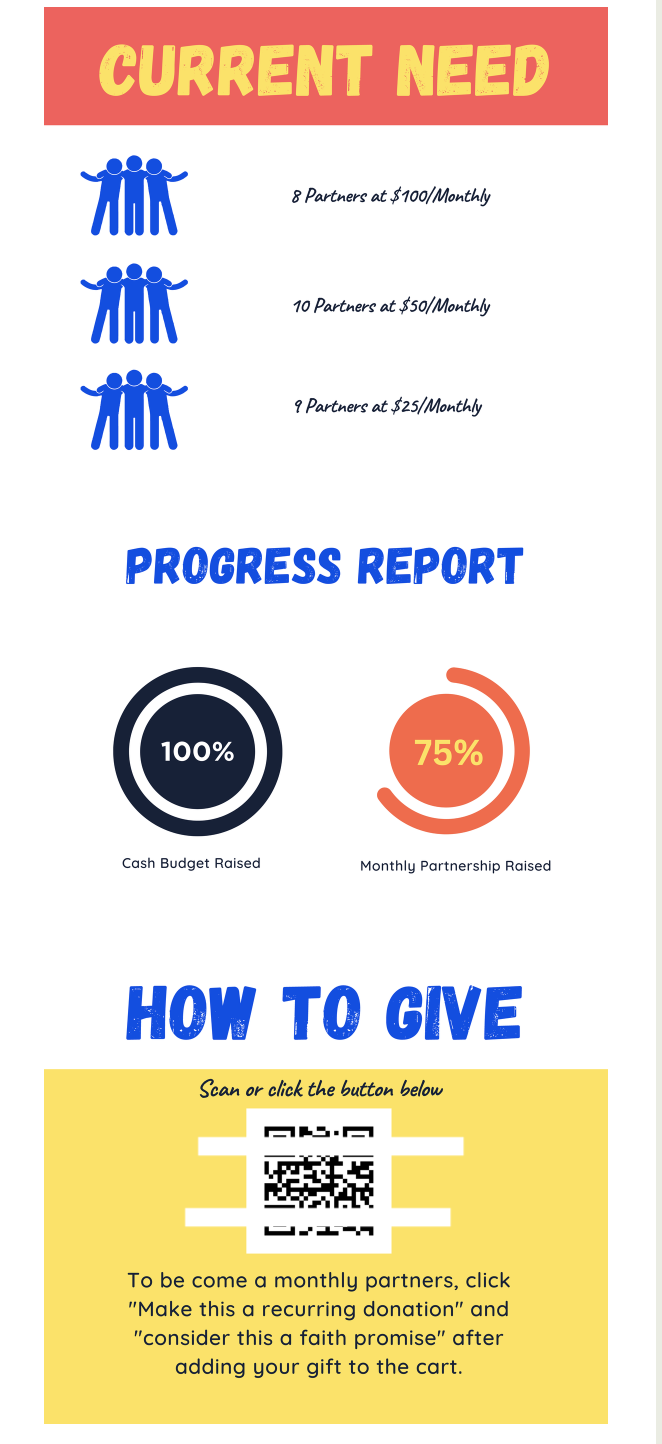
You may try in your multichannel approach to existing partners to do a social media campaign. This would include coming up with a specific goal (10 partners at $50 a month), creating a great graphic, creating posts, and getting together a team of campaigners who can post on their walls on your behalf – spreading your need farther than you could get on your own. This is a bit of an older post that explains the basics in more detail.
What’s Next? Action Steps to Try
Feeling inspired? Keep in mind, creating a concrete goal and thinking through your overall strategy before jumping in may be helpful – but here are some simple things you can do to begin!
Draft an email template to use when a financial partner’s giving stops—having it ready will save you time.
Post a heartfelt “just because” thank-you to your support team on social media or via your newsletter or text.
Take 10 minutes this week to pray intentionally for a segment of your supporters, then send them a message letting them know. (then, see if you can repeat that every month)
Schedule with your ministry team on assignment (or a roommate or anyone you know who is also on financial support!) a regular team session focused on prayer and partnership development.
Personally connect with your supporters in a different way than you have before—maybe even by postcard!
Host a Zoom webinar from the field to share updates and answer questions to your existing partnership team. Record it and share it widely (as you are able to based on security)
Draft an email to send to pastors and then another to send to individuals supporting you asking for an increase. Don’t forget to include in the email the ask of referrals as well!
Start thinking through who may help you do a social media campaign, keeping in mind your need for security!
This post was originally done in 2020, and wanted to freshen it up! – JF
What happens if you are months into your assignment and you notice that the support of one of your financial partners has come to a screeching halt? Would contacting them be awkward? How would you word such a conversation? Here are some tips on how to deal when giving drops off:
If someone’s support drops off, try to deal with it relatively quickly. Don’t wait 4 or 5 months (or yikes…even longer) to reach out. I think waiting until the second month is okay, but I probably wouldn’t go beyond that if you can help it.
If someone stops their giving don’t assume that they don’t want to give any more. It could likely be a credit card expiration situation.
If someone’s support drops off contact that financial partner! Personally I would use email or phone call to connect, and I would stay away from less personal spaces like Facebook Messenger or text. Here’s a sample email or phone conversation:
“Hey Paul! Hope you are doing well! Things here are going great as we continue building the school. We’ve made some huge progress within the past two months and it’s built up morale in the midst of some national unrest at times. It’s also lead to a lot of really great ministry moments recently that I’ll be sharing more in depth in my newsletter coming up next week. Excited to share more! How are you all doing ? Everything ok with you and your family? Would love to hear more. // I want to reach out because I noticed in May that your monthly support did not come in. I’m wondering if that is a credit card issue / expiration or if there are other circumstances? Let me know if you could either way. I would love to be praying if you have any specific prayer requests and thank you for the continued support in ministry, it has and does mean more than words can say. I’ll be attaching instructions to the bottom of this email if indeed it is a credit card change. Thank you Paul!” (*include giving information, instructions on credit card changes that are extremely user friendly, and your contact information)
If they don’t happen to answer, don’t give up, try to reach out in another way. And/or if you are emailing and don’t get a response, wait a week or so and pop in with a quick email that says something like “Hey Paul, just checking in. Did you happen to get the email I sent you on a couple of weeks ago in the beginning of June?”
If they answer back and let you know it’s a credit card expiration, I would respond by providing them again with the needed information to make the change. Do as much of the work as you possibly can for them, and make it AS SIMPLE AS POSSIBLE for them to complete the task.
If they answer that they won’t be continuing and their financial abilities have changed say something along the lines of:
“Hey Paul, thanks for letting me know about the situation that lead to a pause on the giving. It truly helps me. Thank you so much as well for your giving over X amount of time, words cannot say enough how grateful I am. If it’s okay I would love to touch base with you later on down the road and see if jumping back on would make sense after the challenges you are facing pass – and will be praying for you in the midst of it. I’m sure it’s a challenging time and I’m so sorry you have to walk through that (*or whatever helpful language works here based on relationship and challenge they are facing*). I’ll continue sending newsletters and thank you for your continued prayers. If you would like to not get those any longer let me know and I can take you off the list. Again, appreciate you and your family and will stay in touch.”
If you send this back to them set yourself a calendar reminder to email or text them in a month or two just to simply check in and ask how they are doing. There should be no other agenda for that touch point unless they initiate it. Tell them you have been praying for them (and indeed – pray for them!) and let them know you were thinking of them.
Just as a reminder, stay relational with your partnership team! According to Bill Dillon’s statistics in his book People Raising, 66% of people stop giving because they don’t think that you care about them or their giving. Don’t be that worker that goes off to their assignment and forgets the team beyond you and behind you that makes it possible! If that is the case, you will likely have people drop off.
When it comes to raising support, relationships can have tricky nuances that come in wide variety. One potential partner you may see every day and have a strong relationship with, and another you may not have talked for years. In most every circumstance, the best practice of asking for financial support of an individual remains tried and true – face to face appointments. However, at times you may find yourself in a circumstance that is not so cut and dry on how to get the appointment.
Throughout your process there will most likely asks that take some additional thought to navigate correctly, and thus here are several helpful rules of thumb that could help navigate those more nuanced circumstances:
1. Always default to the most relational means possible when making the ask.
At times you’ll question how to best approach a potential partner and ask for a face to face appointment. Say you see someone on your contact list at church on a regular basis and you are wondering if you should send them an invitation letter in the mail first, go up and talk to them to ask for an appointment, or phone call them? Maybe text? How do you know what is best? My general rule of thumb: go for what is most relational! The most relational may mean walking up to them after church and asking for a appointment.
When deciding how to approach it – it may help to see the roles as reversed – think about how you would want to be approached for an appointment if your potential partner was the one asking you.
2. Check your motivation if you aren’t reaching for a face to face appointment following the basic process.
Are you veering away from calling an individual asking for a appointment because there is a more logical way (such as talking to them in person), or is your motivation to get out of making a phone call because it feels scary and awkward to you? If there’s a more logical and relational way in a special circumstance, that may be okay, however stick to the process for the bulk of your asks. If your motivation for doing something like DMing instead of calling someone is off (ie. your trying to cut corners due to lack of time or because you just don’t want to make phone calls), please be honest with yourself about that and go back to the basic process (invitation letter or phone call + appointment).
3. If it feels awkward to send an invitation letter, call first. If it feels awkward to call first, send the invitation letter first. I believe at times sending a invitation letter before making a phone call can be an helpful way to start a conversation of potential support.
What is an invitation letter?
A simple one page letter with a brief (very brief!) summary of what you’ll be doing in ministry and that you need to raise 100% of your finances.
A good invitation letter mentions that YOU will be contacting them soon (within a week) to connect with them further about your assignment, it does NOT say that they should get in touch with you. Always seek to keep the ball in your court!
Should be followed up with a phone call (or the most relational means to approach – see number 1!) asking for an appointment, as invitation letters are a invitation (hence the name!) to further conversation.
Invitation letters DO NOT give a lengthy dissertation of your future assignment or calling, but briefly outline the basic details.
Invitation letters DO NOT ask for finances. Ever.
Includes a catchy (but brief) intro.
Always includes a handwritten ps. (that will be the first thing they see and read!).
Includes your basic contact information.
Invitation letters can be helpful when you want to break the ice before making a phone call and to give your potential partner time to pray and consider support before you call.
A great rule of thumb is if it feels awkward to make a phone call first, then send an invitation letter first. If it feels awkward to send an invitation letter first, you skip that step and go straight for the phone call.
4. If someone lives too far away for a face to face appointment, either set up a FaceTime / Zoom Appointment or wait until you will see them.
Sometimes setting up an appointment isn’t cut and dry due to the proximity of your potential partner. Say I live in Missouri and a friend I want to ask for financial support lives in Alaska, and I have no reason to travel to Alaska nor them come to Missouri. In that type of circumstance it is likely that I will be connecting with them in another way other than face to face.
A great rule of thumb here is to try first to seek out a virtual meeting using your their preferred method. Simply call them up like you would if you were asking for a face to face appointment, but instead schedule a virtual meeting time. (It’s always going to be better to actually see someone when you make an ask, as the connection overall will be richer!)
Of course, there will be circumstances in which someone is not able to meet virtually. Say for instance my friend in Alaska has never used FaceTime or Skype and wouldn’t know the first thing about accepting that type of call. I would then divert to making the ask via phone with that individual. When doing this, check to make sure they have time for a lengthier phone call, if not, schedule the phone call for another time (but don’t just say I’ll give you a phone call another time – truly schedule it with a date and time). I would then proceed to do the shortened version of my appointment over the phone live or at the scheduled time.
In another variance, it may be that your potential partner in Alaska will be visiting Missouri at some point in the future while you are raising support. Simply wait until closer to the time they are coming in town to phone call for an appointment or send an invitation letter.
In yet another variance, it may be that you will be visiting Alaska but not for several months. In that circumstance it may be better to hold off on contacting that individual until about a month (you want to give plenty of time for a heads up that you are coming so that you can schedule an appointment) prior to your scheduled trip.
5. Remain confident in your calling.
Whatever curve balls a potential partner is throwing at you during an appointment or prior to the appointment, try to focus on remaining confident in your calling! By following the call of God on your life, I promise you are super inspiring to those around you! Remind yourself on the daily why you are raising up a team and how God has called you. And of course praying and asking for God’s guidance will always help when those curve balls come.
Do you have a special circumstance you have questions on? Shoot me your questions in the comments!
Several years back I did a blog post on Pre-Itineration for anyone who was about to come off of a ministry assignment into a new season of support raising. I get questions all of the time as to where to start if you have existing support and are coming into a season of raising additional support. Usually additional questions follow, such as:
How much time should I spend on engaging existing supporters and asking for increases?
How much time reaching out to pastors and churches is appropriate?
What do I say to those who have supported me when I come home? What’s the best way to communicate with them?
What should my newsletter reflect?
Where do I start again?!?!
To expound on the old blog post, I wanted to create something particularly helpful for a worker who has raised a full budget and is coming home from being overseas to raise additional support. However, this post isn’t only for the overseas worker, and there of course can be multiple reasons for raising more support. Whatever the case it is for you, I think you will find this blog post helpful to think through your strategy or at least for tucking away for when it’s you find yourself in this situation.
To communicate some ideas on the subject, I chatted with two AMAZING overseas workers (thank you so much to both of you!!!) who have recently come back to the States to raise additional support. First, we will start with my friend Emily* (yup — named changed for security). She has lived overseas on assignment for multiple years and recently came back to raise support as a career worker. When she came back to the States she knew she had an increased budget and that she would like to return to country as soon as possible. I asked Emily some questions about her overall strategy such as where did she begin and what did she specifically do? Keep in mind, within our organization Emily is allowed and encouraged to ask a lot of churches in our denomination, and her answers reflect that ability. Below are her responses.
Question 1: Emily, where did you start with your support raising as you made the transition from first term to second?
“I will give you the whole timeline! Just a note, A and B are where I started with the initial announcement to my supporters of what was next as far as my assignment goes, but it was really what I did later on the bore the most fruit.
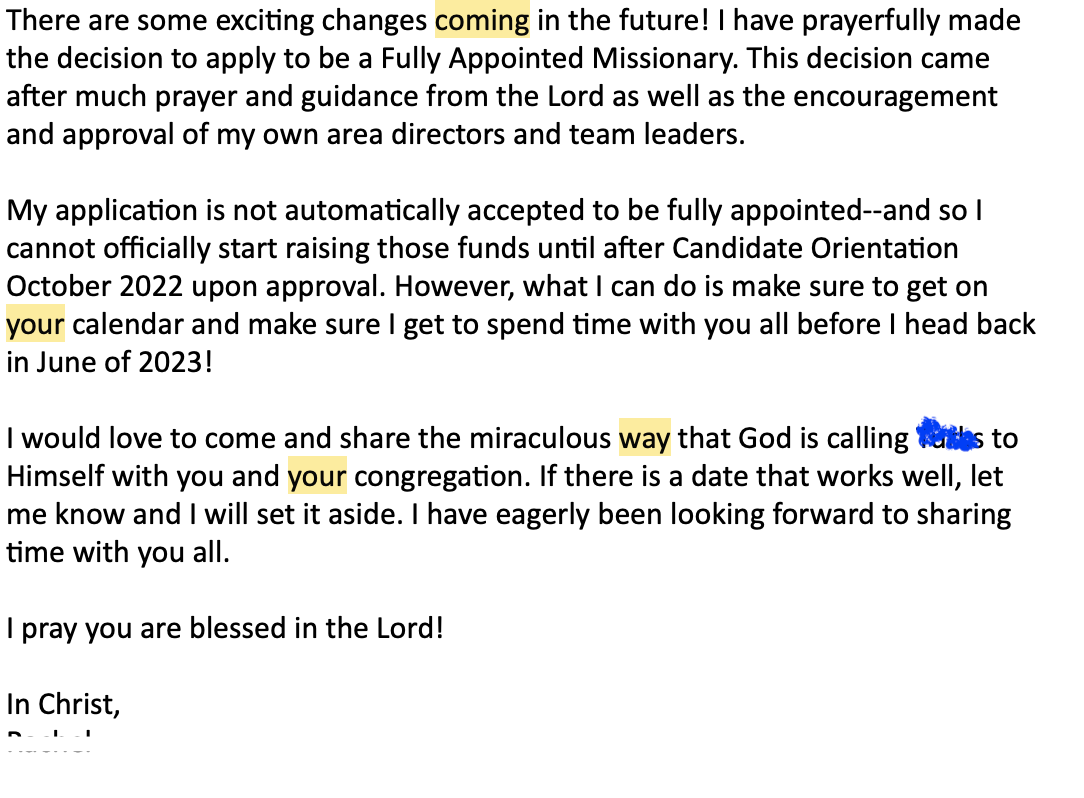
A: About six months before the end of my ministry term, I started by reaching out to my District Director (our denomination gathering of sectional / local churches) to let him know I was returning to the States soon. I did this specifically to ask him if I could begin getting on calendars of churches before my official approval as a worker going from associate to fully appointed. Every district is different, and he gave me the green light to start calling those I had relationship with to get on their calendars for services and to inform them of my transition.
B. I sent out two emails initially. One to churches partnering with me and another to individuals currently partnering with me. I informed them of my next steps without getting too detailed about things that would confuse them–and focused on the fact that my budget was increasing. I thanked them for their faithful partnership. I asked them to consider increasing or even doubling their partnership. (Some fruit came from this -those who wanted to increase, did).
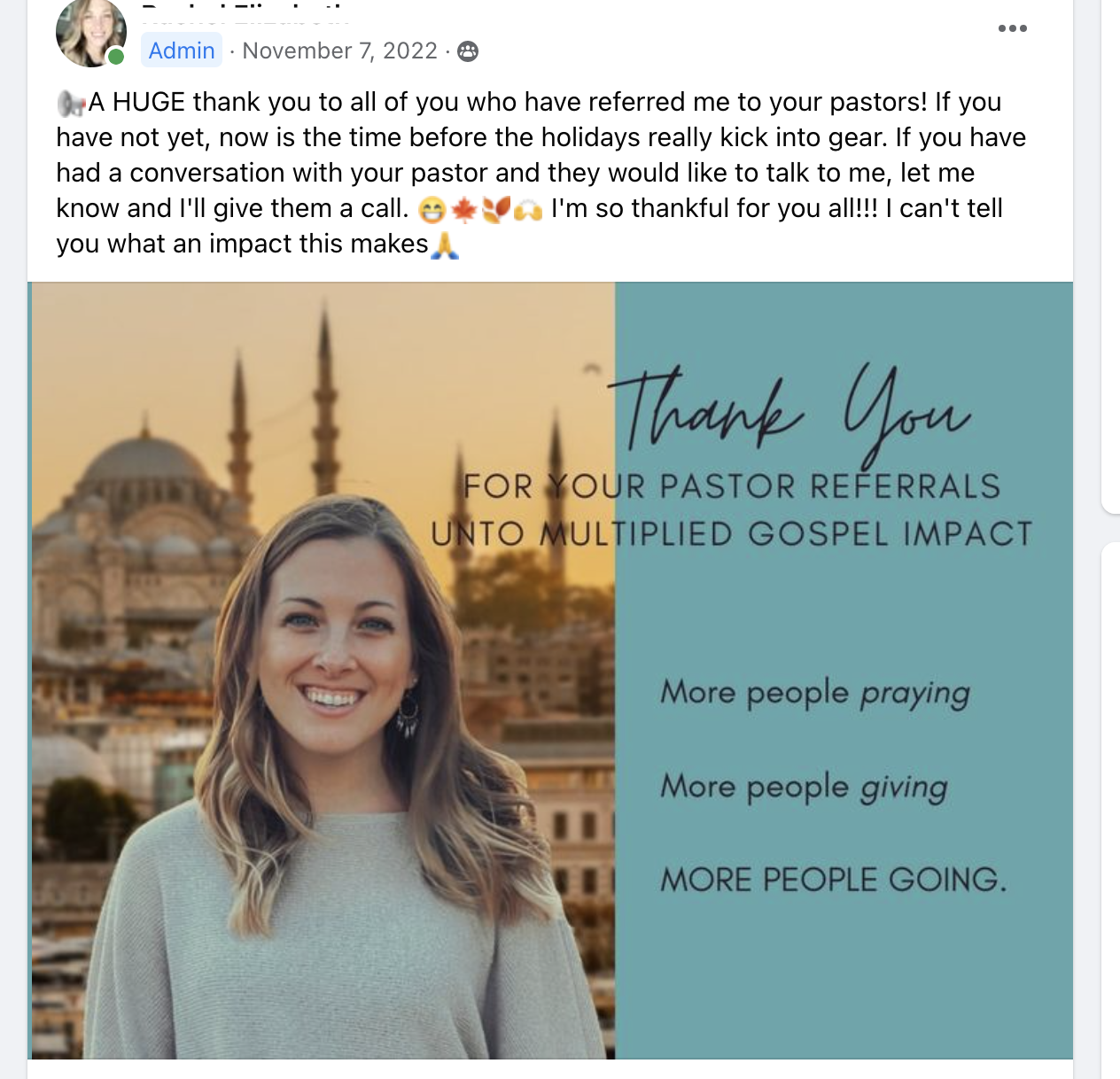
C. THIS was super fruitful: I posted a social request asking people to connect me with their pastors. I had a lot of response from this! I made sure to cast vision that they were multiplying my effectiveness by getting me into their churches. (I have attached this post)
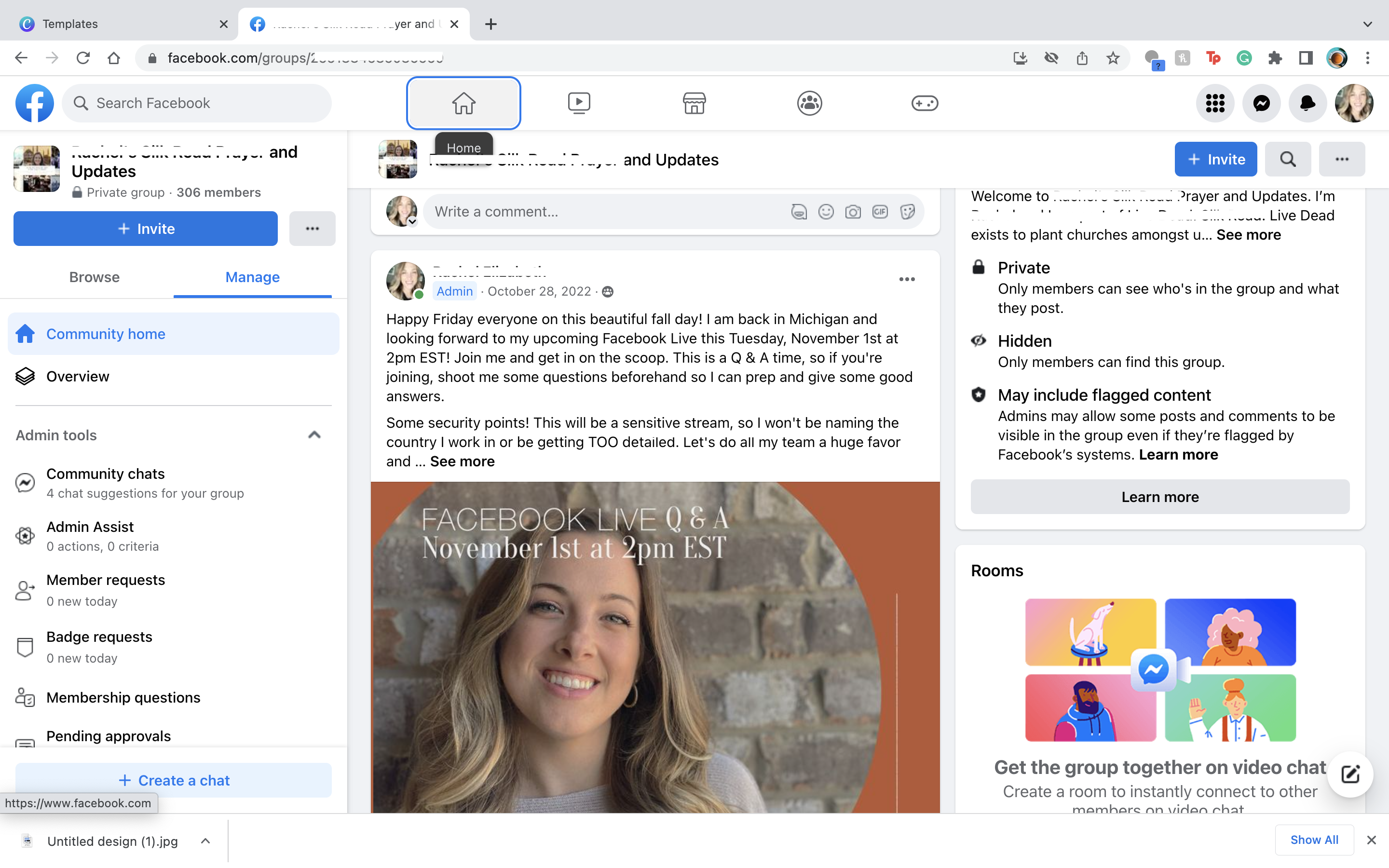
D. I did several Facebook Lives leading up to Giving Tuesday. What was effective from this, was that is seemed to make people want me to speak at their church. I didn’t get a lot of gifts but got a lot of invitations which then led to pledges.
E. Sent Pastor Packet > Follow up call > Follow up email> Repeat. This can seem so extremely monotonous and time consuming…BUT
I sent out packets with a case document,prayer card, and a handwritten note. I included in the correspondence that I would be calling them soon.
I diligently called through my district twice.
I emailed every pastor I could find an email address for directly following the phone call/message.
That three point of communication was a winner for me. I had conversations with many people, not on the initial phone call (leaving the message is what is valuable there if they don’t pick up, so you can even do this on weekends), but usually on follow-up. On each mode of communication, I mentioned the others (I’ll be following up next week with a call … ) to let them know I was planning on a conversation and not just sending them information.
F. OK, the magic here for this last one was connecting with pastors at District Council towards the end of my itineration journey getting my final percentages. I walked into general council at 85%. I emailed our District Director to ask him if they could highlight me on stage and finish me up (you never know unless you ask!) and he gave me a two-minute window that got me in front of everyone I had been having conversations with. This led to the final commitments I needed and many conversations. I believe District Council (again, our denomination gathering of sectional / local churches), if done well and preferably later in your itineration journey, can be very effective. THIS was when I looked back at all my calls, emails and mail-outs and really saw that they had been fruitful and worth the time because everyone in that room knew who I was from previous communication–even if I hadn’t heard from them.
Question 2: Emily, what did you focus your time on and how?
I spent the majority of my time making phone calls, emailing, and keeping up records (an ongoing spreadsheet of communication), and this will come as a surprise, but also writing thank-you cards, even when people said no. Those phone calls, emails, records and thank-you cards took the most time. However, it was also the most fruitful times as those phone calls and email led to appointments and services, which led to partnership.
A phone call tip: If you have a reference, use it! Ask your District Director if you can use their name. Something I routinely started with was “Pastor ____ told me to reach out to you as I itinerate”. It may sound pushy but it just lets them know that someone they respect is pulling for you and they should too.
Below are some screen shots of posts and copy I have referenced! – Emily
I also made this and used it recently in an email. I modeled it after an update another worker couple I admire recently did.
Okay, that’s Emily’s wonderful strategy! The second worker couple I’d like to highlight are the Smiths. They are currently raising support for a longer assignment as career workers and have developed some excellent materials to give to pastors and individuals I’d like to highlight.
First, I’d like to highlight the Smith’s pastor packets. The Smiths are emailing these to pastors whom they have not met with a handwritten note that says they would love to connect with them and will be calling within the week. Notice the packet information is several pages long as opposed to a shorter Case Document. (Case Documents are also super effective – but a longer version could be helpful in some circumstances like this!) Here’s a few snapshots of the packets.
The Smiths are taking this same packet and tailoring it for individuals (which by the way is such a cool idea!). They have made changes to the packet that include the levels of giving chart below (instead of full budget details that are given in the pastor / church packet). They have also changed the individual packet to include individual friendly language and change the size to be a mini packet.
Included with the mini packet is a handwritten card. (see below)
I hope these ideas help as you begin to craft your strategy for entering into a new season of support raising! For other ideas on how to get started: check out this post I mentioned in the beginning. Have any great ideas that have worked for you? Share them in the comments!
2022 is coming to a close and it’s already time to start talking about your Year End Giving strategy. It may feel early and still be 90 degrees outside, but grab a PSL and lets get into it.
I say this every year – but November and December are statistically the best two months of the year for giving. Around 30% of ALL GIVING in the United States occurs in the month of December. 12-13% of giving occurs in the last three days of the year. And maybe you aren’t singing the Jingle Bell Rock just yet but here are some things to think about ahead of time to get your strategy in place NOW.
First off, in September, October, and early November, it’s great to focus one’s efforts on face to face appointments. If you can, kick it into overdrive and set goals for more appointments and initial contacts than usual! Why? Well, typically speaking it’s one of the easiest times of year to schedule appointments. Summer is over and people are into routine, school is back, people are checking their calendars and not overwhelmed with plans. After Thanksgiving is when things should shift from business as usual face to face appointments to Year End Giving mode. Toward the holidays there are additional touches you can create to show your existing team you care as well as generate some excitement and cash gifts. (see below for the ideas!)
Thirdly, September and October are also excellent months of the year to reach out to churches. Churches typically schedule services months in advance so calling in September or October may get you service in January or February 2021. If you wait to reach out to a pastor/church until November or December, you may get radio silence until January due to the church’s busy holiday schedule.
Lastly, consider creating a specific goal for all of your Year End Giving and try a multichannel approach that all work together to support that specific goal. Maybe you want to raise $3,000 for your language learning costs, get $200 in new monthly support, or reach 75% funded. Just make sure it is reasonable and attainable.
With all of that being said, here’s a break down on some specific ideas for your Year End Giving strategy.
1. GO LIVE
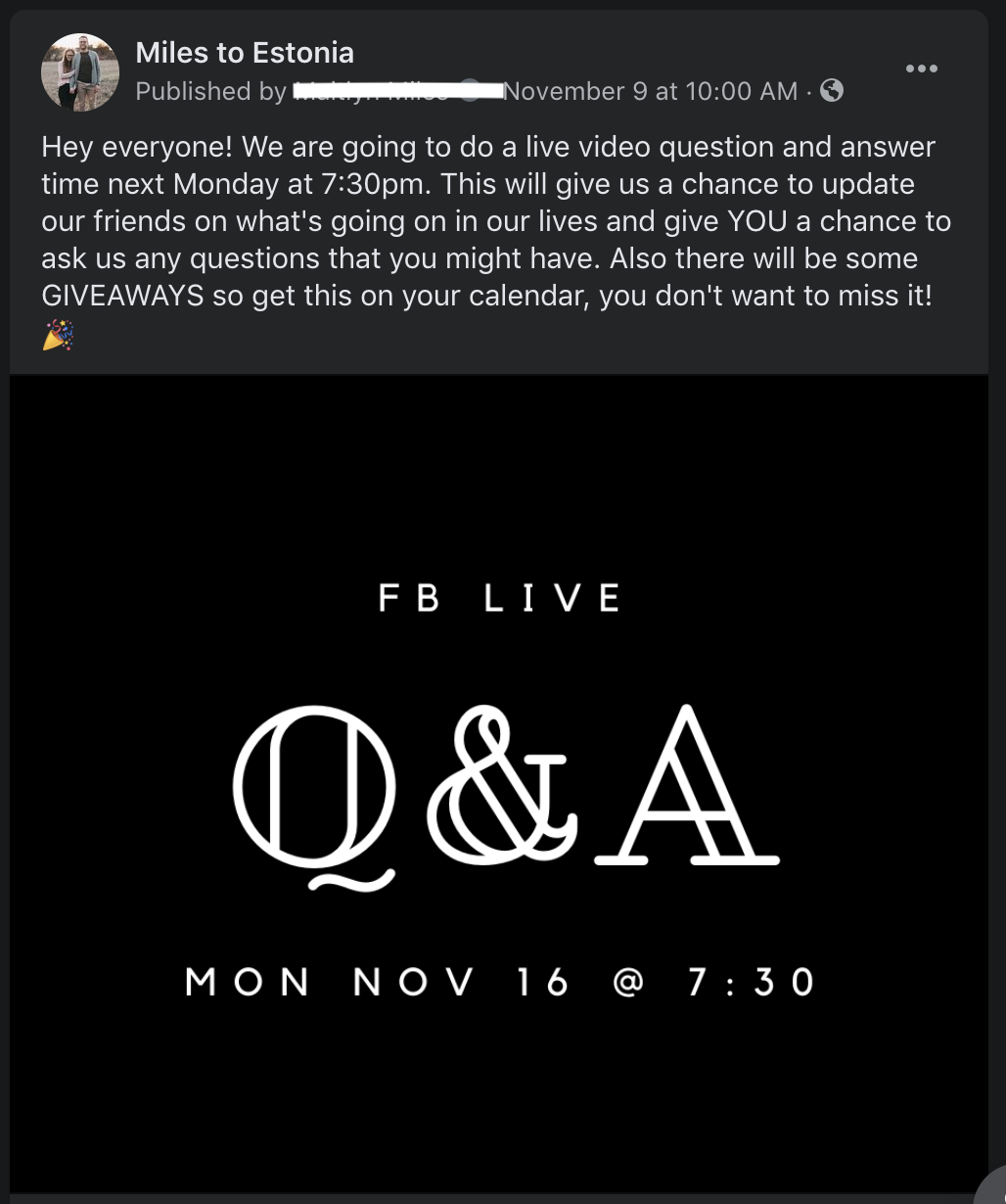
Facebook or Instagram Lives / Q&As could be a great way to generate some excitement and cohesion with your team. The main content of a FB Live (or Instagram if that’s where the bulk of your supporters are) Q&A should be comprised of giveaways, trivia and information on your assignment, and questions from the audience. When you do yours, I think it’s important to stay simple and fun, and promote it however you can before hand. Lives can be great for a deeper dive on you – as people following you can hop in after and watch the recording if they cannot make the specific time. That being said, I think doing multiple Lives during the months leading up to Jan 1 are a good idea, but if you were only going to do one I would consider doing one somewhere towards the beginning-ish of November. Here are some thoughts on a Facebook Live from a worker who did one:
REFLECTIONS ON A FACEBOOK LIVE Q&A:
“I used my iPhone because it has a better camera than my Chrome book. If your laptop has a good camera though, I’d recommend using that because I think it’s easier to the comments that come in. I basically had my computer off to the side reading comments from there. Also FYI if you start the live on your phone vertically you have to keep it that way-it won’t switch over if you turn your phone. I’d recommend starting horizontal.”
“I did giveaways of books. They were just what I had on hand as I thought of giveaways last minute. I had a prayer book for XX as well as some of the books from my ministry.”
“My trivia was how I did the giveaways. Some was about me and my testimony and others were about the country.”
“I announced it a couple days ahead of time, and went Live the day before just for a few minutes to make sure everything worked well. You can also practice going Live on your own feed by setting your security settings to “only me”. I did that just to set up the lighting, and to make sure my background was not too distracting. I also think it would be helpful, if you had somebody reading the comments to you. As a single gal, I was wishing that I had asked somebody to do that for me in the midst of it. Also, my parents had come up with quite a few questions that I had on hand just in case people were not engaging, or the questions lagged for a minute.”
Facebook Live is a fun way for people to hear more about your assignment, get information, build up some hype. Think of them more as a space to get people interested or hear more, but not for asks. I think it’s fine during a Facebook Live to mention you are raising up a team of supporters and to tell them to please DM or comment if interested in joining some aspect of your team, provide the giving information needed, etc. It may also be a great way to kick off or end a Facebook Campaign– but typically Lives are not the place to push direct asks.
Pro tip: There are ways to go Live without ruining any security risks. Think through ways to keep things safe such as using your closed group only to host the Live, or use a safe account. Whatever you do make sure to touch base with your leadership to follow protocols.
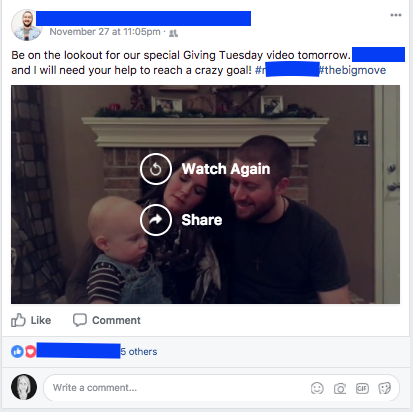
Here’s a quick example of an announcement of a FB Live. You’ll likely want to do 2-3 posts to generate buzz and get the word out prior to going Live.
2. GIVING TUESDAY
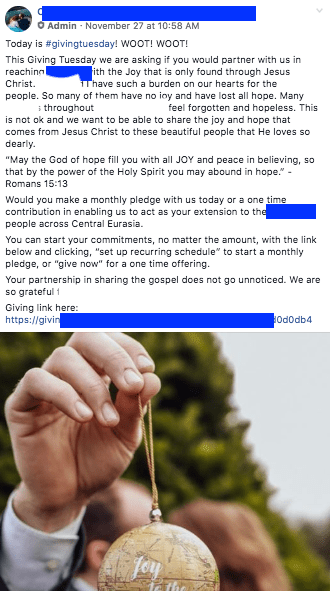
Giving Tuesday, which occurs the Tuesday after Thanksgiving, is a day for non-profits and others raising funds to solicit donations. It is a GREAT DAY to post something online asking friends and family to give. Giving Tuesday donations has risen 143% in the last 7 years.
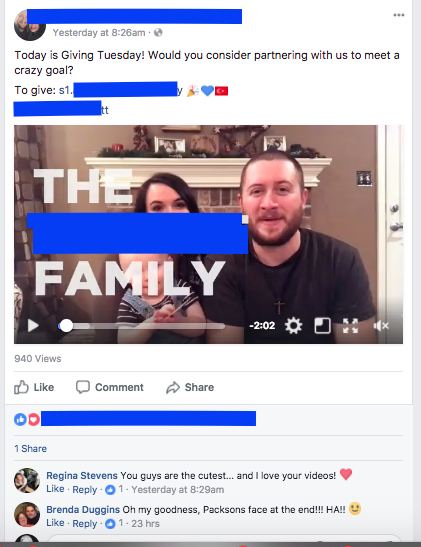
The example below is from a family who was going to a sensitive location. For Giving Tuesday they set a specific goal of $1,000 to go to pre-school and language learning. They promoted throughout the day (and prior!) by posting multiple times it on their Secret Facebook Group, which was comprised of people who were already a part of their team either in prayer and/or finances. They also created a post prior to Giving Tuesday on their regular Facebook page, asking if anyone was interested in hearing more about their journey. Then they added those interested parties to their Secret Facebook Group so that they could see the posts. BRILLIANT.
Do you want to know if they made their goal? Screen shots of their posts and progress are below. For security purposes I am not sharing the totality of their ADORABLE video, however, I did write down their script and have it below. It’s a great example of how you can raise over $1,000 in cash in ONE SINGLE DAY with a little bit of effort and excitement. By the way, the Smiths were EXCELLENT at face to face appointments and had a solid team in place by the time Giving Tuesday came. You may think Giving Tuesday wouldn’t work for an already established team…but see below for the results!
VIDEO SCREEN SHOTS:
VIDEO SCRIPT:
Jason: “Hi guys, we are the Smith family. This is baby Justin, my wife Sara, and I’m Jason. Justin just turned 1 year old yesterday (all: YAY!) We hope you had a wonderful Thanksgiving!”
Sara: “After Black Friday, Small Business Saturday, and Cyber Monday if there is anything left in your bank account today is what is called “Giving Tuesday”. It’s an opportunity to bless people who are in the process of raising money. Many of you know that we are moving to X in the spring and we have been in the process of raising our monthly budget. But we also have to raise a cash budget up front. We are asking our friends and family on Facebook to consider giving us a cash gift of $25. Our goal is to raise $500 for Justin’s school and $500 for our language learning training for a total of $1,000 in just 1 DAY! You can give towards Justin’s school which will give him the opportunity to learn language, learn the culture, and make friends. Or today you could choose to give to our language training which will give us the opportunity to learn X and connect with people in their language.”
Jason: “Now it’s super easy to give, all you have to do is click the link and it will take you straight to the page where you can give. Then if you would send us a Facebook Message telling us which of these two things you gave towards – that way we can keep a running tally. Otherwise we won’t know for a couple of days, and that’s way less exciting.”
Sara: “Thank you friends for your generosity we appreciate you more than words can say.”
Both: “Happy Giving Tuesday!”
*funny bloopers with Justin and family at the end
*graphics displayed on video about link with arrows, Giving Tuesday, and Thank You.
*fun music in the background – light and airy.
POSTS:
3. NOVEMBER NEWSLETTER
Send out a regular newsletter at the beginning of November, even if you have done one recently.
Keep it to 1 page – be brief.
Keep it ministry focused with specific stories.
Use it to promote any Facebook Live or Giving Tuesday efforts you will be doing.
Say a very hearty thank you!
Don’t do any asks on this newsletter.
4. CHRISTMAS CARD / YEAR END LETTER
Do Christmas cards along with a year end letter sometime before December 31st (think about sticking it in the mail the day after Thanksgiving). I think it’s a good idea in some circumstances (see below for more on this) to bundle these two and stick them in the mail together, the card of course being Christmasy with the year end letter inside. Send these out to your existing financial and prayer partner list.
Include the following components:
Merry Christmas greeting.
Express your authentic thankfulness for your support team. Emphasize and focus your letter on the impact your partners are having.
Percentage update of where you are at raising your funds.
A gift-wrappy-Christmasy-wonderful-snowy graphic that has your organization’s giving website / ways to give. (Make it pretty – I made the one to the right in 5 minutes using Canva.com)
An actual ask in the letter for finances (yep, this is the only time of year I say go for it on a letter!). Consider making it about one story of a life changed or need.
Try to stay away from “I” language and use “we” language instead. Example: “I need $500 more in monthly support” to “In order to keep this ministry to the United School in South Africa and impact people like Miles, we are looking for $500 more in monthly support.” Answer the question “What difference will this make in someone’s life?”
Do a nice handwritten PS.
Tips for year end letter:
Switch this up from a regular newsletter. Use a slightly different template than a regular newsletter and make it more like a letter.
Don’t send an ask year end letter to anyone who recently started giving, just gave one time recently, or just increased their giving. (probably within the past 6 months). Just send them Christmas cards instead. You don’t want to overwhelm them with too many asks.
Consider creating a different version of your year end letter to those who haven’t started giving yet or didn’t give when asked. Change particulars as needed for the audience.
Perhaps for people who have said that they can’t give- give them a soft opportunity to give. Change the thankfulness for being on your support team and instead thank them for their prayers and involvement in your life.
For those you haven’t yet met with, change the particulars to reflect your desire to meet with them soon and thank them for the involvement in your life. You may want to include a soft ask but not as bold as to those you send it to who you’ve already met with.
Snail mail your year end letter.
Keep it to 1 page make it look really nice!
5. SMALL GIFTS
Send your members of your partnership team small gifts. December is a great time of year to express your thankfulness to your support team. Go above and beyond that newsletter!
6. FACEBOOK CAMPAIGN
A well crafted, intentional, relational Facebook Campaign can be helpful during these months of giving. Consider creating a Facebook Campaign in October, November, or December if you haven’t already done one recently. Keep in mind, this is advisable only if you have gotten far enough in your financial partnership (75-80%) to start one.
Last note on Facebook Campaigns: GET SILLY. (this applies to Giving Tuesdays as well!) Shave a head if you reach your goal! Do a weird dance! Eat something weird! Write a song! Don’t discount the lure of silly rewards. Here’s a screen shot of a worker who jumped into freezing waters on the last day of their Campaign (they reached their goal of $1,000 in monthly support in 10 days):
7. EMAIL AFTER CHRISTMAS
Send out an email on December 29th or 30th. Include the following:
Greeting of Happy New Year for your partners
Remind them of your ministry as they execute their giving.
Use that christmasy-graphic and update it to be new-years-y with a clickable link on giving online.
Don’t include a formal ask. Just thank yous’ and the graphic on how to give online.
OTHER TIPS:
Stay consistent with your goals and shoot for a multi-channel approach. The secret sauce for creating a successful year end strategy is all about sequence. What does that mean? Essentially, sequence is you creating a goal and using that message/goal consistently to create a multi-channel integrated approach. Your goal should be consistent across any blogs or websites, social media, email, and written mail.
Have your strategy in place and communication pieces written BEFORE November.
Sequence maximizes the return on your effort and time investment. Stay consistent.
Try to get a hook when creating your goals. Maybe an image, theme, tagline, story.
Try to be eye-catching. Be compelling.
Less is more. The fewer words the better. Keep videos as short, fun, and informative as possible.
Don’t send a year end letter to anyone who just started giving, gave a special gift, or increased their giving in the last six months. Just send them a Christmas card.
Customize two different letters: one for on-going financial partners, one for non-givers.
In your wording, focus on the partner. Example: “There is hope, and that hope is you.” Talk about how your partners make the world better with their gift: “You gave 50 kids the gift of Jesus last year with your donation, and now you can do more.” The partner and the partnership between you becomes the hero of this story. Acknowledge their important role in your mission.
Get creative! These aren’t the only ways to utilize this season, just some ideas I’ve seen work very well.
Don’t let your partners only hear “asks” from you. Be sure you stay on top of personal communication. The routine newsletter that arrives in early November will be helpful – 1 page with pictures, ministry focused with specific stories. But get beyond that and reach out in micro relational ways to your team.
BONUS:
Here’s posts from a couple who did both a Facebook Live Q&A and Giving Tuesday:
Notice just a few short days after their Live they went into Giving Tuesday
First, I’d like to briefly share some things I believe are important NOT to do in a newsletter.
What Not to Do Newsletters:
Do not write super long paragraphs / pages about what you are learning. It sounds harsh…but short ones = AWESOME. Long ones = NO DICE. And always share what GOD is doing.
Do not forget your contact information, giving link / giving information, QR code (if you have one) — or any needed additional information. Make sure your contact information is up to date, and also is what you will be using if you are going abroad. Lastly, make sure your contact information is also easy to read (as in not teeny tiny font or in colors hard to read or notice). ***Bonus — QR codes including your Linktree or other online places to share additional information are a nice touch and easy for the reader to use. ***Bonus Bonus — always use your branding and/or your organizations branding.
Do not add everyone to your newsletter list before asking them personally to be a part of your team. If you do that, the buy in / engagement will likely be low and you may end up with general feelings of non-relationship from your potential partners. Wait until you’ve asked them to be a part of your team, or they have heard from you at a church service and signed up personally for your newsletter (see connect cards).
Do not use vacation-like photos, keep photos as ministry active as possible.
Do not make it boring. Consider doing something different (but still accessible) for your newsletter. Video newsletters are awesome (if you do one, don’t make it long). If you go for a video newsletter: (1) know what you are going to say in advance, (2) pick an interesting background that represents what you are doing, (3) don’t make the background of your video a noisy street where hearing the audio is going to be a challenge.
Do not stick to newsletters as your only form of communication. In this day and age where we have easy global access, merely emailing your team once a quarter with a generalized email newsletter is not going to cut it as your only form of communication. Get beyond the newsletter. I love this quote and I believe it’s so true: “Relational connection is now a STANDARD measurable of worker effectiveness.” – Randy Jumper of First NLR. That being said, here are 10 easy things you can do to stay in touch and show you care in micro ways.
Do not make your newsletter an attachment in an email. NOPE. Use programs like Mailchimp or Constant Contact (just give it a google if you are looking for more options – there are a lot) to make the newsletter more accessible as well as personalized (“Thank you Jenn” vs “Thank you support team”)
Do not assume your newsletter won’t go into their spam folder. Check with your supporters to make sure they are getting your newsletter, or when you are signing them up for it send them a text and tell them to be on the lookout for it and check their spam folder. Perhaps post in your hidden Facebook group or other communication that you have recently sent one out – and to let you know if they did not receive it.
Do not write a boring subject line. “Summer Newsletter” is not as effective as “Hey Jenn, how’s your summer going so far?” (yes, you can customize subject lines in many newsletter programs)
Second, a couple of notes on newsletters I think are important to highlight:
Newsletter Tips
Use your newsletter to communicate your passion for your ministry, not as a woe-as-me-fest. Stay positive, not negative. Every newsletter should convey what God is doing and has done.
Say thank you a lot and often. Thank your team for being a part of what God is doing. Remind them how thankful you are for them.
Stay consistent. If you say your going to do a newsletter every other month – stick to it. Newsletters truly don’t have to be long to be effective.
Do short e-blast newsletters from time to time (beyond your usual newsletter cycle). I love to hear successes from workers just because. Maybe a building finally got built and you share a thank you and a picture, or a person whom you care about and have been walking with came to Christ. Or maybe you reached 75% raised and you’re pumped — so share it briefly with your team. Quick videos of thanks and praise reports are generally a good idea.
In your newsletter – use “we” languageinstead of “I” language. Your team is alongside of you and you are doing this work TOGETHER. You could not be doing it without them, and you are in many ways representing the churches and individuals that support the work – by being the boots on the ground they are not / can’t be / don’t know they should be yet – so cut out any “I” language and replace it with inclusive “we” language.
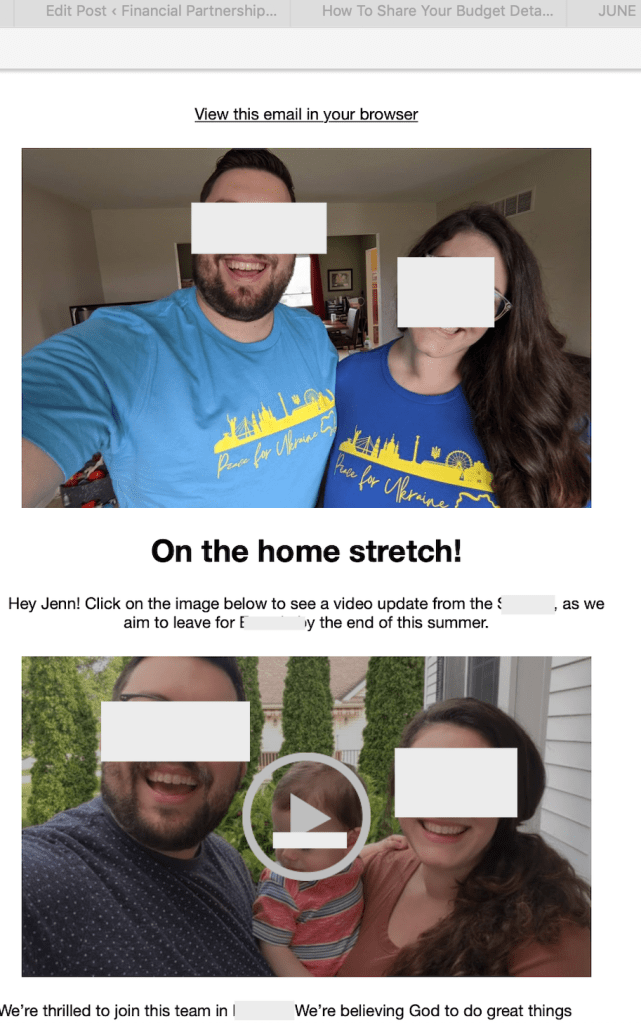
Lastly, below is an example of a good, but regular newsletter (in that it’s not overly fancy or hard to accomplish) that I recently got and thought I would share. *names and faces are blocked out for sensitivity. It’s also a bit chopped up but you get the idea) Here are a few things that I like about it:
The video! We can’t see the actual here on the blog, so to sum up the content of it: it gives many more details on their ministry but does so quickly – it clocks in at 2:42. In the video the couple shares about one specific ministry win that recently happened. They also share that things are going well in their support raising season.They also announce in the video (while holding their adorable child!) that they will soon be doing a Facebook Campaign coming up to get them from 75% to 100% raised.
They share with joy and passion!
It’s a great example of a newsletter while support raising – It isn’t needy, communicates enthusiasm, is informative, and thanks the team.
They mix up sharing with the video and some brief reading – which is such a nice way to engage with a newsletter.
*** I left off the end of their signature because of sensitivity and I also ran out of room 🙂 But it does capture their contact information.
This list of tips and do not’s is not comprehensive – just some of the things I believe are important to nail. I hope these thoughts on newsletters are helpful! Share your thoughts or tips in the comments! – JF

























 Financial Partnership Development