You Need To Listen To This Podcast

Recently a friend of mine from Support Raising Solutions, Aaron Babyar, was a guest on a great podcast called EngagingMissions.com. He spoke on the topic of support raising.

I think every ministry worker needs to hear it. Including you.

Think of this podcast episode like a audio syllabus for a upper-level support raising class at a fancy university. Also, if you have been searching for better language to describe what you are doing in raising up a financial partnership team, steal every one-liner Aaron says and turn it into your own vocabulary. Here are some great examples of Aaron one-liners for stealing purposes:

Begging and inviting — those are diametrically opposed.

My supporters are a part of my ministry because they are in it with me.

“Believe and have faith that it all depends on God, but meanwhile, work like it all depends on you.”

Take an hour to listen sometime this week and thank me later – here’s the link:

http://engagingmissions.com/em140-aaron-babyar/


GUEST POST – Let’s Be Real: Why Ministry and Fund Raising Follow Up is So Important

Before we get into this amazing post, I (Jenn Fortner), just want to say how thankful I am for another Pastor Chris guest post. In this post Pastor Chris continues to challenge us with his wisdom in a huge area of ministry partnership development: follow-up. If you didn’t get to read his first guest post you can find it here.You can also read Chris’s full bio below. Enjoy! – JF

Are You Doing Proper Follow-Up?  This is a critical question regarding your success as a christian worker.  As a christian worker or missionary you are going to find many people interested in speaking to you about Jesus, but they may not always be ready to make a commitment.  They may not be prepared to forsake Islam or their family’s religion of many generations because you told them a nice story.  Successful ministry work requires faithful and patient follow-up with that person who has shown some interest.  The man who pumps my gas gave his life to Jesus, but only after I spoke with him many times.  He had to know more than my “story” about Jesus… he had to know ME. Was I a worthy person to carry such a story to him?  Could I be trusted?  Did I really believe the message I was sharing with him?

The first place you learn and practice how to do follow-up is while raising your financial support.  You may think raising money and sharing the gospel are vastly different but they are not.  If you are unable to look a pastor square in the eyes and say, “I need your support to fulfill God’s call on my life” – then you will find it difficult to look another man, with another religion, square in the eyes and say to him, “I need you to abandon everything you have been taught and follow Jesus!

Before you get to meet that man and share the gospel with him – you must meet many pastors and individuals who will help send you to the field of your calling.  You will face a lot of rejection along the way.  Your success will depend on how YOU HEAR rejection.  Yes, you read that correctly… it is up to YOU how YOU hear rejection.  When a pastor says to you, “I’ve just taken on several other families and our budget cannot support another one right now” – What do you hear?  Do you hear “NO”?  Or do you hear “NOT NOW”?

I have been serving on the field for many years.  I have raised a lot of funds.  I have done a lot of asking. I do not remember in all of those times of asking that I have ever heard a “NO”. If you hear “NO” when you ask (or if you are hearing “I DO NOT WANT TO SUPPORT YOU”), then I believe you are hearing incorrectly.  Most people you share your vision with likely believe in you, and admire what you are doing.  However, everyone is not going to be willing, AT THE MOMENT YOU ASK, to support you.  This is where follow up becomes a key to your success.

Successful sales people will tell you the one difference between them (the successful ones) and the others (the unsuccessful ones) is performing proper follow up.  Salesmen are pushed by their organizations to close the deal on the first meeting.  When they are not able to do that (close the deal) they allow the potential client to drift off to a competitor, while they go looking for a new potential client.  This is a HUGE mistake.  Recent studies have shown that most sales come much later than originally thought and after multiple contacts.

In an article entitled – Shocking Sales Statistics as it Relates to Follow Up – the author shares these statistics:

48% of sales people never follow up with a prospect
25% of sales people make a second contact and stop
12% of sales people make more than three contacts

– – – – – – – – – – – – – – – – – – – – – – – – – – – – –

2% of sales are made on the first contact
3% of sales are made on the second contact
5% of sales are made on the third contact
10% of sales are made on the fourth contact
80% of sales are made on the fifth to twelfth contact

follow up

Look at that last line.  80% of all sales come between 5 and 12 contacts. Amazing!!! I do not know how those statistics compare to fund raising, but I believe they would be very similar.

How can you apply this information to your fundraising campaign? Here are some ideas:

1.Change the way you HEAR rejection

Unless a “NO” is a very emphatic “NO” – you must learn to hear it as “not now.

2.Develop a Contact & Follow-up Strategy

Every contact with a potential supporter does not need to be an “ask”.  In fact if it is, you may become obnoxious and pastors will run when they see you.  This is true when presenting the gospel on the field also… every time you meet that guy or gal you are sharing with – you cannot ask them to accept Jesus; however, there will be the right time when you can.  Every time you meet a pastor you cannot ask for money, but there will be the right setting when you can.

3.Set a Goal to Work your Strategy

If you are raising your support for the first time set a goal to contact every pastor in your district multiple times (of course always follow the protocol within your organization / your role on this one).  Contacts can be any kind of contact: a newsletter, a Facebook post, a postcard, a formal letter, an invite to coffee or lunch, greeting him/her at a district function, etc. Create a spreadsheet and track how many times you have contacted each pastor.  Look for the ones you have had little contact with and try to increase your connection with them.

Doing these things will help keep you moving towards your goal of reaching the field and sharing the gospel with the people God is calling you to.

Ye have not… because ye follow up not!

Begin today putting together a Follow-Up & Contact Plan that works for you!

-Pastor Chris

Want more on these subjects? Here are some suggestions:

Dealing with the Monster of Rejection

6 Tips for Connecting with Pastors

Effectively Communicate with Your Financial Partners

Part 2: Hard Questions with Thoughtful Answers – Q&A with Support Raising Geniuses

Q&A with Ms (8)


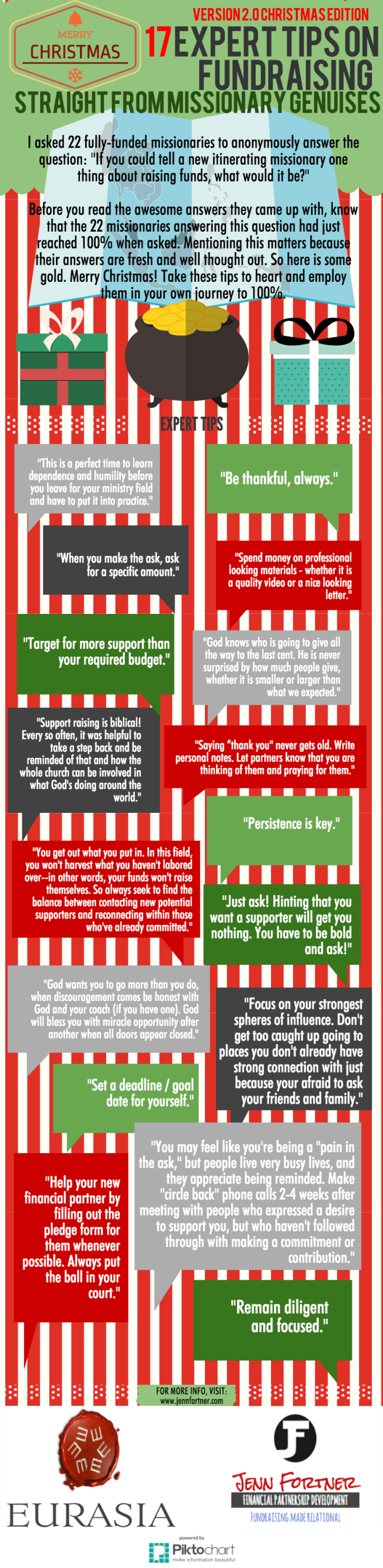
Special thanks to the ministers who participated and gave their heartfelt and practical answers. You all are my heros. Have your own tips? Post them in the comments!

The Insider’s Guide to Having An Effective Display Table

Having a display table set up for speaking engagements can be an effective tool for communicating with people about your ministry.

For the sake of absolute clarity, here’s the type of scenario I’m describing:

(1) Missionary speaks for 5 minutes at a church service. (2) Missionary has a table or area set up in the foyer of the church. (3) After the service (sometimes before too) missionary uses the table / area to connect with members of the congregation.

As many of you know from observation display tables can be very effective to opening up conversations. They can also fall very, very flat if done incorrectly.

So what are some practical things you can do to make your table the best ever? Or at the very least – a more interesting place to start a conversation? Is it worth it to invest time and finances into a great display table? Below are some of my thoughts:

Thought #1: Is it worth it to invest resources into a display table?

Yes, it is worth it, but it should have the following components to make it worth it:

(1) You must have created a reason to stop by your table. At the very least, you should mention during your time that you have a table in the back. Convey that you would love to meet the congregation and connect more.

(2) Your table is not sloppy. Make your table inviting, not boring. Create a space that people want to stop by. Have some astectic appeal. No excuses — you can find someone to help you if you aren’t good at this.

(3) Make your table visible. People have to be able to find you to connect with you. Don’t put yourself in a corner. Don’t put yourself right at the entrance to the bathroom either. Your table must be in a place that isn’t awkward for people to stop and chat at.


Thought #2: Get Creative! Have something interactive on your table to spark conversation. Here are a couple of great ideas from successful missionaries:

“We put the alphabet of the country we were going to on the tabl, then asked guests to try and spell their names out in the foreign alphabet. It broke the ice. Once we did this we saw a huge difference in table interaction!”

“We made up a coloring page for kids with crayons to pass out. It was fun for our girls to give to the kids, and the kids liked it. I saw another missionary do it and thought it was a cute idea. Tables are a great way to engage in conversation with someone who otherwise may be too shy to just strike up a conversation. We try to keep our costs low by using Walmart posters and homemade stuff!” 

“When I first went out I actually had a double paned “10/40″ window with a net and fishing lures between the two pieces of glass. I used it to talk about fishing the 10/40 window. I equated the 10/40 window to a store front window, in which one can see in but can’t get to the things inside easily. I also equated it to ice fishing and how in the 10/40 window countries the fish are there, yet you have to drill holes in the ice (over time/prayer). Also one can’t use nets like other places in the world.”

“I sold coffee at my table from Eurasia Cafe and it sparked a lot of great conversation!” 

“We created a “progress map” that represented how far along we were with raising our support. Every time our support grew, we moved a toy plane closer to Georgia from the US. A little cheesy, but it was a big conversation piece and helped people visualize us at 100%.” 10953955_10204211576868236_1918223454239609490_n


Thought #3: Have a video playing. Does your ministry have a high quality video? If so, use it! If you don’t know if your ministry has a video, simply ask your mentor to find out. If they don’t, why not make your own? Adobe Voice is an app for iPads and is great place to start. There are also a lot of great companies or freelancers that make affordable videos. Find out if your ministry has a vendor list to see if they know of anyone able to help you create a video. Throw the video on a tablet and play it continuously at your table.


Thought #4: Put together all of your printed resources. You probably know this one, but just in case you don’t, make sure you have printed resources on your table. Add to them by creating a resume/packet type binder or book that combines statistics from your ministry, facts about you, your area, etc.


Thought #5: If you are going overseas, put out a map of the world so that your visitors can find the country you are going to.


Thought #6: Always smile. 


Thought #7: The most important thing you could have on your display table is a sign-in sheet. People want to get continuos information about your ministry. If you provide those that stopped by only with printed resources, you may never hear from them again.  Ask everyone you connect with to fill out your sign-in sheet. Doing this allows you to get their contact information, so that you can take the responsibility of following up with them. Here’s an example of some good sign-up sheet fields (make yours fancier):
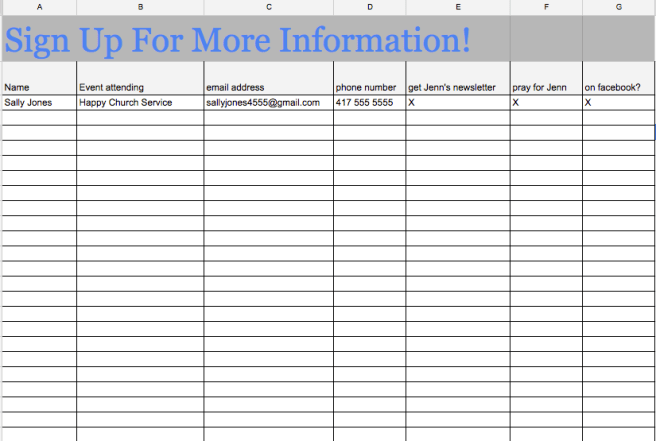
sign up sheet

Keep in mind, you will absolutely want the permission of the host/pastor to put this sign-in sheet out.

If you do get permission, everyone you connect with signs this sheet! Tell them you would like to remember them and keep them updated on your ministry.

After the event, make a phone call to those that signed in (also make sure this is okay with the pastor/host). When you call, share the following:

(1) Ask if they are interested in joining some aspect of your partnership team – whether by prayer or finances.

(2) Thank them for connecting with you and tell them you appreciate their church/group and interest.

(3) Ask them if they have any questions.

(4) If appropriate ask if they would like to meet face-to-face. Tell them you would like to find out more about them, build relationship, and find out if joining some aspect of your team is a good fit for them.

(5) Tell them you are adding them to your newsletter list.


I hope these thoughts help you develop great display tables and communication with the people you meet as you travel. Do you have any thoughts to add?

(plane photo cred goes to the missionaries that created the “progress map” thank you! // check out http://www.faithhousedesigngroup.org/ for really great graphic design resources)

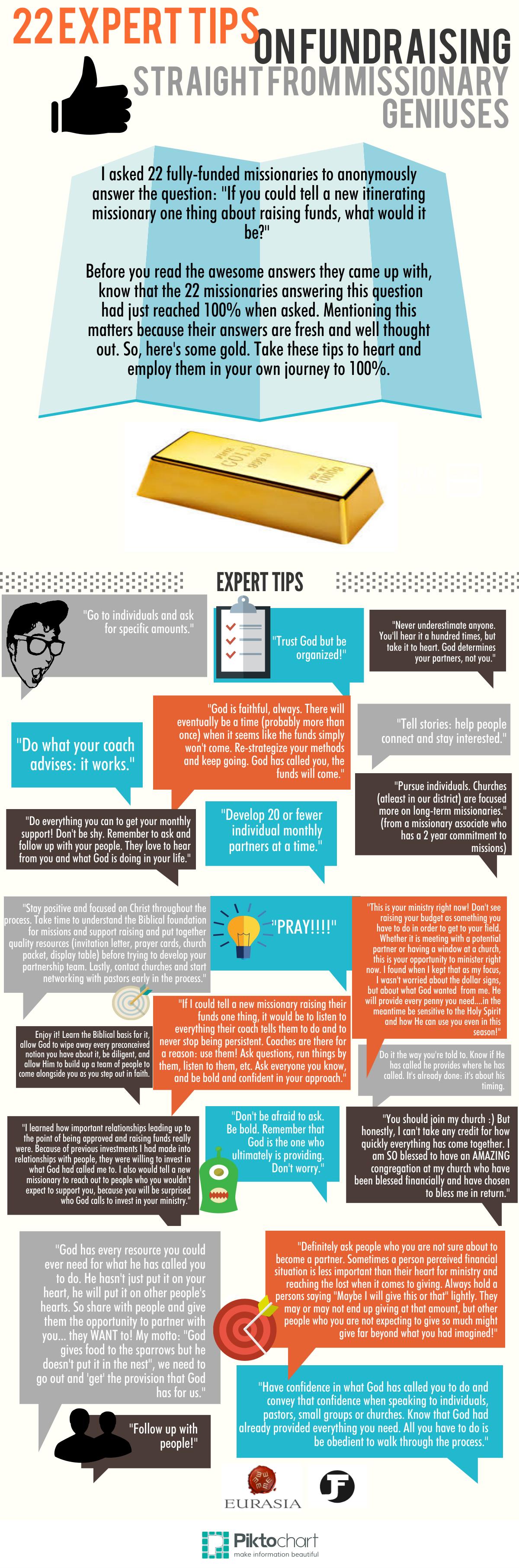
22 Expert Tips on Fundraising Straight From Missionary Geniuses

22 Expert Tips (4)

I pray you find these tips insightful and helpful. Do you have a favorite? Mention it in the comment section. Don’t agree with something? Mention it in the comment section.

Read here for more practical tips on fundraising.